Building a Searchable Reference Library for Writers
The Library Mindset
Professional writers have libraries. Not just physical books (though many do), but curated collections of sources that inform and support their work. These writers can discuss topics deeply because they've read widely and retain knowledge across years.
Most aspiring and intermediate writers don't have libraries. They have random bookmarks, scattered notes, and half-remembered research. Their writing lacks the depth and authority that comes from drawing on a curated collection of sources.
Building a searchable reference library transforms your writing. You're no longer working from immediate research; you're working from a foundation of accumulated knowledge that you've built intentionally over months and years.
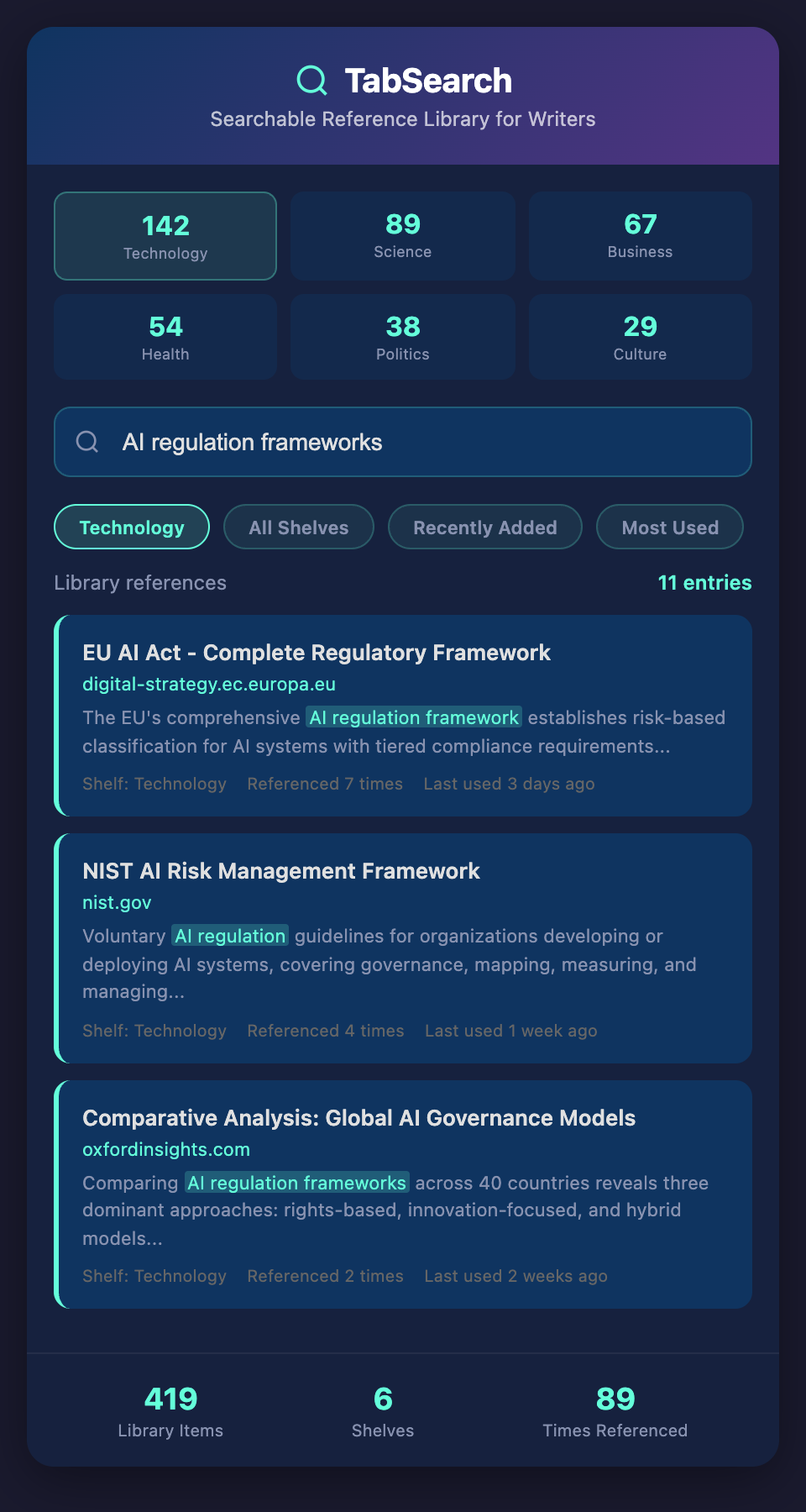
From Collection to Library
A reference library is different from a generic folder of bookmarks. A library is:
Curated. Not everything you encounter makes it into your library. You're selective about what's worth preserving. This curation means your library contains high-signal sources, not noise.
Organized by your needs. Your library's structure reflects how you think about your field, not arbitrary categories. A journalist might organize by beat (politics, economics, culture). A technical writer might organize by product area. A self-improvement writer might organize by topic (productivity, health, relationships).
Extensively documented. Each source in your library includes metadata about its credibility, relevance, date, and your own annotations about its key insights.
Growing and evolving. Your library isn't static; it grows as you read more, learn more, and discover new sources. Over years, it becomes a searchable map of your expertise.
Supportive of your writing. The ultimate test: does your library make you a better, faster writer? If you can write faster and with more authority because of your library, it's succeeding.
Building Your Library Systematically
Start with the sources you'd want to preserve indefinitely. In your field or topic area, who are the key thinkers? Which publications do you trust? Which studies or reports are foundational?
These become your library's core. Capture them first. Add their full content, metadata, and your own summary of their key insights.
Next, as you research for writing projects, add sources selectively. Not every source you read goes into your library. Ask before capturing:
-
Will I reference this again? If not, do you need to preserve it?
-
Is it authoritative? Does it come from a credible source?
-
Is it specific or evergreen? Time-specific news might not be worth preserving; evergreen insights are.
-
Does it fill a gap in my library? Or is it redundant with sources I already have?
This curation keeps your library focused and high-quality. A 500-source library of carefully chosen references is more valuable than a 5,000-source collection of random sources.
Organizing by How You Think
Don't force your library into an arbitrary structure. Use organization that mirrors how you think about your field.
If you write about technology, you might organize by:
-
Topic areas: AI/ML, software engineering, cybersecurity, infrastructure
-
Source type: Research papers, journalistic coverage, industry analysis
-
Audience level: Beginner explanations, intermediate deep-dives, expert research
If you write about business, you might organize by:
-
Function: Marketing, operations, finance, HR
-
Scale: Startup tactics, scaling challenges, enterprise strategy
-
Industry verticals: SaaS, e-commerce, fintech
Your organization should make intuitive sense to you. You shouldn't need to think about where to find something—you should know where it logically is.
Annotations and Summaries
The most valuable part of a reference library isn't the sources themselves—it's your own annotations about them.
For each source, document:
-
Key insights. One or two sentences about the most important takeaway.
-
Notable quotes. Passages you might want to reference in future writing.
-
Related sources. Other sources in your library that discuss similar themes.
-
Use cases. Situations or topics where you'd reference this source.
When you revisit sources months later, these annotations help you quickly understand why you captured them and where they're relevant.
Discovery Within Your Library
A well-built library enables serendipitous discovery. As you search for information about Topic A, you might see a related source about Topic B that you'd forgotten you had. This cross-topic browsing often sparks new writing ideas.
Organize your library in ways that enable this discovery. Tag sources with multiple relevant topics. Group related sources together. Maintain a "suggested reading" section of sources that aren't topic-specific but are broadly valuable.
The Authority Effect
A writer with a searchable reference library of 500+ carefully chosen sources has obvious authority. When writing, you can draw on this foundation. You're not relying on a single study or one person's opinion; you're synthesizing insights from multiple perspectives and sources you've accumulated.
This depth of knowledge shows in your writing. Readers sense it. And editors recognize it when considering future assignments.
Library Maintenance
A library requires occasional maintenance:
Remove outdated sources. If a source contained time-specific information that's now stale, remove it. Keep your library focused on evergreen knowledge.
Update annotations. As your thinking evolves, your annotations should too. If you've learned something new about a topic, update your notes about relevant sources.
Add new sources regularly. Commit to adding to your library as part of your regular reading. Even adding one new source per week means 50+ new sources per year.
Audit your organization periodically. Every year, review how your library is organized. As your knowledge grows, your organizational system might need to evolve.
Your Professional Library
Investing in a reference library is investing in your writing career. The library becomes increasingly valuable over time. Each source you add, each annotation you write, is an investment in future projects.
Build Your Reference Library Now
Ready to create a professional reference library that grows with your writing career and makes you a more authoritative, faster writer? Join our waitlist to get early access to a reference library system designed for serious writers and content creators.