Create a Searchable Content Archive in Minutes
The Archive Every Writer Needs
Professional writers accumulate knowledge across years. But most of that knowledge lives in scattered locations:
-
Browser bookmarks (disorganized and often forgotten)
-
Saved articles in various apps (Pocket, Instapaper, etc.)
-
Scribbled notes (analog or digital)
-
Vague memory of articles read months ago
-
PDFs saved to random folders
None of this constitutes an archive. It's just fragmented data.
A true searchable content archive is different:
Comprehensive: Everything you consider research-worthy is captured.
Organized: Not by manual filing, but by full-text indexing making everything instantly discoverable.
Accessible: Search in seconds instead of spending minutes hunting for that one article.
Permanent: Content is preserved and backed up, surviving device changes, browser updates, and the passage of time.
Personal: Everything is private and owned by you.
Building this archive used to require:
-
Discipline to manually save articles
-
Time to organize and tag content
-
Technical knowledge to set up systems
-
Ongoing maintenance
Now, it doesn't.
The Modern Archive Approach
Instead of manually building an archive, automatically capture and index everything you research.
Here's how:
Step 1: Install & Enable
A browser extension runs automatically. No configuration needed.
Step 2: Research Normally
Open tabs, read articles, explore topics. Do your research exactly as you normally would.
Step 3: Automatic Capture
Every page you visit is automatically captured—content, metadata, timestamp, URL.
Step 4: Automatic Indexing
The captured content is full-text indexed. Every word is searchable.
Step 5: Use Your Archive
Search by topic, keyword, phrase, or exact quote. Find what you need instantly.
Within weeks of normal research activity, you've built a substantial archive. Within months, you have hundreds of sources. Within years, thousands.
What Gets Captured
Content: The full text of every article, blog post, research paper, and resource.
Structure: Headings, paragraphs, lists—the semantic structure of the content.
Metadata: Title, URL, publication date, author (if available).
Timestamps: When you visited the page, when it was published.
Variations: If you revisit a page and it's changed, both versions are captured.
Images & Media: Visual content can be captured (depending on format).
Formatting: Bold text, emphasized passages, code blocks—all preserved.
This comprehensive capture means your archive contains complete information, not just summaries or links.
Search Capabilities
Your archive is searchable across multiple dimensions:
Keyword Search:
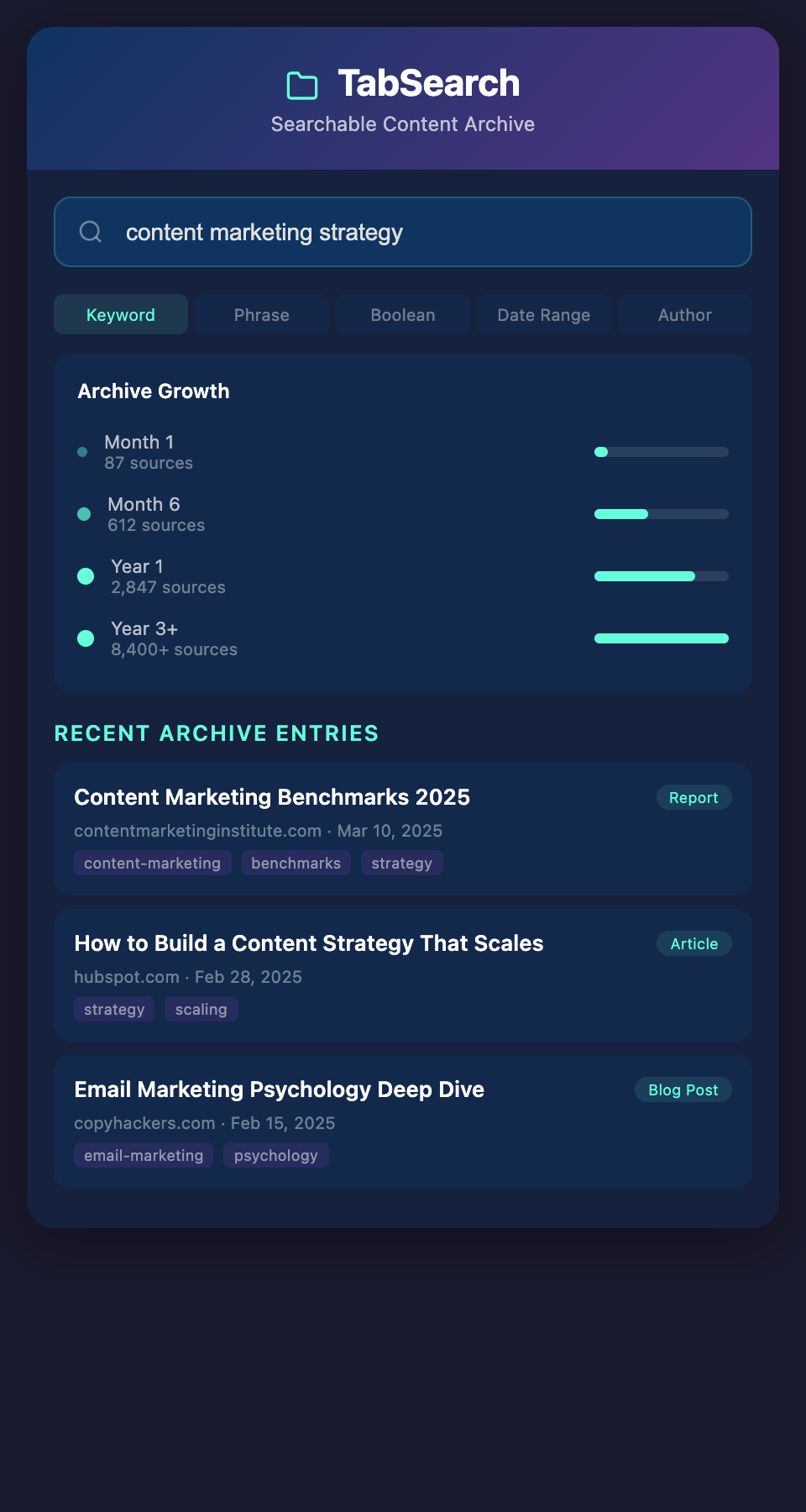
"Content marketing strategy"—finds all articles mentioning those terms with context snippets.
Phrase Search:
"The customer is always right"—finds exact phrases.
Wildcard & Fuzzy Search:
Search for approximate matches, handles typos and variations.
Boolean Search:
"remote work AND productivity NOT burnout"—combine terms with logic operators.
Date Range Search:
Find articles from a specific time period.
Author/Source Search:
Find all content from a particular publication or author.
Tag Search:
If you've tagged content, search by tags.
Advanced Queries:
Combine search types for precise results.
Archive Organization Without Filing
The key insight is this: you don't organize your archive, you search it.
Traditional filing systems force you to:
-
Decide categories upfront
-
File each item in exactly one location
-
Maintain the hierarchy as your understanding evolves
Archive search eliminates this overhead:
Instead of: "Should this article go in 'productivity' or 'remote work'?"
You search: "productivity" or "remote work" and find it either way.
Instead of: "I forgot which folder this was in"
You search: A keyword or phrase and it appears instantly.
Instead of: "The categories have become too large and disorganized"
You search: More specifically and refine results.
Search is more flexible than filing because you can find information in multiple ways without duplicating content.
Growing Your Archive Over Time
Your archive grows naturally as you research:
Month 1:
Normal research activity. Your archive has 50-100 sources.
Month 6:
Regular writing and research accumulates. Your archive has 500-1000 sources.
Year 1:
Active writing and research. Your archive has 2000-5000 sources.
Year 3+:
Your archive becomes a comprehensive resource containing years of learning and expertise.
At each stage, the archive becomes more valuable:
-
Month 1: Quick access to recent research
-
Month 6: See emerging patterns across sources
-
Year 1: Deep reference material for complex topics
-
Year 3+: Personal knowledge base spanning your entire career
Archive as Competitive Advantage
Writers with comprehensive archives have advantages:
Better Research: You've already researched most topics. You're building on previous work instead of starting from scratch.
Pattern Recognition: Searching your archive reveals how topics evolve, which experts consistently appear, which approaches repeat.
Speed: You write faster because research is just searching your archive, not re-researching.
Authority: Your writing draws from deep, verified research—the sources are right there.
Confidence: You know you've covered the topic thoroughly because you can see your complete research trail.
Archive Portability
Your archive should be portable—you should own it completely:
Export: Download your entire archive in standard formats (markdown, HTML, JSON).
Transfer: Move your archive to a new device or system.
Backup: Create copies for safekeeping.
Integration: Use your archive data with other tools.
A proprietary system that locks your archive data is worse than no archive. Choose tools that give you data freedom.
Start Your Archive This Week
You don't need a perfect system. You don't need to decide categories or hire someone to help. Start capturing your research today, and your archive builds automatically.
Within months, you'll have hundreds of sources instantly searchable. Within years, you'll have thousands.
Join our waitlist to start building your searchable content archive today—capture everything you research and unlock the power of instant, comprehensive access to your personal knowledge base.