Creating Searchable Archives of Web Research
The Disappearing Web Problem
The internet is not permanent. Articles get deleted. Websites disappear. Publications fold. URLs change. That in-depth Medium post you researched three years ago? The author might have deleted it. The study you found that perfectly supports your argument? The journal's website might be restructured and the link broken.
This creates a quiet crisis for content creators who rely on web research. Sources you built arguments on become inaccessible. You need to verify quotes or data points months later and find that the original source is gone. You link to articles in your published work, and readers encounter broken links weeks later.
The solution is creating searchable archives of your research—permanent records of sources that remain accessible even if the original websites become unavailable.
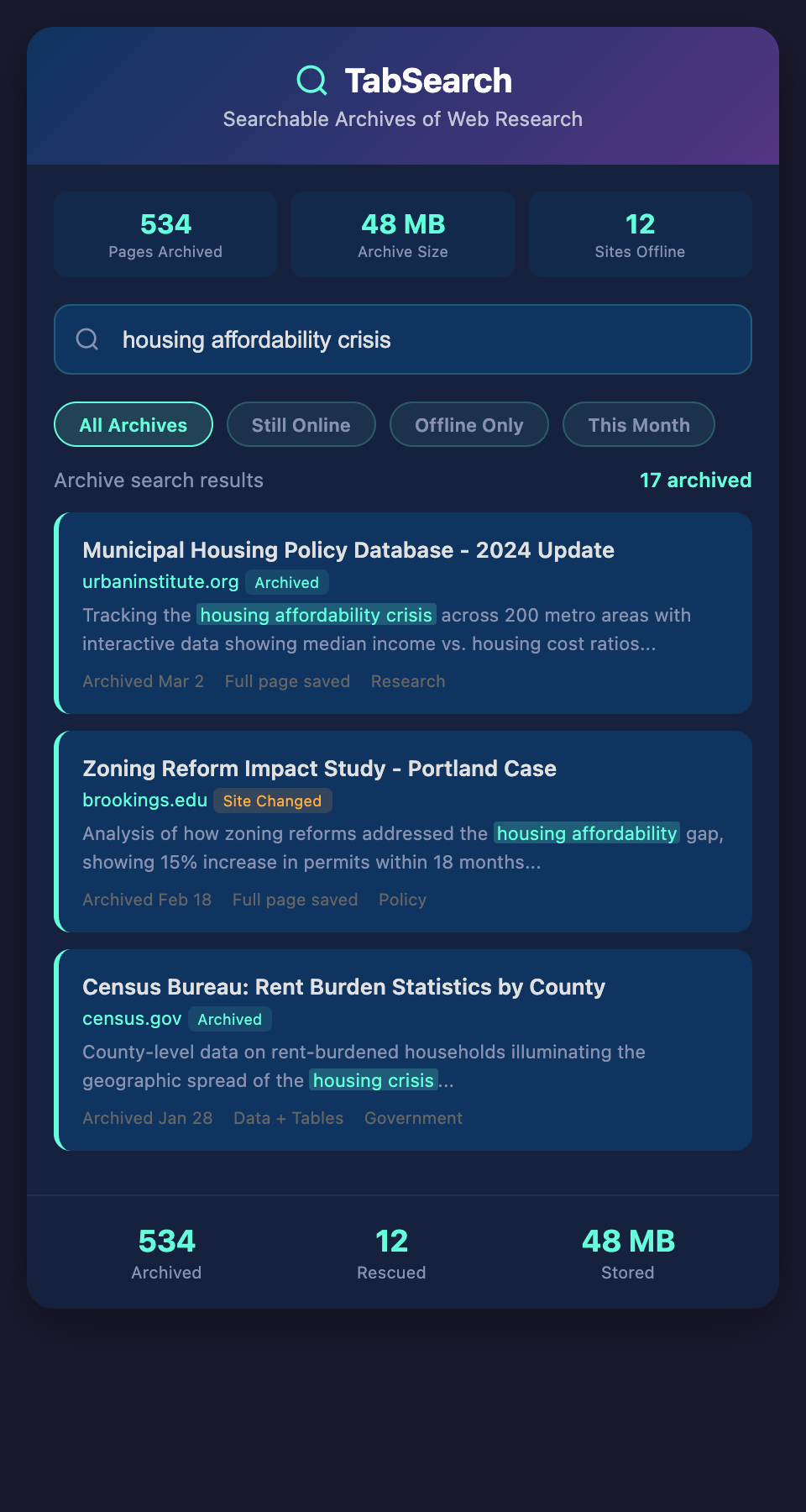
Beyond Browser Bookmarks
Many writers attempt to solve this with bookmarks or apps like Pocket. These tools save URLs, but they don't truly archive content.
The URL can break. If the original site disappears, your bookmark just links to a dead page. Pocket mitigates this with snapshots, but the snapshot isn't searchable—you can't full-text search across your archived content.
Bookmarks lack metadata. You bookmark something, but months later you've forgotten why it mattered. A bookmark collection with hundreds of items becomes useless without comprehensive search.
Bookmarks don't preserve format. Archived pages often lose their original styling, images, or interactive elements. But full text remains—which is what you actually need for research.
Building an Archival System
A proper research archive should satisfy several criteria:
Complete Capture of Page Content
When you archive a source, capture the entire text. Don't rely on the article's headline or the first paragraph; preserve everything. This enables full-text search and prevents needing to return to the original source to find specific passages.
Permanent Storage
Archive content should be stored in a format and location that will remain accessible for years. This means not relying on cloud services that might shut down or change pricing, and using standard formats that won't become obsolete.
Metadata Preservation
Every archived page should preserve metadata: URL, publication date, author, domain, title, and your capture date. This metadata enables filtering, verification, and proper citation.
Full-Text Searchability
The core purpose of an archive is retrieval. Every word in every archived page should be indexed and searchable. Boolean operators (AND, OR, NOT) enable precise queries.
Version Tracking
Websites change. The version of an article you captured three years ago might differ from its current version (if it still exists). Your archive should preserve the version you actually used as research.
Creating Your Archive
Start with a clear intention: which sources warrant archival? You can't archive every webpage you visit, but certain sources deserve permanent preservation:
-
Peer-reviewed studies and academic papers
-
Industry reports and white papers
-
Authoritative journalistic articles
-
Expert blog posts and commentary
-
Statistical data and research findings
-
Any source you plan to cite or quote directly
When you identify a source worth archiving, capture the full page to your archive system. This shouldn't require switching applications or complex steps—ideally, a single click or keyboard command.
Archival as Part of Your Research Workflow
Rather than treating archival as a separate task, integrate it into your research process:
-
During research: As you evaluate sources, flag important ones for archival immediately.
-
During drafting: When you write a section, search your archive for sources relevant to that section.
-
During editing: When you verify citations, check your archive to confirm exact quotes and data.
This creates a virtuous cycle: your archive grows alongside your published work. By the time you've published five articles, your archive contains all the research that informed them—a searchable corpus of sources you've curated.
Archive Accessibility
An archive is only valuable if you can access it. Consider:
-
Search speed. Searching your archive should be fast, returning results in under a second.
-
Offline access. You should be able to search your archive without internet connectivity.
-
Multiple devices. If you work on a desktop, laptop, and tablet, your archive should be accessible across all devices.
-
Export capability. You should be able to export sources from your archive (for sharing with collaborators or creating reference lists).
Long-Term Value
An archive that starts small (100 sources) might grow to 1,000 sources over a few years of active writing. At that scale, full-text search becomes incredibly valuable. You can perform analyses: "Show me all sources mentioning both X and Y," or "Find every study about Z from the past two years." These queries would be impossible without a searchable archive.
Archives also provide a record of how your field is evolving. You can see which sources were popular when you were researching a particular topic, and how the landscape has shifted over time.
Building Your Permanent Knowledge Library
An archive is more than a backup of sources—it's the foundation of expertise. As it grows, it becomes your searchable reference library, enabling faster research and deeper understanding.
Start Archiving Your Research Now
Ready to build a searchable archive that preserves your research forever and enables instant retrieval? Join our waitlist to be among the first to use an archival system purpose-built for writers and researchers.