Quick Fact-Checking Workflows for Writers
The Cost of "Trusting Your Memory"
You're three paragraphs into an article. You write: "Research shows that personalized emails have a 49% higher open rate."
Then you pause. Wait—was that 49%? Or was it 45%? You think it was from an HubSpot report, but you're not entirely sure. Do you:
A) Include the stat and hope it's close enough
B) Delete the sentence and lose a good point
C) Stop writing to search for the exact stat (breaking flow for 10 minutes)
Most writers choose A, which is how incorrect or vague statistics end up in published work. The second choice means weaker writing. The third choice means your 3-hour writing session becomes a 4-hour writing session.
There's a fourth option: a fact-checking workflow so fast it doesn't break your flow.
Why Fact-Checking Matters (And Stops Most Writers)
Publishers and readers now expect citations. A vague statistic without a source is actually less credible than no statistic at all. Writers know this. But fact-checking is slow. So most writers do one of two things:
They fact-check as they research (which means research never ends), or they skip the statements they can't immediately verify (which means their writing is weaker).
Neither is acceptable, but both are common because traditional fact-checking workflows are designed for editors at publications, not for individual creators writing on deadline.
You need something faster.
The Three-Phase Fast Fact-Checking System
Phase 1: Capture While Researching
During research, don't just save the statistic. Save the source context. When you find a stat, capture it with:
-
The exact number or claim
-
The source (author, publication, date)
-
A direct link
-
The page context (what was the article really about?)
-
Your own verification note (does this pass the smell test? seems legit? seems suspect?)
This takes 30 extra seconds per source, and it eliminates fact-checking delays later.
Most writers capture sources without this metadata, then spend 15 minutes verifying during writing. You're moving the work upstream, which is always more efficient.
Phase 2: Quick Verification During Writing
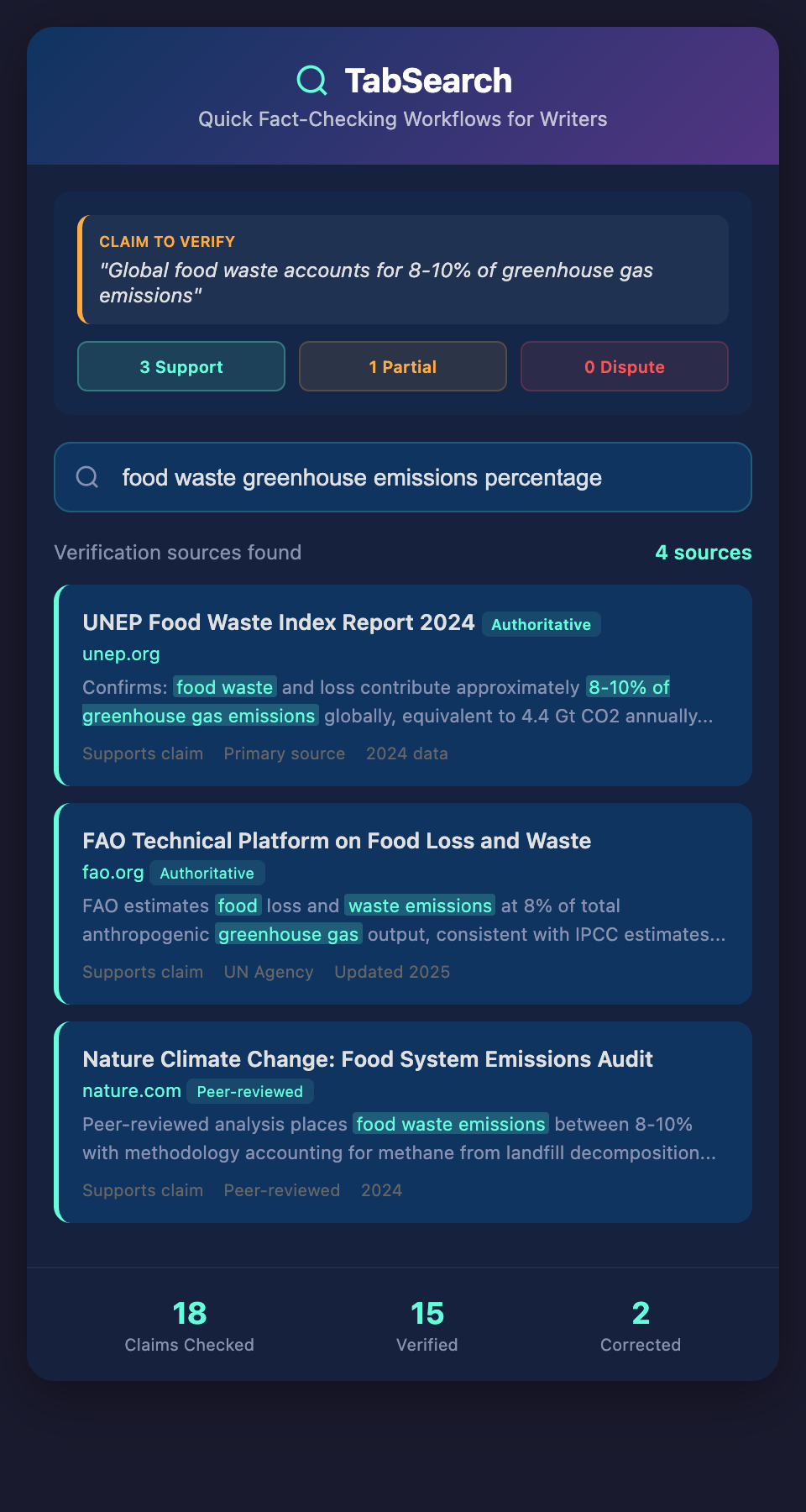
You're writing and hit a claim you want to verify. Your fact-checking workflow should be:
-
Open your research library
-
Search for the claim or key term (30 seconds)
-
Find the source in the results (10 seconds)
-
Scan the source for the exact claim (30 seconds)
-
Include the claim with confidence, or note that you need to revise
Total time: 2 minutes, and you're back to writing.
Compare this to the alternative: Google the claim, find the source, verify it, bookmark it, then go back to writing. That's 10-15 minutes.
The difference is having your research organized and searchable versus scattered across the web.
Phase 3: Final Verification Pass
After you've finished a draft, do a fast verification pass. Go through every claim that has a source and verify:
-
The source still exists (the link isn't broken)
-
The quote is accurate (word-for-word from the source)
-
The context is correct (you're not misrepresenting the original)
-
The attribution is clear (the reader can find the source)
This pass is quick because you've already verified most claims during writing. You're just double-checking, not discovering.
Tools and Strategies for Each Phase
For Phase 1: Efficient Capture
You need a system that lets you capture sources with metadata easily:
-
Browser extensions that let you highlight text and save it with context
-
Research tools with fields for source, author, publication date
-
Quick templates in your notes app for "save source" entries
-
Bookmarklets that capture page context automatically
The goal: capture with context in 30 seconds per source.
For Phase 2: Searchable Research
This is where most writers struggle. You need your research to be:
-
Full-text searchable: You search the content, not just the title
-
Instantly accessible: Results appear in seconds, not minutes
-
Linked to the source: Click to view the original source
-
Integrated with writing: Access from your writing tool without context-switching
If your research system requires you to stop writing, open a different app, search through folders, and remember what you were writing about, it's too slow. You'll skip the verification.
For Phase 3: Final Pass Checklist
Create a simple checklist for your final verification pass:
-
Every factual claim has a source attached
-
Every quote is word-for-word from the source
-
Every source link still works
-
Context is accurately represented (not misquoting or misleading)
-
Attribution is clear for all sources
-
No statistics are included without source attribution
This checklist should take 30-45 minutes for a typical 2,000-word article. That's a 2-3% time investment for dramatically more credible writing.
The Psychology of Confident Claiming
Here's something that happens when your fact-checking is fast: you make stronger claims.
When fact-checking is difficult, your writing becomes hedged and tentative. "Research suggests..." "Some studies indicate..." "It's possible that..."
When verification is instant, your writing becomes authoritative. "Research shows that..." "Studies confirm..." "The data reveals..."
The difference isn't dishonesty. It's confidence born from knowing you can verify before publishing.
Readers feel this difference. Tentative writing feels weak. Verified writing feels authoritative. And the primary difference between them is how easy fact-checking was.
When You Don't Have the Source
Sometimes you remember a statistic or claim but can't locate the source. In this case:
Don't guess. Delete it or rephrase.
A claim without a source is a liability. You have three options:
-
Find the source (spending time you might not have)
-
Rephrase it as "my observation" or "you likely notice" (moving away from stats to experience)
-
Delete it (losing the point but maintaining credibility)
Option 3 is better than a vague source or a guessed statistic.
The Real Win
A fast fact-checking workflow removes the biggest barrier to confident writing: the fear that you'll accidentally include wrong information.
When your research is organized, searchable, and instantly accessible, fact-checking stops being a chore that happens after writing and becomes seamless part of the writing process. You don't even notice you're doing it. You write a claim, quickly verify it's correct, and move on.
This changes your writing in measurable ways:
-
More specific, concrete claims (backed by data)
-
Stronger authoritative voice (because you're verified)
-
Faster overall writing time (fact-checking isn't a separate phase)
-
Higher credibility with readers (everything is substantiated)
Build Your Fact-Checking System
Start with just the first phase: capture sources with metadata next time you research. For one week, slow down your capture process by 30 seconds per source to add author, publication, and date.
Then, for your next writing project, verify claims by searching your research library instead of re-searching the web.
Notice the time difference. Notice how much more confident your claims feel. Notice how fast it is.
Ready to make fact-checking effortless? Join our waitlist to get early access to a research tool built for writers—one where every source is captured with context and instantly searchable while you write.