How to Organize Research Notes for Long-Form Writing
The Research Chaos Problem
Every serious writer faces the same challenge: as your research deepens, the volume of information explodes across a dozen browser tabs, scattered PDFs, handwritten notes, and half-remembered sources. By the time you're halfway through a 5,000-word article or book chapter, you've lost track of where that perfect quote came from, which expert study contradicted a point you made, or how to quickly verify a fact you're uncertain about.
Long-form writing demands precision. Unlike social media posts or quick blog entries, readers expect meticulous sourcing, accurate citations, and logical flow that ties together evidence from multiple sources. Without a coherent research organization system, you'll waste hours on reconstruction work—searching for sources you know exist but can't locate, double-checking facts you should've documented clearly, and second-guessing your own assertions because you didn't record context properly.
Why Traditional Methods Fall Short
Most writers start with default browser bookmarks or scattered notes in Google Docs. These approaches have critical limitations:
Bookmarks lack context. You save a URL, but three months later, you've forgotten why it mattered or which section it supported. Folders help minimally; searching them doesn't work well.
Separate note-taking apps create friction. Toggling between your writing document, notes, and browser interrupts your flow. Important metadata—the exact phrase you wanted to quote, the publication date, the author's credentials—gets lost in translation.
Full-text searching across sources is nearly impossible. If you remember a specific phrase but not its source, you're stuck manually reviewing tabs or documents. For writers handling multiple projects simultaneously, this becomes paralyzing.
Citation tools require manual input. Apps like Zotero or Mendeley help with formatting, but they still demand you manually enter metadata or rely on imperfect auto-detection, adding busywork that disrupts creative momentum.
The Ideal Research Organization System
A proper research framework for long-form writing must handle several layers simultaneously:
Capturing Information Effortlessly
The system must work within your browser—the place where you do actual research. Every tab should be accessible without switching applications. When you find a relevant page, capturing it should take seconds, not minutes. Context should attach automatically: the URL, publication date, author, headline, and full text.
Making Content Instantly Searchable
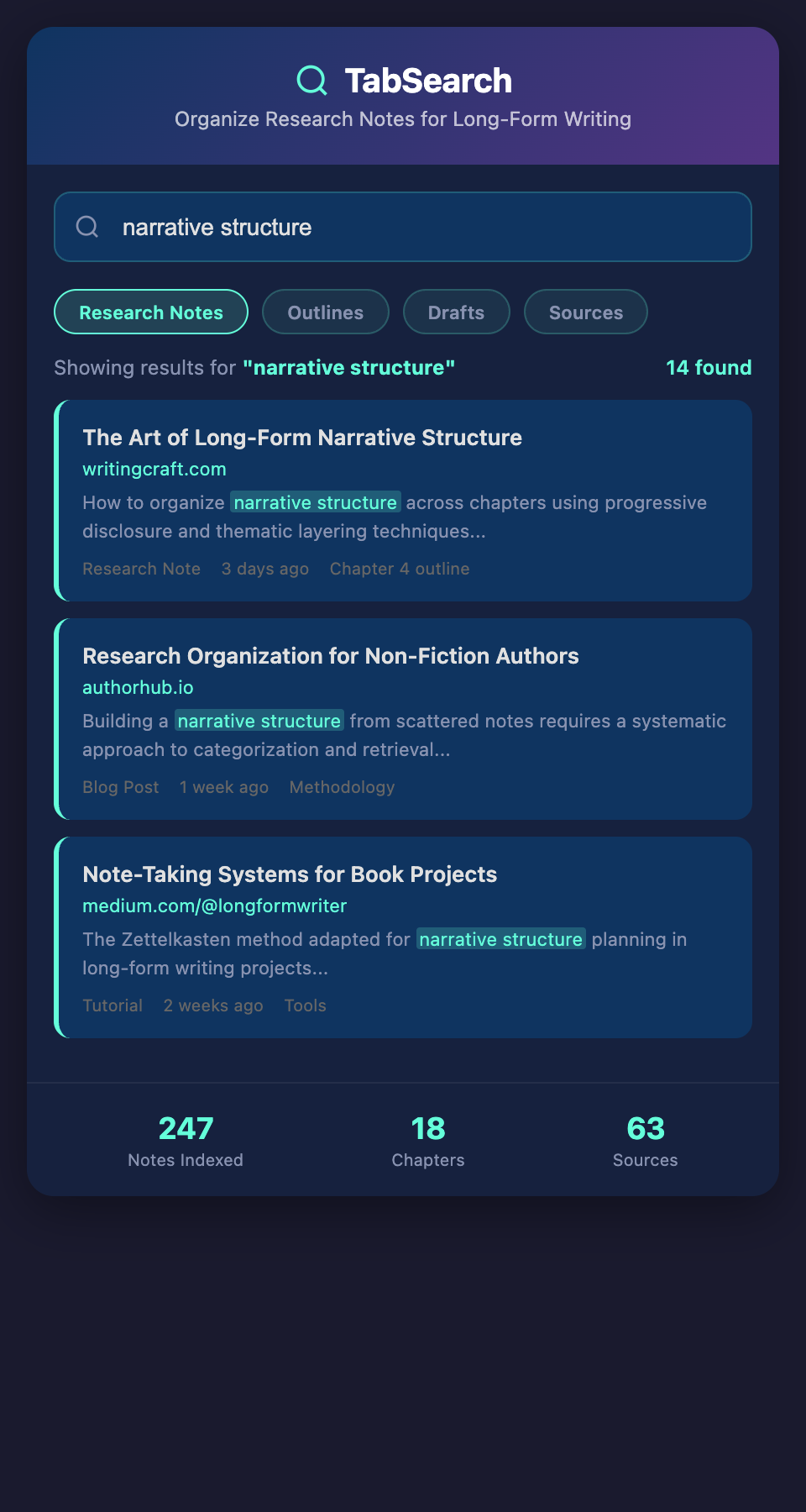
Once captured, every piece of research should be full-text searchable. You should be able to remember one phrase and find every source containing it. Boolean operators (AND, OR, NOT) enable precision—filtering by multiple keywords, excluding irrelevant results, finding exact phrases.
Maintaining Source Attribution
Every piece of captured content should preserve its metadata intact: publication date, author, domain, and original URL. When you find a useful quote, you should never have to wonder whether you can trust it or whether you'll be able to cite it properly.
Supporting Comparative Research
When researching contentious topics, you need to compare perspectives across sources side-by-side. Your system should let you tag content by topic, source type, or stance—then filter and review systematically.
Enabling Offline Access
The internet connection might fail mid-research session, or you might want to review sources on an airplane. Your research database should remain accessible whether you're online or offline.
Implementing a Researcher-Centric Workflow
Start by capturing your sources comprehensively. Don't manually select fragments; let the system preserve entire pages. Full-text capture prevents you from needing to re-visit sources later to reconstruct context or find the exact phrasing of a quote.
Next, tag and categorize as you research. This sounds burdensome but actually saves time: spending 15 seconds assigning a topic tag as you capture a source prevents 15 minutes of scrambling later when you need to recall everything you learned about that subtopic.
Use your system's search capabilities ruthlessly during drafting. When you're writing a specific section, search for all your captured content using the keywords for that topic. Skim results quickly; full-text search means you'll often find relevant passages you'd forgotten you had.
Cross-reference constantly. When you cite a source, verify it's still accessible and accurate. When you quote someone, ensure your capture includes enough context that a reader could verify it independently.
Finally, maintain a simple master index of your source types: how many peer-reviewed studies versus journalistic pieces versus expert blogs did you review? This meta-awareness prevents you from accidentally building arguments on weak sources.
The Time Multiplier Effect
Implementing this system feels effortful initially. But the compounding effect is dramatic. In week two of a project, when you need to reference something from week one, you'll recover 30 minutes. By month two, if you're managing multiple simultaneous projects, you'll recover hours—time you'll reinvest in deeper thinking, better writing, or additional research that strengthens your work.
For prolific writers managing dozens of sources per project, a proper research system becomes non-negotiable infrastructure.
Ready to Transform Your Research Process?
The best research organization system is one that works in your actual environment—your browser—without demanding extra steps or creating additional busywork. Join our waitlist to be notified when our browser extension launches, giving you full-text searchable access to every page you research, organized and retrievable in seconds.