Building a Personal Research Database for Writers
Why Writers Need a Personal Database
The most successful writers don't just write well—they research efficiently. They have systems that let them capture ideas and sources without breaking flow, and retrieve them without friction. That capability is built on a personal research database.
A personal research database is fundamentally different from a notes app, bookmarks folder, or document archive. It's a searchable, interconnected collection of sources, ideas, and references that grows with your work. Every article you write, every source you check, every fact you verify contributes to this database. Over time, it becomes your competitive advantage.
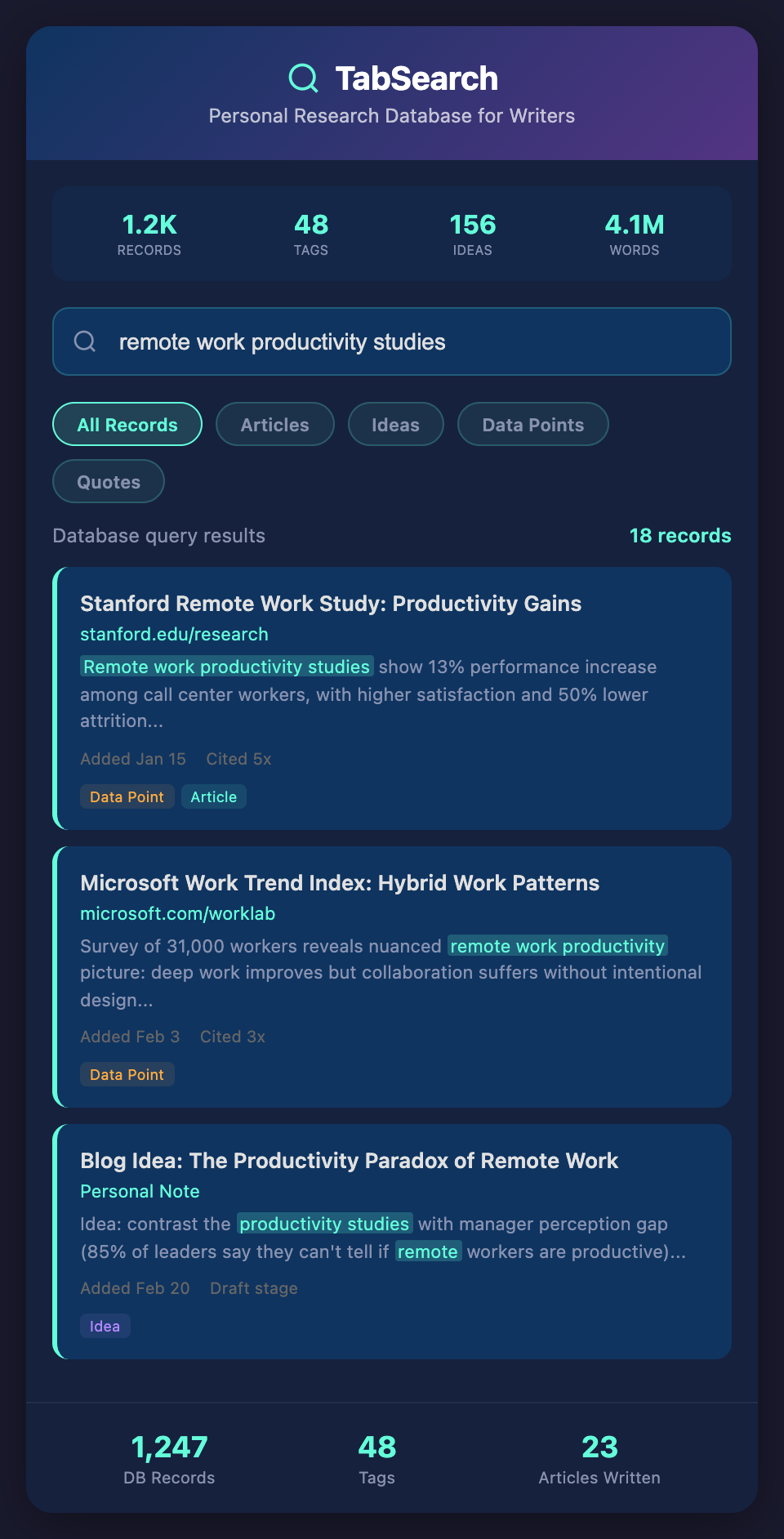
What Goes in Your Research Database
Before building your system, understand what you're actually storing:
Source Content
The full text of articles, blog posts, research papers, and pages you find. Not just URLs—actual content. This is the difference between having a reference and having the reference at your fingertips.
Metadata
When you found it, where it came from, who wrote it, what it's about. This metadata is what makes searching and sorting possible.
Your Annotations
Quotes you want to remember, your own thoughts about the content, context about why you saved it. This is your value layer—the insight that makes generic content personally useful.
Connections
Which sources relate to each other? Which topic do you have the most research on? Which experts appear repeatedly? These connections create a web of knowledge, not just a pile of sources.
The Architecture of an Effective Research Database
Single Source of Truth
Everything you research goes into one system. Not one app for articles, another for quotes, another for notes. One place. This solves the biggest research problem: fragmentation. You're not trying to remember where you saved something; everything is in one spot.
Automatic Indexing
The database should index everything automatically. Every word of every page becomes searchable. You don't manually tag sources into categories or maintain folder structures. The system does this work for you.
Flexible Retrieval
You need multiple ways to find information:
-
Full-text search: Find anything by searching words, phrases, or concepts
-
By project: Show me all research related to this article
-
By topic: Show me everything I've saved about marketing psychology
-
By source type: Show me only case studies, only academic research, only interviews
-
By date: What did I research last month?
With these options, you can find something even if you only half-remember it.
Integration with Your Writing
Your database shouldn't live in isolation. When you're writing an article, you should be able to:
-
Pull in sources directly
-
Insert quotes with automatic citations
-
Reference your notes without leaving your writing tool
-
See related research without context-switching
How to Actually Use a Research Database
Building the system is one thing. Using it consistently is another.
Capture During Research
When you're in "research mode" (browsing, reading, exploring), capture ruthlessly. Save anything that might be useful. Don't judge whether you'll actually need it. The friction should be near-zero. You find something interesting, you save it. That's it.
Don't overthink categorization during capture. Tagging or filing during research slows you down. Focus on gathering material.
Batch Process Your Captures
Once a week, spend 30 minutes processing what you've captured. Read through your "unsorted" sources. Add meaningful notes. Apply consistent tags. Build connections between related items.
This batching approach keeps captures fast while keeping the database organized.
Reference During Writing
When writing, you have everything you need at your fingertips. Need a statistic? Search for it. Want a relevant quote? Search your database. Need to verify a claim? Find the source immediately.
This eliminates research time during writing. Your research phase ends, your writing phase begins, and they don't overlap.
Mine It for Ideas
The real power emerges over time. As your database grows, patterns emerge. You realize you have extensive research on three interconnected topics. That's an article. You notice a question appears in multiple sources but nobody answers it well. That's an angle for your next piece.
Tools and Platforms
Different writers need different tools. Some prefer:
Specialized research tools that integrate capture, annotation, and search. These often have browser extensions for quick saving.
Note-taking systems that support full-text search and tag-based organization. Good for writers who already prefer taking structured notes.
Document databases that let you store and search PDFs, web content, and your own annotations. Good for academic or long-form writers.
Wiki-style systems that let you build connections between sources and ideas. Good for writers building a personal knowledge system.
The specific tool matters less than the system itself. Pick something that makes capture fast and search easy, then commit to using it consistently.
The Compound Effect
Using a research database changes how you approach writing. On day one, it's slower than just browsing and re-researching each time. But by week two, you're finding sources faster than re-searching. By month two, you're spotting patterns and connections that make your writing better. By month six, you have a searchable library that gives you unfair advantage in your niche.
This is the power of a system that compounds. Every article you write makes your next article easier. Every source you save makes your next project faster. The database becomes more valuable the longer you use it.
Start Building Today
You don't need a perfect system from day one. You need a system you'll actually use. Pick one that has fast capture, full-text search, and simple organization. Then use it consistently. Your future self will thank you.
Join our waitlist to be notified when we launch our research database tool—designed specifically for writers and content creators who need to capture, search, and reference sources in seconds.