Better Source Citation Management for Creators
The Citation Problem Nobody Talks About
You're writing a well-researched article. You have five sources you want to cite. You spend:
-
10 minutes finding the sources again (you saved them but now you need to locate them)
-
5 minutes verifying the citation format is correct (Chicago style? APA? MLA? Something custom?)
-
3 minutes adding the citations to your article
-
2 minutes fixing the formatting because it doesn't match the rest of your document
-
5 minutes verifying all sources actually exist and the links work
That's 25 minutes of work that isn't writing.
And that's if you have a system. Most writers do this:
-
Pause writing to search for a source
-
Copy the URL manually
-
Type out the author and publication
-
Forget to add the access date
-
End up with inconsistent citation styles across the article
Citation management is a solvable problem, but most writers handle it in the most inefficient way possible.
Why Citation Matters (And Why Most Writers Skip It)
Citations serve multiple purposes:
They give credit where it's due. This is ethical and builds trust.
They provide accountability. If a reader wants to verify your claim, they can go to the source.
They improve your credibility. An article with proper citations is perceived as more authoritative than one without.
They create a paper trail. Readers and future-you can understand where your thinking comes from.
But—and this is the key problem—citation is tedious. It doesn't make your writing better. It doesn't make the article longer or more interesting. It's just administrative work.
So most writers either skip it or do it so haphazardly that citations are unreliable.
The solution isn't to be more disciplined (that never works). The solution is to make citation automatic.
The Citation System That Actually Works
Capture with Citation Information
When you save a source, capture:
-
Author(s)
-
Title
-
Publication
-
Publication date
-
URL or DOI
-
Access date (if it's a web source)
This shouldn't be manual. Your capture tool should grab metadata automatically. Most of the time, the information is right there in the page.
Capturing this information takes 30 seconds, which is part of your regular source capture process.
Reference by Source, Not by URL
When you're writing, you reference sources by their stored entry, not by typing URLs manually.
This means your writing tool and your reference system need to be connected. You're writing about customer psychology. You want to cite a study. You search "customer psychology studies" in your reference system, find the right one, and insert the citation.
The system handles:
-
Inserting the citation in the right format
-
Maintaining consistency
-
Tracking citation count and sources
You handle: deciding which sources to cite (the thinking part).
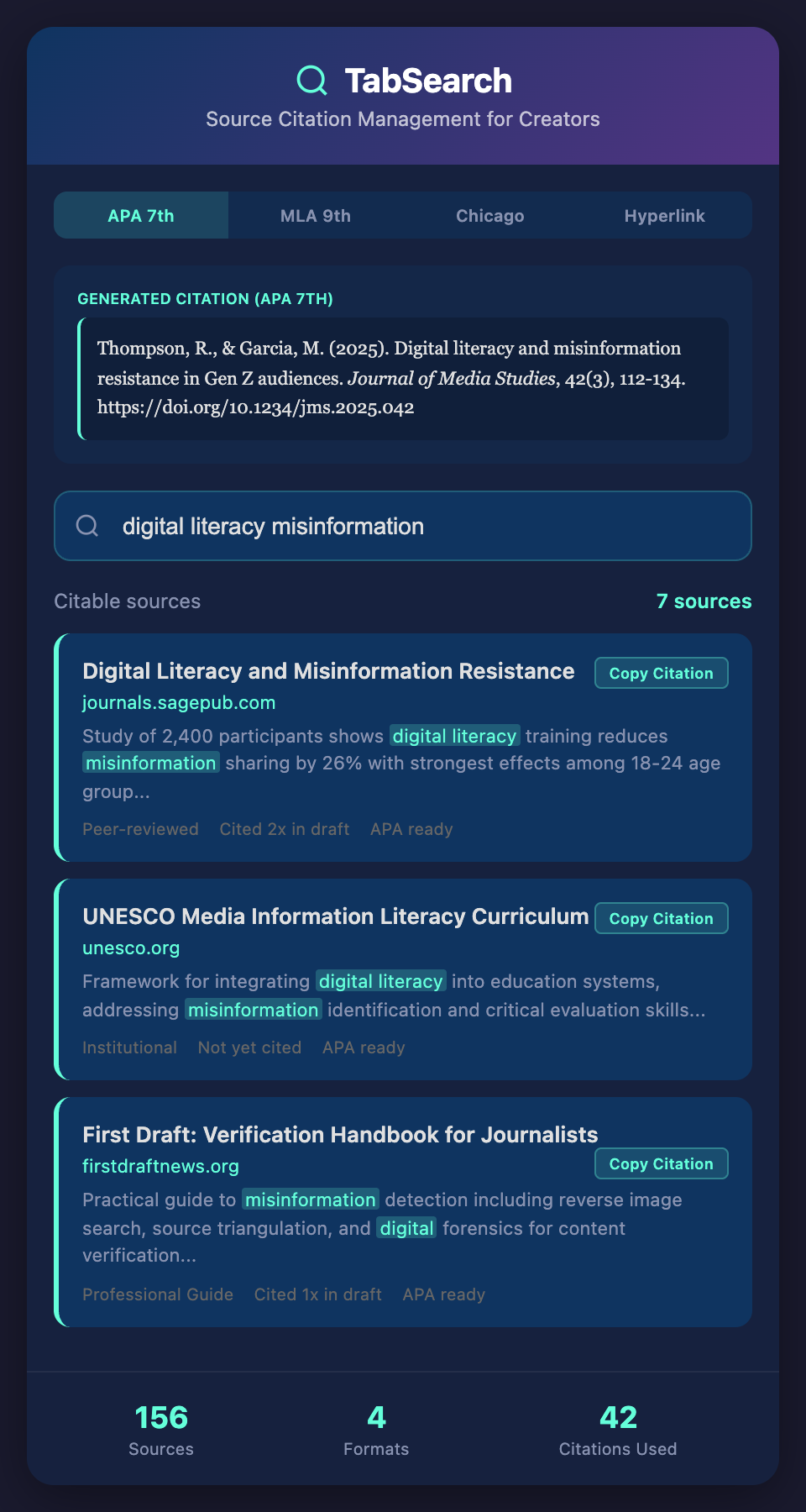
Multiple Citation Format Support
Your citation system should support different formats. Different publications expect:
-
Chicago Manual of Style
-
APA
-
MLA
-
Harvard
-
Custom formats (for brand guides or personal style)
With proper metadata captured, converting between formats should be automatic. You shouldn't have to manually reformat citations because you're submitting to a different publication.
Automatic Bibliography Generation
Once you've cited sources throughout your article, your system should generate a full bibliography automatically in the correct format. You don't type it. The system builds it from your citations.
Link Verification
Before you publish, your citation system should verify:
-
Every link in citations still works
-
The source still contains the information you're citing
-
URLs haven't changed
This prevents the embarrassing situation of a reader clicking your citation and getting a 404.
Implementing Citation Management
For Simple Cases
If you're writing one-off articles, use a system that:
-
Captures source metadata automatically
-
Lets you insert citations as you write
-
Generates bibliography in your preferred format
-
Verifies links before publishing
Tools like Zotero, Mendeley, or EasyBib handle this well. They integrate with word processors and automatically format citations.
For Complex Cases
If you're building a body of work (a book, a series of articles, a research project), you want:
-
Centralized source storage
-
Full-text search for finding sources
-
Multiple citation format support
-
Version history (what sources did I cite in v1 vs. v2?)
-
Collaboration features (if working with editors or co-authors)
Some systems purpose-built for writers, like Citavi, are better for complex projects.
For Modern Creators
If you're a content creator who publishes across mediums (blog, Twitter, newsletter), you might use:
-
A personal research library with automatic citation metadata
-
Integration with your writing tools (Medium, Substack, Ghost)
-
Automatic bibliography generation
-
Built-in link tracking to see which cited sources get traffic
The Credibility Advantage
Here's what happens when you cite sources properly and consistently:
Readers trust you more. They know you're grounded in real sources, not making things up.
You write with confidence. When you know every claim is backed by a source, your tone changes. You're not hedging. You're stating facts.
You attract the right audience. Serious readers prefer well-sourced articles. You'll be read by people who value substantiated claims.
You build authority. In most niches, the writers with the best citations become the authorities.
You get better feedback. Instead of comments saying "where did you get that?" you get comments engaging with your actual argument.
The citation isn't friction on top of writing. It's integral to credible writing.
From Tedious to Automatic
The shift from "citation is tedious" to "citation is automatic" changes everything about how you write and publish.
When citing is easy:
-
You cite more (because it doesn't slow you down)
-
You cite correctly (because the system enforces format)
-
Your bibliography is always complete (because it's auto-generated)
-
Your credibility increases (because sources are trustworthy)
When citing is tedious, the opposite happens. People skip citations, use wrong formats, miss sources, and their credibility suffers.
Your job is writing. The system's job is citation management. Let it do its job.
Start Managing Citations Now
If you're currently:
-
Manually typing citations
-
Using inconsistent citation styles
-
Forgetting to add sources to a bibliography
-
Dealing with broken source links
It's time to implement a proper citation system. Pick a tool that integrates with your writing workflow and automatically captures source metadata. Start using it for your next article.
Notice how much faster you write. Notice how much more authoritative your work becomes.
Ready for citation management that doesn't slow you down? Join our waitlist to get early access to a tool where every source is automatically citeable in any format—and your bibliography is always complete and correct.