Creating an Organized Source Library System
From Chaos to Order
Most writers describe their current research system in terms usually reserved for natural disasters: "a mess," "complete chaos," "I just hope I remember." The problem isn't lack of effort. They've tried:
-
Elaborate folder structures that become overgrown and confusing
-
Tagging systems so complex they'd rival a library cataloging system
-
Taking multiple types of notes in multiple places
-
Painstakingly adding articles to spreadsheets (only to stop after week two)
The issue isn't complexity. The issue is systems that are too complicated to maintain consistently.
An organized source library doesn't require complexity. It requires clarity, consistency, and the right structure.
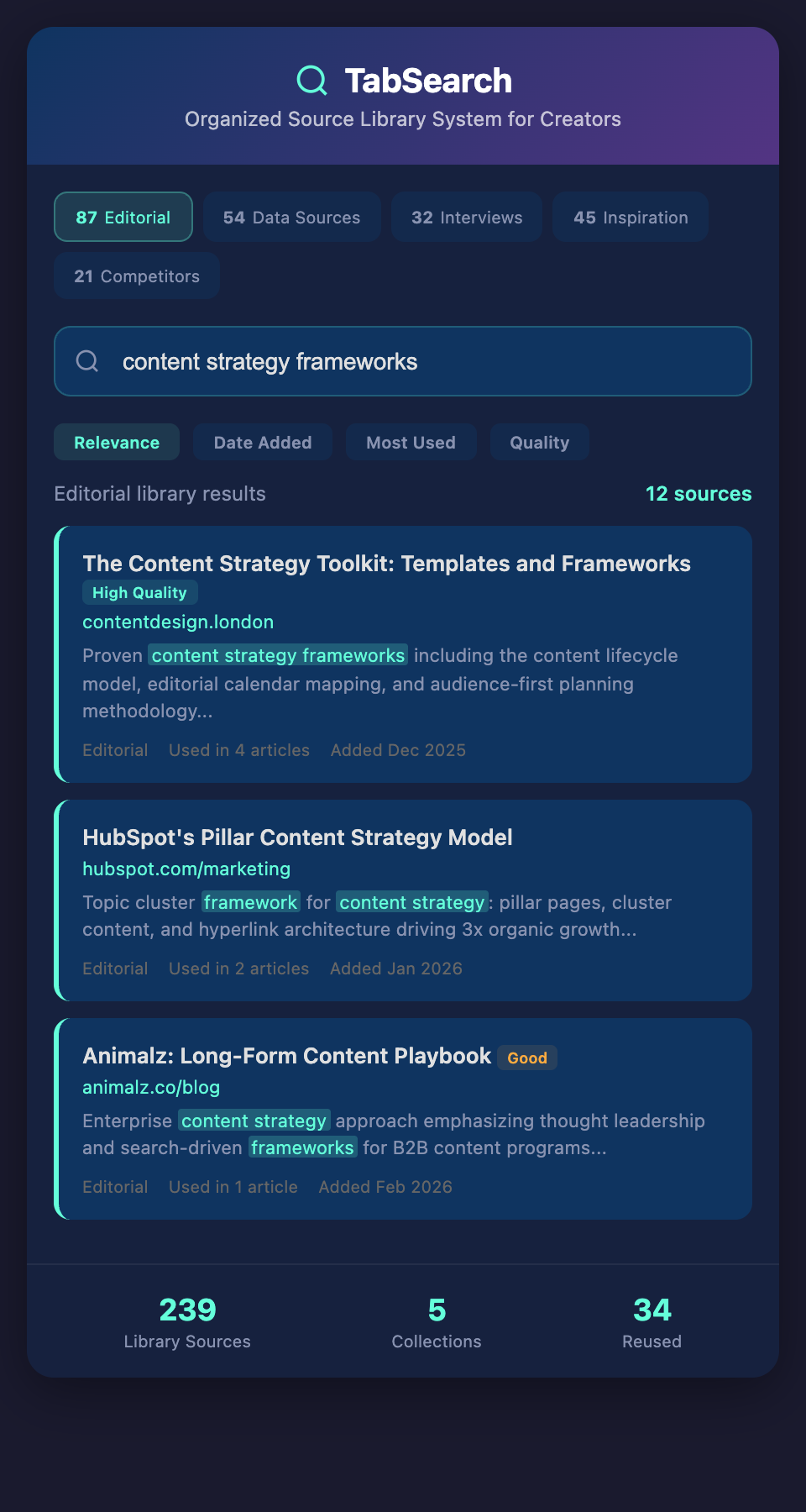
The Four Pillars of a Scalable Source Library
Pillar 1: Unified Capture
Every source goes into one place. Not articles in Pocket, videos in a spreadsheet, quotes in a doc, and research PDFs in a folder. One system. This solves the fundamental problem: fragmentation.
When everything has one entry point, you:
-
Capture without thinking about where it goes
-
Know exactly where to look for something
-
Build a cohesive knowledge base instead of scattered collections
Make capturing so easy that you do it without friction. A browser extension, a quick action, a keyboard shortcut—something that requires under five seconds per source.
Pillar 2: Flexible Organization
Contrary to conventional wisdom, you don't need perfect folders. Real research doesn't fit into rigid hierarchies. A source about email copywriting could belong under "Email," "Copywriting," or "Psychology." Which folder is "correct"? None. It belongs in all of them.
Use tags instead of folders. Tags are flexible. A source can have multiple tags. You can create them on the fly. The system can even suggest tags based on content.
Your tag system should reflect your actual thinking:
Project tags (what are you working on?):
-
"q1-newsletter"
-
"ebook-draft"
-
"client-x-proposal"
Topic tags (what's this about?):
-
"email-marketing"
-
"copywriting"
-
"psychology"
-
"video-editing"
Type tags (what kind of content?):
-
"case-study"
-
"template"
-
"tool-review"
-
"framework"
Status tags (where in the workflow?):
-
"to-read"
-
"cite-ready"
-
"needs-verification"
Quality tags (how useful was it?):
-
"gold" (exceptional, return often)
-
"reference" (useful, not exceptional)
Keep your tag vocabulary small (under 50 total) and consistent. You're building a classification system you'll use every single day.
Pillar 3: Powerful Search
Every word of every source should be searchable. Not just the title or the URL, but the full text content. This is the difference between a reference library and a research tool.
With full-text search, you find information by concept, not by category. You remember a statistic about engagement but not the source? Search "engagement rate increase." You want to find case studies on conversion optimization? Search "conversion rate optimization case." You're looking for that one quote about procrastination you read months ago? Search a phrase you remember.
Full-text search is the superpower that makes everything else work. It doesn't matter if your tags are imperfect or your organization is loose. You can find what you need if you can search the content.
Pillar 4: Accessible Retrieval
Once you've organized your library, you need to be able to actually use it while you're writing.
This means:
-
Quick search that returns results in seconds
-
Clear display of relevant information (title, key quotes, source, date)
-
Easy linking to source from your writing
-
Portable format that works across your writing tools
The best source libraries integrate with where you're already working—your writing app, your note-taking tool, your document editor. You shouldn't have to leave your writing to reference your research.
Building Your Source Library Step by Step
Week 1: Start Capturing
Set up your unified capture system. Browser extension, bookmark folder, whatever tool you choose. For one week, just capture. Don't organize, don't tag, just save sources as you find them.
Goal: Get comfortable with the capture process. It should take you under 10 seconds per source.
Week 2: Process and Organize
Look at what you've captured. Add basic tags (maybe 3-5 per source). Add your own notes about why you saved it. Don't be comprehensive—just functional.
Goal: Create a minimal viable tagging system that you understand.
Week 3: Search and Verify
Start using your library. Try searching for things you've saved. Use your tags to browse by project or topic. Does the search work? Are your tags helpful?
Adjust as needed. Maybe you need to add more tags. Maybe your tag vocabulary isn't reflecting how you think. This is the iterative improvement phase.
Week 4: Build the Habit
By now, capturing should be automatic. Search should feel natural. Your library is starting to have value.
Spend this week just using what you've built. When writing or researching, go to your library first before searching the open web. Notice how much faster you work.
The Compound Growth Effect
Here's what happens over time:
Month 1: Your library is small but organized. It saves you a few minutes per article.
Month 3: You have 200+ sources organized by project and topic. You notice you're referencing the same sources across multiple articles. Your library is saving you 15-30 minutes per article.
Month 6: Your library has 500+ sources. You've built extensive research on your core topics. When starting a new article, you can reference months of accumulated research. Your library saves you 1-2 hours per article. You're also noticing connections between topics that make your writing better.
Year 1: You have 1000+ sources in an organized, searchable library. You're an expert on your core topics partly because you've systematically built knowledge through deliberate research. Your library is a competitive advantage.
The Real Benefit
An organized source library isn't just faster research. It fundamentally changes how you think and write.
When you know you have extensive, searchable research at your fingertips, you take more ambitious writing projects. You make stronger claims because you can instantly verify them. You spot patterns and connections that would take months to discover otherwise. Your writing becomes more authoritative and better-informed.
Start Your Library Now
You don't need complex software. You don't need a perfect system. You just need:
-
One place where all sources go
-
A flexible tagging system you'll actually use
-
Full-text search capability
-
Enough structure to find things later
Once you have those four elements, everything else is just optimization.
Ready to build your organized source library? Join our waitlist for access to a tool designed specifically for writers—one that makes capture instant, search powerful, and source management effortless.