Streamline Your Content Creation Workflow from Research to Published
The Friction Points in Content Creation
Creating content is a multi-phase process:
-
Ideation & Planning: Developing the concept, researching angle
-
Deep Research: Gathering sources, understanding the topic
-
Drafting: Writing the initial version
-
Refinement: Editing, restructuring, improving clarity
-
Fact-Checking: Verifying claims and sources
-
Publishing: Getting the content live
-
Promotion: Sharing and driving traffic
Most writers experience significant friction between these phases. Moving from research to writing requires context-switching. Fact-checking requires finding sources again. Publishing requires managing multiple platforms.
The faster you can move through these phases without friction, the more content you produce.
Where Writers Lose Time
Between Research and Writing:
You finish researching. You switch to a writing app. You're in a different tool, different context. To reference something you read, you either:
-
Switch back to your browser (context switch, time waste)
-
Trust memory (leads to inaccurate citations)
-
Rewrite from vague recollection (reduces quality)
During Fact-Checking:
You wrote that a statistic shows "75% of remote workers prefer async communication." Now you need to verify it. Finding the original source means:
-
Scrolling through browser history
-
Checking multiple bookmarks
-
Possibly re-searching online
Between Platforms:
If you publish across Medium, Substack, your own site, and LinkedIn, you're copying and reformatting content multiple times.
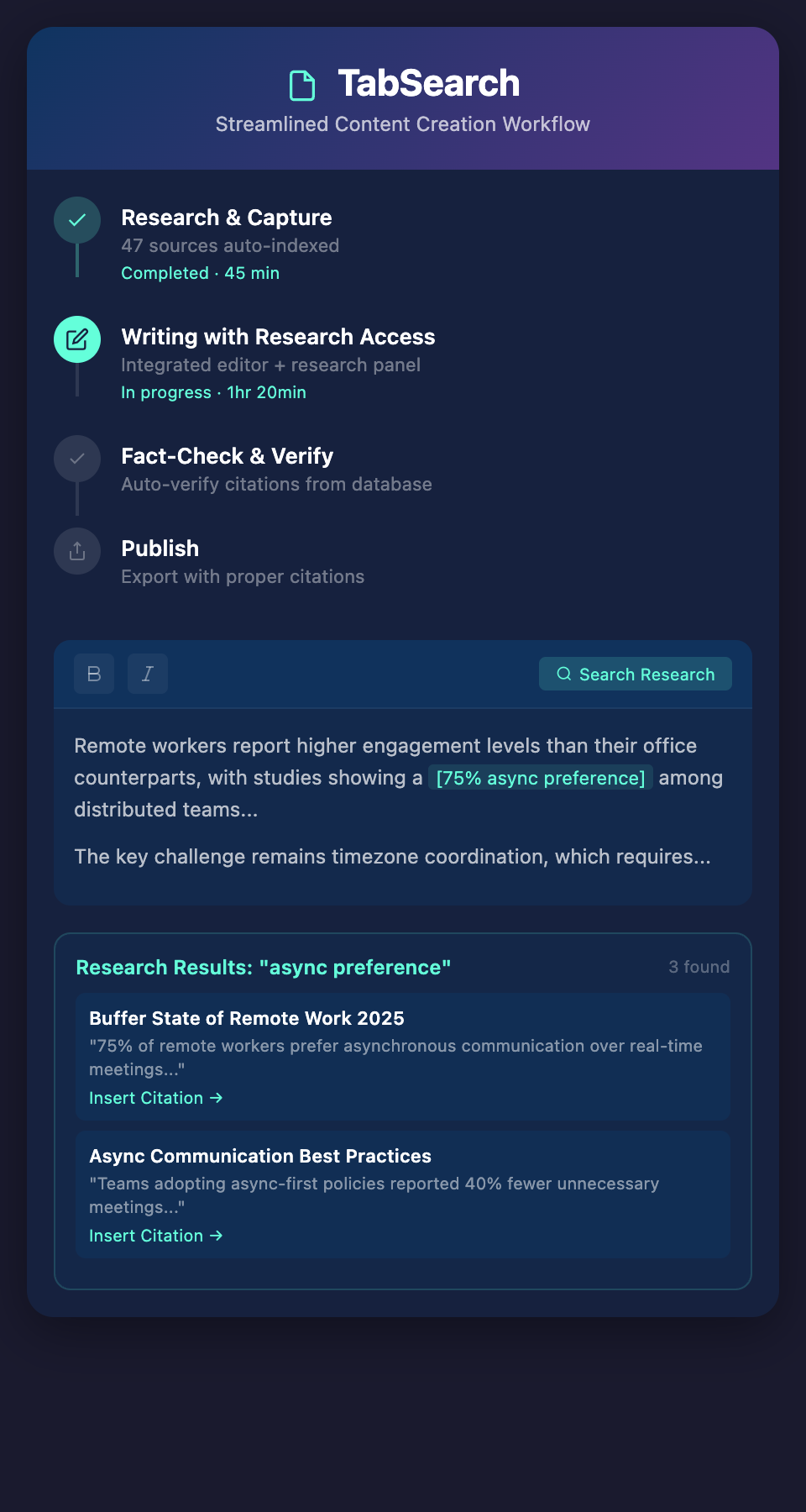
An Integrated Workflow
Imagine this process instead:
Research Phase:
Open tabs, browse normally. Everything is automatically indexed.
Writing Phase:
In your writing tool, you have access to your research. While writing, reference something? Search your research directly from the editor. Find the source instantly. Paste the quote with attribution automatically linked.
Refinement Phase:
Rewrite and improve. Your research is always available as reference material. No switching between apps.
Fact-Checking Phase:
Search your research database for each claim. Verify instantly. Adjust citations if needed.
Publishing Phase:
Publish your article. It includes proper citations and linked sources.
This integrated workflow eliminates context-switching. Your research and writing tools work together, not independently.
The Technical Reality
This integration is achievable with:
Local Full-Text Search: Your research is indexed locally, so searches are instant.
API Integration: Writing tools can integrate with your research database via API, allowing searches directly from the editor.
Citation Tools: Extract quotations with proper metadata automatically.
Export Formats: Generate content in formats suitable for your publishing platforms.
Research Sync: Keep your research database updated as you publish, capturing any new sources mentioned in your articles.
The technology exists. The question is whether your tools are designed to work together.
Workflow Before and After
Before: Disconnected Tools
-
Browser (research)
-
Google Docs (writing)
-
Notion (sometimes taking notes)
-
Spreadsheet (managing articles to write)
-
Email (communication)
-
Multiple publishing platforms (Medium, Substack, WordPress, etc.)
You're constantly switching contexts, copying and pasting, and manually managing information flow between tools.
Time to publish an article: 3-5 hours (including 1+ hours of friction)
After: Integrated Workflow
-
Browser extension (automatic research capture and indexing)
-
Editor with integrated research access
-
Unified publishing platform or connector
You research, write, cite, and publish without switching tools or losing context.
Time to publish an article: 2-3 hours (minimal friction)
The time saved isn't just about speed—it's about maintaining creative flow. Context-switching breaks that flow, requiring mental re-engagement with the piece.
Building Sustainable Content Output
For serious creators producing regular content (1-4 pieces per week), workflow efficiency compounds:
-
Time saved per article: 30-60 minutes
-
Articles per week: 2-3
-
Time saved per week: 1-2 hours
-
Time saved per year: 50-100 hours
Over a year, that's weeks of additional writing time freed up simply by reducing friction in your workflow.
Specialized Workflows by Content Type
Blog Posts & Articles
Fast turn-around from research to publishing. Integrated research access during writing speeds up citations and fact-checking.
Long-Form Content (Essays, Book Chapters)
Weeks or months of research culminating in sustained writing. A searchable research database becomes essential reference material.
Newsletters
Weekly or biweekly publication with rapid research-to-writing cycles. Tool integration becomes critical for maintaining consistent output.
Comparison & Analysis Content
Comparing multiple sources or perspectives requires cross-referencing many sources. Integrated research access eliminates manual switching.
The Experience of a Streamlined Workflow
When friction is minimized, something changes psychologically:
-
Writing becomes more enjoyable: You're not interrupted by research friction
-
Citations improve: Finding sources is easy, so you cite more and more accurately
-
Quality increases: More time in creative flow, less time managing tools
-
Output accelerates: You write more because it's less effortful
You still do the same research and thinking. You just do it with less waste.
Start Streamlining Today
The most effective writing workflow is one where research and writing are integrated, friction is minimized, and you spend maximum time on creative work.
Join our waitlist to experience a streamlined content creation workflow where research integration eliminates context-switching and accelerates your path from idea to published article.