Building Comprehensive Knowledge Bases for Active Research Projects
The Knowledge Base Opportunity
A comprehensive knowledge base is the difference between research that's scattered across tools and research that's unified, searchable, and ready to build on.
Every serious research project needs one: a single location where everything about the project lives—papers, findings, data, analyses, synthesis work, and connections between sources.
Most researchers never build these because the overhead is too high:
-
Setting up a knowledge base system takes time
-
Maintaining it requires discipline
-
Choosing structure is paralyzing
-
Tools are complex or inflexible
The result: your research knowledge lives in email attachments, scattered PDFs, multiple note-taking apps, and unreliable memory.
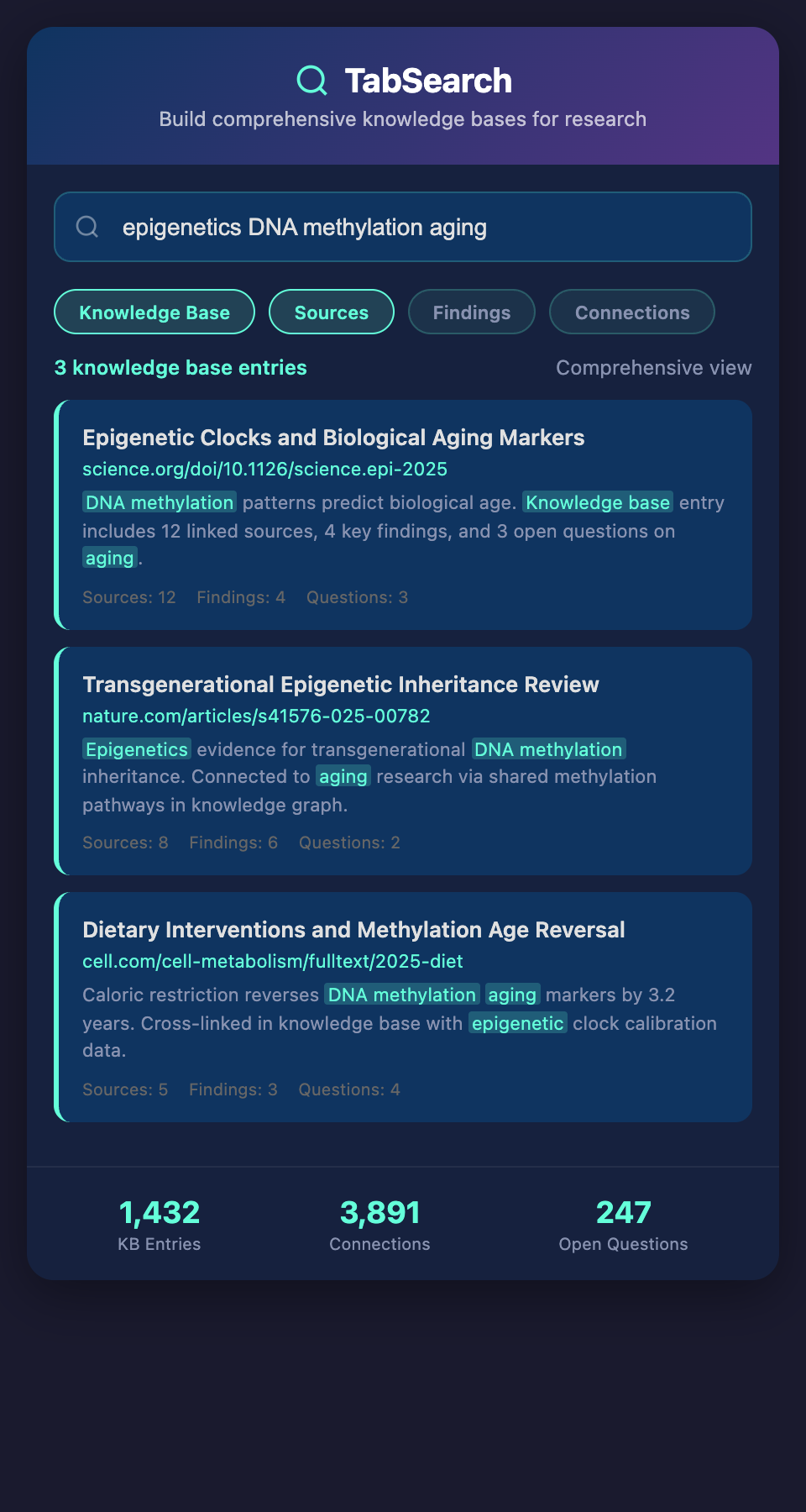
Why Research Knowledge Bases Fail
Attempts at research knowledge bases usually fail because:
-
Manual entry required: Too much friction to maintain
-
Rigid structure: Can't adapt as understanding evolves
-
Tool complexity: Learning curves discourage daily use
-
Disconnected sources: Knowledge base is separate from actual research reading
-
No search capability: Can't efficiently find information
The system becomes maintenance burden rather than research asset.
The Automatic Knowledge Base Approach
A functional research knowledge base should:
Capture and Index Everything Automatically
Every source you read, every note you create, every finding you document is automatically indexed and added to the knowledge base.
Support Organic Categorization
Rather than forcing structure upfront, create categories and connections as they emerge from actual research:
-
Active projects
-
Literature reviews
-
Methodologies
-
Datasets and data sources
-
Key findings
-
Synthesis work
-
Contradictions and gaps
Categories evolve as understanding deepens.
Enable Comprehensive Search
Find anything across the entire knowledge base:
-
All sources discussing a specific methodology
-
Every data point related to a topic
-
All contradictions related to a finding
-
Papers that cite a specific author or work
-
Your notes and synthesis on a topic
Generate Structured Output
When you need to communicate research:
-
Export literature reviews with complete citations
-
Generate data summaries with source attribution
-
Create topic overviews from captured knowledge
-
Produce bibliographies in any format
Building a Knowledge Base by Project Type
Empirical Research Project
Capture:
-
Literature review sources and findings
-
Methodology descriptions and discussions
-
Data collection documentation
-
Analysis results and interpretations
-
Methods papers and related work
Organization:
-
Literature (background and related work)
-
Methodology (your approach and alternatives)
-
Data (collection, preprocessing, organization)
-
Analysis (results, interpretations, implications)
-
Synthesis (where your work fits in the literature)
Search enables:
-
Finding methodological precedents
-
Identifying similar study designs
-
Locating relevant data sources
-
Understanding how others handled similar analyses
Conceptual or Theoretical Project
Capture:
-
Theory papers and foundational work
-
Criticisms and alternative frameworks
-
Applications and case studies
-
Your synthesis and interpretations
-
Contradictions between theoretical approaches
Organization:
-
Core theory
-
Critical perspectives
-
Applications
-
Your interpretations
-
Unresolved questions
Search enables:
-
Finding theoretical precedents for your ideas
-
Understanding critiques you need to address
-
Locating applications of theory
-
Identifying gaps in the theoretical literature
Meta-Analysis or Review Project
Capture:
-
All included studies
-
Study details and findings
-
Methodological notes
-
Study outcomes and effect sizes
-
Synthesis work
Organization:
-
Study population (who participated)
-
Outcomes measured (what was studied)
-
Interventions (what was tested)
-
Results (what was found)
-
Quality assessment
Search enables:
-
Finding studies meeting specific criteria
-
Comparing findings across similar studies
-
Identifying methodological patterns
-
Spotting outlier findings that need investigation
Real-World Knowledge Base Development
A researcher building a knowledge base for a systematic review on digital mental health interventions:
Week 1-2: Setup and Initial Capture
-
Enable automatic capture of all literature review sources
-
Open 50+ sources on digital mental health interventions
-
System automatically indexes everything
-
No manual entry required
Week 3-4: Organization Emerges
-
Search sources by intervention type (apps, websites, devices)
-
Mark sources as study-level findings, qualitative data, etc.
-
Annotate key findings as reading
-
Tags and categories emerge naturally
Week 5-6: Synthesis Support
-
Search for "smartphone interventions depression" across 50+ sources
-
Find 12 directly relevant studies
-
View results with findings highlighted
-
Identify gaps (most studies use college students; few real-world implementations)
Week 7-8: Output Generation
-
Export bibliography with all 50+ sources formatted correctly
-
Generate tables of included studies with key characteristics
-
Create summary of findings across sources
-
Write review with all citations ready
Building the knowledge base took no additional time beyond normal literature review work. The benefit: research is organized, searchable, and ready for output.
Making Knowledge Bases Sustainable
The only way a research knowledge base remains useful is if maintaining it requires zero additional effort. The system must:
-
Capture automatically (no manual entry)
-
Index comprehensively (everything is findable)
-
Require minimal maintenance (organization emerges from usage)
-
Support your workflow (integration with actual research reading)
If maintaining the knowledge base becomes another task competing for attention, it will be abandoned.
Expected Outcomes
Researchers building automatic knowledge bases report:
-
Faster research: Everything is indexed and searchable
-
Better synthesis: Patterns emerge from comprehensive source review
-
Reduced rework: Never duplicate analysis or misremember findings
-
Stronger output: Built on comprehensive knowledge base instead of incomplete memory
-
Reusability: Knowledge base supports multiple outputs (papers, proposals, presentations)
The Compound Value of Knowledge Bases
A knowledge base's value increases over time:
-
After 1 project: Foundation for next related research
-
After 3 projects: Cross-project patterns and connections emerge
-
After 5 projects: Personal research knowledge base becomes valuable resource
You can't build this value without automatic, comprehensive capture.
Transform your research projects into organized, searchable knowledge bases. Join the waitlist for automatic capture that builds comprehensive research knowledge bases without additional effort.