Creating Searchable Research Note Systems for Better Synthesis
The Research Note Synthesis Problem
You've read 30 papers on cognitive aging. You have highlights, annotations, and handwritten notes scattered across PDFs, notebooks, and text files. Now you need to synthesize findings: What's the consensus? Where do sources disagree? What patterns emerge?
You spend 3 hours rereading your notes, recopying findings, and trying to reconstruct the connections you made while reading but didn't explicitly document.
This is a problem every serious researcher faces: notes are written for immediate comprehension, but synthesis requires finding patterns across notes and sources. Traditional note-taking—even comprehensive note-taking—fails because:
-
Notes are disconnected from original sources
-
Patterns require manually connecting notes (tedious, error-prone)
-
Rereading notes triggers different interpretations than rereading original sources
-
Citation information is often lost or incomplete
The result: synthesis becomes rework rather than advancement.
Why Standard Note-Taking Systems Fail Synthesis
Common approaches:
-
Handwritten notes: Impossible to search, hard to reorganize, disconnected from sources
-
Digital notes in isolated apps: Can't search across multiple note sets; sources aren't linked
-
Spreadsheet-based systems: Rigid structure, poor for capturing nuance, not searchable
-
PDF highlights only: Can't organize or connect highlights across documents
Each approach captures some information but creates barriers to synthesis.
The Searchable Research Note System
Effective synthesis requires notes that:
Are Searchable and Connected to Sources
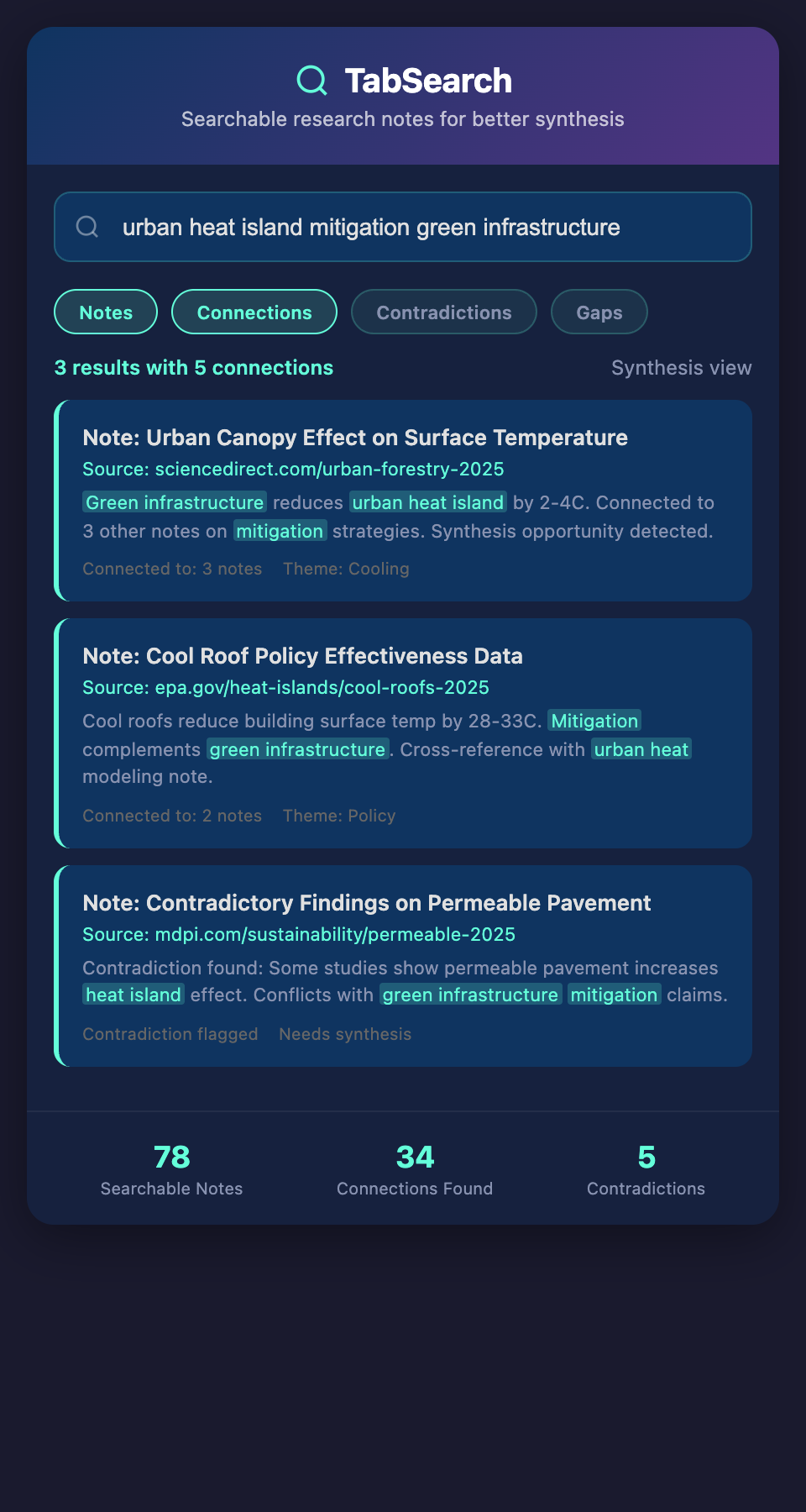
Every note is attached to the original source. Search returns notes along with source context. You can verify your understanding by reviewing the original.
Span Multiple Documents and Sources
Search across all your notes simultaneously. Find every mention of "individual differences" across your entire research, not just within single papers.
Support Pattern Recognition
Search results are grouped by theme. View all notes about "methodology" across 30 sources at once. Patterns emerge.
Include Source Context
Each note includes:
-
Full source citation
-
Surrounding text from the original (context preservation)
-
Your highlighted passage
-
Your annotation or interpretation
-
Connection to other notes on related topics
Are Easy to Create and Maintain
Notes capture automatically as you read and highlight. No additional work. You don't manually create a separate note-taking system.
Building Searchable Notes While Reading
During Reading
As you encounter important passages:
-
Highlight the passage (captured automatically)
-
Add brief interpretation or significance (your note)
-
Continue reading
That's it. No manual note creation. No post-hoc organization.
During Synthesis
When you need to synthesize:
-
Search for key concepts across all notes
-
View results grouped by source and theme
-
See note context with original source text
-
Identify patterns and contradictions
-
Compare interpretations across sources
-
Create synthesis without rework
Real-World Synthesis Example
A researcher studying emotion regulation across the lifespan:
Reading phase:
-
Opens 25 papers on aging, emotion regulation, and neurobiology
-
Highlights key findings about age-related changes, individual differences, and interventions
-
Adds brief notes interpreting significance of each finding
-
All notes are captured with source information and context
Synthesis phase:
-
Searches across notes for "age-related changes in emotion regulation"
-
40 results appear, organized by source
-
Scans results; 8 are highly relevant
-
Views each result with original source context
-
Notices pattern: most studies focus on reappraisal; few examine acceptance-based strategies
-
Searches "acceptance emotion regulation aging"
-
Only 3 results; major gap identified
-
Documenting gap for literature review takes 10 minutes instead of 3 hours
The synthesis was faster because:
-
All notes were searchable
-
Results included source context
-
Patterns emerged from search results
-
No rework required
Designing Your Note Structure
You don't need elaborate note-taking systems. Effective searchable notes require:
Essential Information
-
The finding: What did the source say?
-
Your interpretation: Why is this significant?
-
Source context: Where did this appear? (automatically captured)
-
Connections: Related findings in other sources (search reveals these)
Optional Organization
-
Project association (which research project is this for?)
-
Confidence level (high-confidence finding vs. speculative discussion)
-
Status (incorporated into synthesis, still evaluating, contradicts earlier finding)
Most of this should be automatic. Only add what helps you think.
Implementation Strategy
Week 1: Start Highlighting
As you read sources, highlight important passages and add brief interpretations. The system captures everything automatically.
Week 2: Practice Searching
Search your notes for key concepts. See how search-based retrieval finds connections across sources.
Week 3: Identify Patterns
Look for patterns in search results. Notice contradictions, gaps, and convergent findings.
Week 4: Synthesize
Use search results to support synthesis writing. Watch how much faster writing becomes.
Expected Outcomes
Researchers using searchable research notes report:
-
60% faster synthesis: Patterns emerge from search results instead of manual rereading
-
Better gap identification: Seeing all mentions of a topic reveals what's missing
-
Stronger synthesis: Built on actual source content, not from memory
-
Reduced rework: Never re-read or re-extract information
The Power of Connected, Searchable Notes
Synthesis quality depends on comprehensiveness and clarity. You can't make good connections if:
-
You can't find all your notes on a topic
-
Notes are disconnected from source context
-
Contradictions are invisible until you manually compare sources
Searchable notes connected to sources solve all three problems.
Transform your research note system. Join the waitlist for searchable notes that connect to sources, enable pattern discovery, and make synthesis faster and better.