How to Organize Research Notes Efficiently Across Projects
The Research Note Organization Crisis
As a researcher, you face a problem that most professionals never encounter: information overload at scale. A single literature review might span 50+ papers. A funding proposal requires synthesizing findings across 100+ sources. Your browser session becomes a chaotic library, each tab a potential nugget of insight—and a potential source of lost work.
The traditional solution—notebooks, filing systems, even Notion databases—breaks down because they require constant manual categorization. You're forced to choose between comprehensive note-taking and forward momentum in your actual research.
What if your note organization could be automatic, searchable, and always synchronized with the sources you're actually reading?
Why Standard Note-Taking Methods Fail Researchers
Most note-taking systems were designed for general knowledge workers. They assume:
-
You'll manually tag everything (unrealistic at scale)
-
Tags stay stable over time (researchers' frameworks evolve)
-
Search happens within your notes (but the source content matters too)
-
Everything fits in a pre-defined hierarchy (research is messy)
When you're in flow—reading a paper, finding a critical quote, jumping to a reference—stopping to categorize breaks momentum. The result: most notes end up untagged, unsearchable, and eventually lost.
The Intelligent Capture Approach
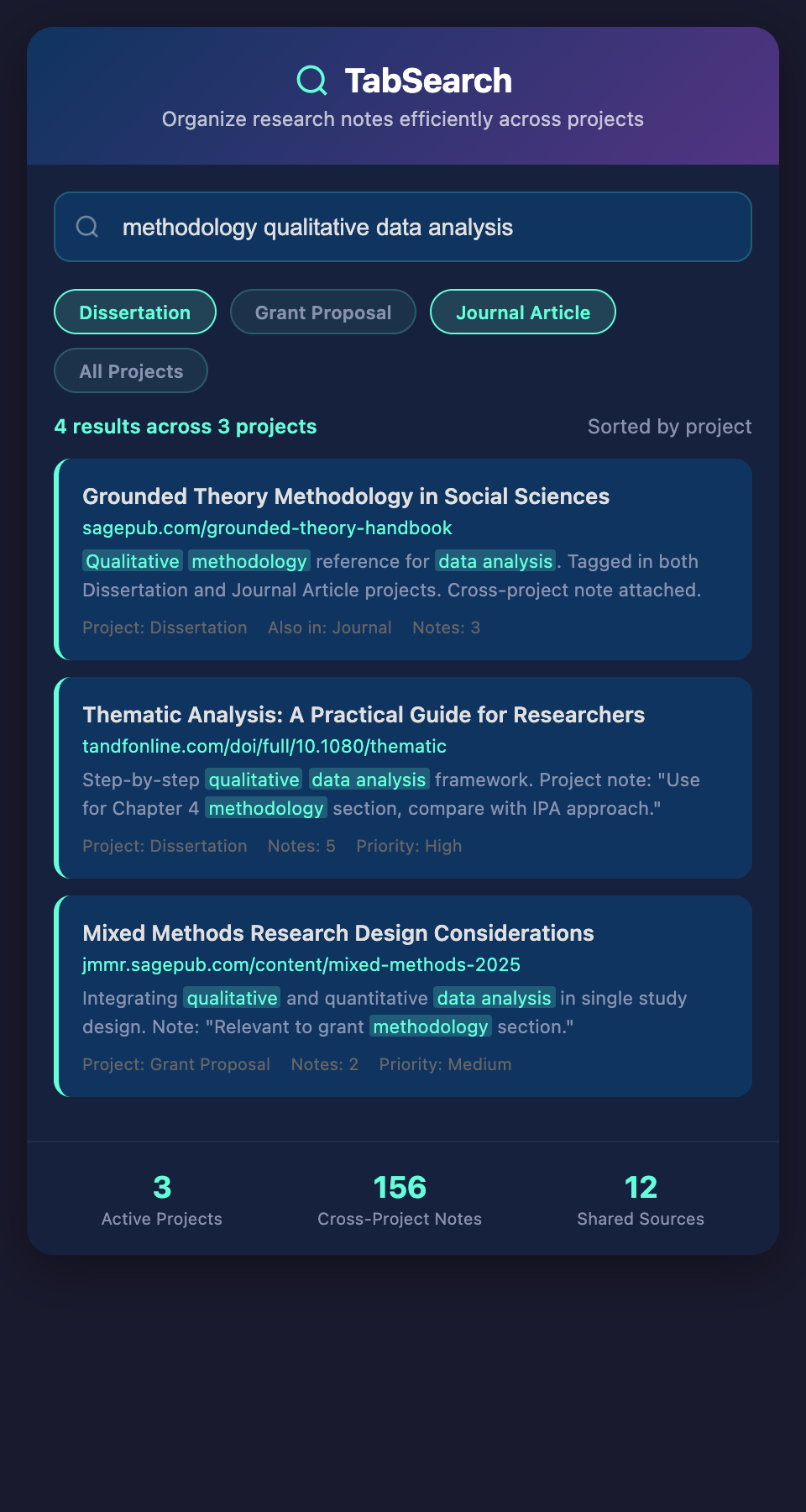
Efficient research note organization starts with automatic capture. Instead of manually creating notes, every piece of content you encounter—papers, preprints, blog posts, datasets—is indexed and available to search.
This means:
-
No manual entry required: Everything you read is documented
-
Context preserved: Notes include the original source and surrounding content
-
Full-text search works: Find that critical paragraph instantly
-
Cross-tab synthesis: Identify patterns across 50+ sources without rereading
The key insight: researchers don't need better organizational systems. You need access to everything you've encountered, indexed in a way that supports your thinking.
Structuring Your Research Capture System
Once you're capturing everything, structure emerges naturally:
Capture Everything You Read
Every journal article, preprint, blog post, and dataset description you open becomes automatically indexed. No decision required. The system just works.
Layered Retrieval
Search first. When you need to relocate a finding, full-text search across your entire research session returns results instantly, with context. Manual categories become optional—useful when they help, but not required.
Project-Based Collections
Mark sources as belonging to specific projects. This creates lightweight organization without forcing premature categorization. Move sources between projects as your thinking evolves.
Annotation Without Friction
Highlight key passages while reading. Your highlights are captured with source metadata, making synthesis work trivial later.
Making It Work in Practice
Implement this system in stages:
-
Week 1: Enable automatic capture for everything you read. Stop worrying about documentation.
-
Week 2: Practice search-based retrieval instead of browsing categories.
-
Week 3: Begin using project-based collections for current work.
-
Week 4: Add highlights and annotations to sources you plan to cite.
The shift from "How should I organize this?" to "I captured it; can I find it?" transforms your research workflow.
Real-World Impact
Researchers using this approach report:
-
40% faster literature reviews: Find sources without manually searching your notes
-
Better reference accuracy: Original source always linked, never paraphrase confusion
-
Reduced rework: Never spend hours hunting for a source you know you read
-
Improved synthesis: Full-text search reveals connections across disparate sources
Your research accelerates because you're no longer fighting your own organizational system.
Next Steps
The best research note system is one that captures automatically, searches comprehensively, and gets out of your way. One that lets you focus on thinking, not filing.
Ready to transform how you organize research? Join the waitlist for early access to tools built specifically for researcher workflows—automatic capture, intelligent search, and the control you need.