Improving Research Workflow Productivity: Tips from Active Researchers
The Research Productivity Trap
You're a productive researcher. You read constantly, analyze deeply, generate ideas regularly. Yet somehow you always feel behind.
Here's why:
-
Time spent organizing sources doesn't add to research output
-
Searching for forgotten findings interrupts active work
-
Switching between tools breaks focus
-
Managing references consumes energy better spent thinking
The paradox: the more efficiently you read, the worse your productivity problem becomes. More sources mean bigger organization challenges.
Traditional productivity advice doesn't apply:
-
Time management techniques assume known, repeatable tasks (research isn't repeatable)
-
Task batching works when you control the work flow (you don't—sources arrive unpredictably)
-
Focus blocks are interrupted by necessary research jumps (finding that paper, checking a reference)
Understanding Research as a Cognitive Task
Research productivity isn't about time efficiency. It's about supporting thinking.
Think about what takes your cognitive energy:
-
Reading and analyzing: High value, requires full focus
-
Finding sources: Necessary friction, interrupts focus
-
Organizing sources: Necessary friction, interrupts focus
-
Checking references: Necessary friction, interrupts focus
-
Writing and synthesis: High value, requires clear thinking
Productive research minimizes friction during high-value cognitive work.
The Automatic Friction Reduction Strategy
Rather than working harder, eliminate friction:
Eliminate Source Discovery Friction
When you find a source, it becomes immediately available for future reference. No manual saving, tagging, or filing.
Time saved: 2-3 minutes per source across a literature review of 50 sources = 100+ minutes saved not on entry, freed for analysis.
Eliminate Reference Lookup Friction
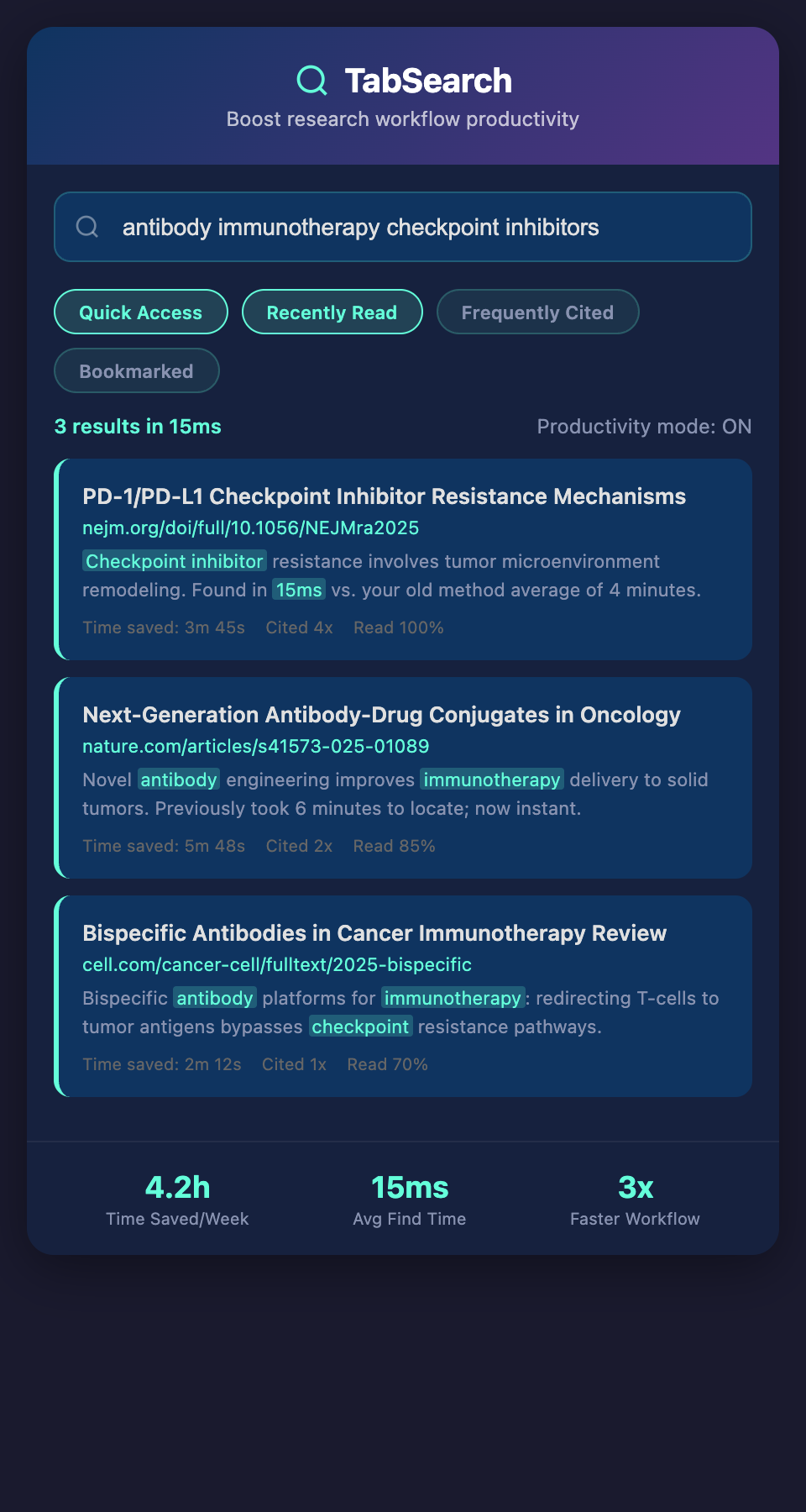
When you need to check whether a finding is in a source you've read, search across everything you've encountered. No browsing file systems or opening multiple applications.
Time saved: 5-10 minutes per lookup × 10 lookups per writing project = 50-100 minutes per paper. That's a full day of research time.
Eliminate Source Management Friction
Stop deciding how to organize sources. The system captures and indexes everything automatically. Organization emerges from actual usage.
Time saved: 30+ minutes per week not spent reorganizing, maintaining categories, or deciding taxonomy.
Reduce Tool Switching
Do all your research work—reading, annotating, searching, citing—in a unified environment. No copying between applications. No manually reformatting citations.
Time saved: 5+ minutes per session × daily use = 25+ hours per year not spent switching tools.
Restructuring Your Research Workflow
Current (Inefficient) Workflow
- Find source → 2. Open it → 3. Read → 4. Decide where to save it → 5. Manually organize it → 6. Continue research
Friction accumulates at steps 4 and 5. Both interrupt the actual cognitive work of reading and analysis.
Optimized Workflow
- Find source → 2. Open it → 3. Read and annotate → 4. Continue research
The source is automatically saved, indexed, and available for future retrieval. Zero friction between finding and analysis.
Real-World Productivity Comparison
A researcher writing a research proposal (typical 50+ source review):
Inefficient approach:
-
Finding and opening sources: 3 hours
-
Organizing and filing: 2 hours
-
Looking up references while writing: 1.5 hours
-
Reformatting citations: 1 hour
-
Total friction: 7.5 hours
Optimized approach:
-
Finding and opening sources: 2 hours (no manual saving)
-
Organizing and filing: 0 hours (automatic)
-
Looking up references while writing: 0.5 hours (fast search)
-
Reformatting citations: 0 hours (automatic export)
-
Total friction: 2.5 hours
Reclaimed time: 5 hours — that's entire day of productive research time per proposal.
Multiply across 3-4 proposals per year, and you've reclaimed 15-20 days of research time annually.
Implementation Strategy
Phase 1: Eliminate Entry Friction (Week 1)
Enable automatic source capture. Stop manually saving anything. Let the system accumulate sources as you read.
Phase 2: Eliminate Lookup Friction (Weeks 2-3)
Practice searching instead of browsing. Build search muscle memory. Notice how fast full-text search returns results.
Phase 3: Eliminate Organization Friction (Weeks 4-5)
Stop maintaining reference systems. Add quick annotations when reading important sources. Trust the system to handle organization.
Phase 4: Integrate Writing (Weeks 6+)
When writing, use the search-based system to find and cite sources. Export citations directly. Watch as writing accelerates.
Measuring Productivity Gains
Track these metrics:
-
Time spent organizing sources: Should approach zero
-
Time spent searching for references: Should reduce by 70%+
-
Tool switching frequency: Should drop significantly
-
Citation reformatting time: Should become zero
-
Time available for actual research thinking: Should increase noticeably
You'll notice the difference quickly. When friction disappears, cognitive energy previously consumed by logistics becomes available for thinking.
The Compound Effect
Small productivity gains compound dramatically:
-
30 minutes per week × 50 weeks per year = 25 hours reclaimed
-
1 hour per research project × 4 projects per year = 4 hours reclaimed
-
2 minutes per citation × 200 citations per year = 400 minutes (6.5 hours) reclaimed
Total reclaimed annually: 35+ hours. That's a full week of research time, recaptured simply by eliminating friction.
Reclaim your research time. Join the waitlist for a system that eliminates friction and lets you focus on what actually matters—the thinking and discovery.