Managing Literature Reviews Across Dozens of Browser Tabs
The Literature Review Tab Problem
You have 47 tabs open. Some contain PDF articles. Others are journal websites, preprint servers, and institutional repositories. Three tabs are datasets. Two are methodology references. One is a blog post about something tangential but potentially relevant.
You're halfway through a comprehensive literature review. Your task: synthesize findings across all these sources, identify gaps, find contradictions, cite everything properly.
Your browser is now an unorganized archive. Finding "that paper about statistical methods I read yesterday" means clicking through tabs or desperately searching your browser history.
The stakes are high: a comprehensive literature review becomes the foundation for research proposals, papers, and future studies. Missing a key source or misremembering a finding has real consequences.
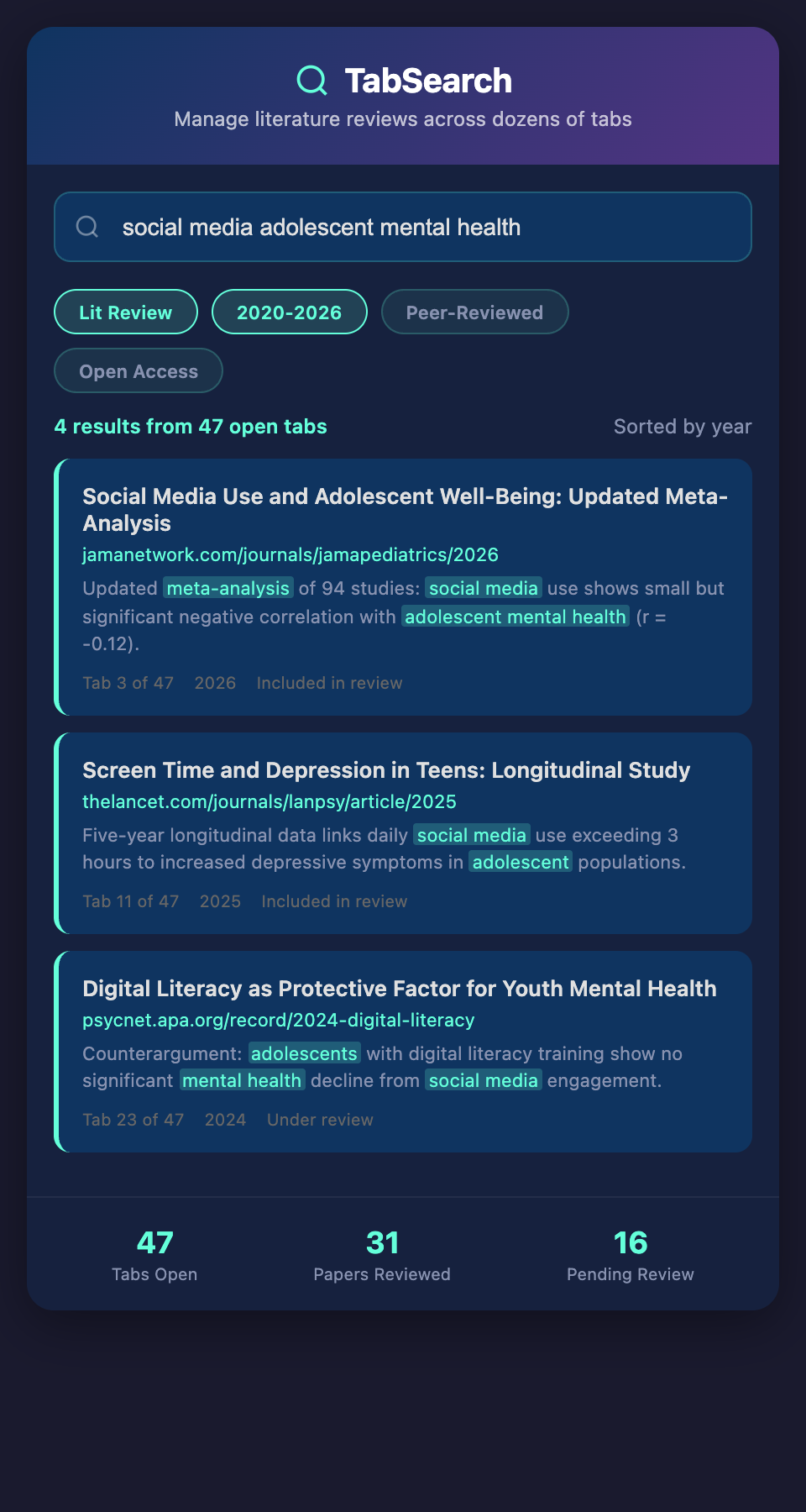
Why Browser Tabs Defeat Traditional Literature Review Methods
Literature reviews traditionally use:
-
Physical note cards: Worked for pre-internet research
-
Spreadsheets: Spreadsheets track what you've read, not what's in those papers
-
Reference managers (Zotero, Mendeley): Require manual import and organization
-
Folder systems: Impossible to search across sources, easy to lose files
Modern researchers open tabs because it's fast. You find a relevant paper, open it immediately, and keep going. The downside: managing dozens of simultaneously-open sources becomes logistically impossible.
Building a Literature Review Workflow That Scales
Effective literature review at scale requires a system that:
Captures Every Source Automatically
The moment you open a source, it's documented with publication details, abstract, and full text. No manual entry. No forgotten sources.
Enables Cross-Source Search
Find that methodology discussion by searching across all 47 open sources simultaneously. Full-text search returns results with context, showing exactly where the information appears.
Tracks Source Status
-
Papers to read
-
Papers you've skimmed
-
Papers you've analyzed deeply
-
Papers cited in your review
-
Sources contradicting previous findings
Move sources through stages without manually reorganizing.
Captures Key Quotes and Findings
Highlight passages while reading. Your highlights are automatically linked to source metadata, abstract, and citation information. When you write your literature review, all citations are already prepared.
Structuring a Large-Scale Literature Review
Phase 1: Broad Discovery
Cast a wide net. Open everything that might be relevant. The system captures everything automatically.
Phase 2: Source Evaluation
Review captured metadata. Identify which sources are directly relevant. Mark sources as "core," "supporting," or "context."
Phase 3: Deep Analysis
For core sources, annotate key findings, methodologies, and contradictions. Full-text search across your annotations reveals patterns.
Phase 4: Synthesis
Search for specific topics across all sources. Read context around each result. Identify gaps and contradictions that deserve discussion.
Phase 5: Citation
Every source is already documented with metadata. Create your citation list directly from captured sources.
Real-World Literature Review Workflow
A researcher conducting a meta-analysis on neuroplasticity:
-
Opens 60+ papers from journal sites, preprint servers, institutional repositories
-
System automatically captures every source with metadata
-
Searches across all sources for "critical periods" and finds 8 directly relevant discussions
-
Marks those sources and reads them deeply, highlighting key findings
-
Searches for contradictions by looking for sources discussing "limitations of critical period hypothesis"
-
Identifies a gap: most literature focuses on early childhood; few studies address adult neuroplasticity
-
Documents this gap with citations already prepared
-
Exports references and findings into their review draft
The entire process takes days instead of weeks.
Implementation Strategy
Week 1: Enable automatic source capture. Start your literature review with all tabs captured and indexed automatically.
Week 2: Practice searching across sources instead of browsing tabs. Build search skills.
Week 3: Begin deep annotation of core sources. Let the system handle citation management.
Week 4: Synthesize findings. Use search-based discovery to identify gaps and contradictions.
Expected Improvements
Researchers report:
-
60% faster literature reviews: Searching beats browsing and manual organization
-
Higher citation accuracy: All sources automatically formatted
-
Better gap identification: Search reveals patterns across large source sets
-
Reduced rework: Never lose a source or forget which paper discussed a topic
The Competitive Advantage
A well-organized literature review is the foundation of strong research. Research that's built on comprehensive, accurately-cited sources outweighs research with knowledge gaps.
Join the waitlist for a platform that turns your browser tabs into a searchable, organized literature review database. No manual entry. No lost sources. Just comprehensive research.