Cross Reference Documentation Between Different Frameworks Quickly
The Framework Switching Problem
You're a JavaScript developer who knows React well. You've researched it extensively. You've read the docs. You've built projects. Now you're switching to Vue for a new role. You have to start from scratch, learning Vue's lifecycle, hooks, rendering, props system—everything feels unfamiliar even though you understand the core concepts from React.
You have vague memories of something similar in React, but you can't make the connection because you can't search your React research and compare it side-by-side with Vue docs.
Backend example: You're a Node.js developer switching to Python. You know Express patterns. Django should have similar concepts, but are they in the same place? What's the equivalent of Express middleware? How do you think about routing?
Language example: You know TypeScript well. You're learning Rust. Both are strongly-typed languages with advanced type systems. The concepts overlap, but the syntax is different. If you could compare TypeScript patterns you've researched with Rust documentation, you'd learn faster.
Why Learning Curves Are Steeper Than Necessary
When you switch frameworks or languages, your brain has to do extra work:
-
Forget known patterns temporarily. You have to suppress what you know about your previous framework to avoid confusion.
-
Relearn fundamentals. Every framework teaches "components" or "controllers" differently, so you learn from first principles.
-
Miss analogies. You don't recognize that a React "hook" is analogous to a Vue "composition function" because you can't see them side-by-side.
-
Lose context from previous learning. Your research about React state management doesn't feel relevant to Vue, so you don't apply lessons learned.
It's like learning Spanish when you know French. The languages are similar, but because you can't see the similarities during learning, you memorize everything as if it were new.
Documentation is Designed for Isolation
Official documentation is written as if you know nothing about other frameworks:
-
React docs explain "state" without acknowledging Vue's reactive system
-
Vue docs explain composition without referencing React hooks
-
Angular docs assume you're starting from basics
Each framework wants to be self-contained. This makes sense for comprehensive learning, but it makes learning faster when you have prior knowledge unnecessarily hard.
You can't search React docs and Vue docs simultaneously to compare. You can't ask: "Show me this pattern in both frameworks."
Building a Cross-Framework Reference
The ideal learning tool would let you:
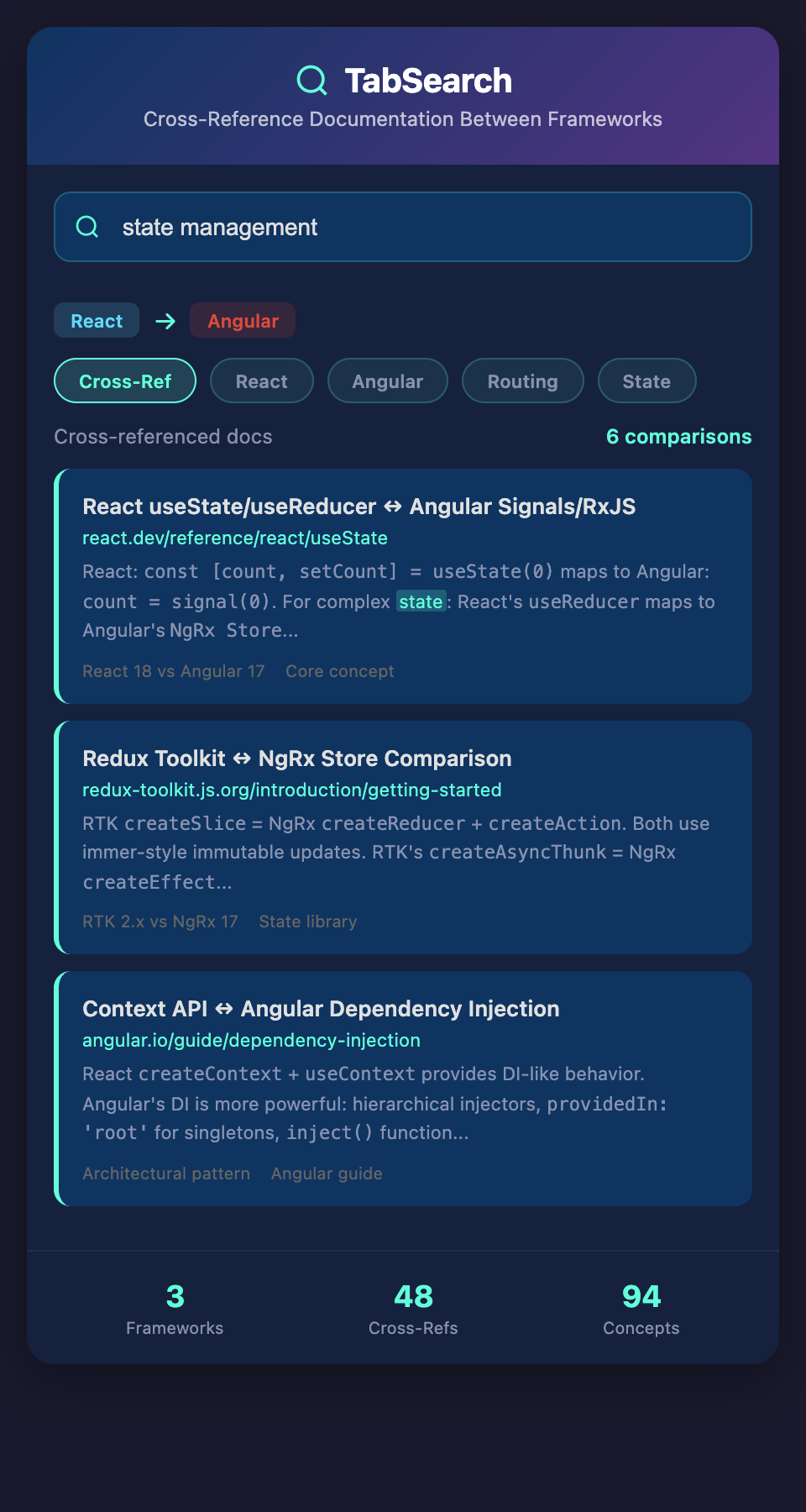
Compare side-by-side:
-
React's
useStatehook next to Vue'sref() -
React's component lifecycle next to Vue's lifecycle hooks
-
Redux next to Pinia
-
React Router next to Vue Router
See analogies instantly:
-
Search "state management" and get examples from every framework you've researched
-
Search "routing" and see how each framework approaches it
-
Search "testing" and see testing patterns across React, Vue, Angular, Svelte
Reuse learning shortcuts:
-
When you learned React, you found a blog post that explained hooks brilliantly. Now learning Vue, you want to find the analogous resource.
-
You learned about prop drilling in React. Now you want the equivalent resource for Vue's provide/inject.
Accelerating Framework Adoption
Teams often stay on one framework even when a better choice exists, because learning a new framework takes too long. A developer knows React well but learning Vue or Svelte takes 3+ months.
With better learning tools, that drops to 4-6 weeks. You understand concepts 10x faster because you're not starting from zero—you're translating from known patterns.
Practical Workflow
Scenario: You're switching from Express (Node.js) to Django (Python).
Without comparison: You read Django documentation. You learn models, views, serializers, middleware. It feels unfamiliar even though you understand similar concepts in Express. You probably learn slower and don't build mental models efficiently. You might implement something inefficiently because you don't realize the Django way matches what you already know.
With cross-framework docs: You search "routing" and see Django URL routing next to Express routes. You see analogies instantly. You search "middleware" and understand Django middleware in the context of Express middleware you've used for years. You search "request handling" and see the entire flow in both frameworks. Learning takes less time because you're not memorizing—you're translating.
Multi-Language Learning
This extends across languages:
You know Python well. You're learning Go. Both have functions, but Go's approach to organizing code is different. If you could search patterns you've researched in Python docs and see the equivalent Go documentation, you'd understand Go's philosophy faster.
You know JavaScript promises well. You're learning Rust futures. The concepts overlap—both are about handling asynchronous operations—but they look completely different. A searchable cross-language reference would show you the connections.
Building Your Personal Polyglot Library
After you've researched multiple frameworks or languages, you have the raw material for a cross-reference library:
-
You've read React docs, Vue docs, and Angular docs
-
You've researched JavaScript and TypeScript documentation
-
You've studied Node.js, Python, Go, and Rust guides
-
You've gone through Express, Django, and FastAPI examples
If all of that research is indexed and searchable, and if you can search for concepts across all of it, your next framework becomes an exercise in translation, not memorization.
The Productivity Multiplier
For teams that use multiple frameworks:
-
A team using React and Node.js that switches to Vue saves weeks of onboarding per developer
-
A startup using JavaScript that adds a Python backend can hire JavaScript developers and have them productive faster
-
A consultant switching between client tech stacks learns each stack faster by comparing to previous ones
Faster Learning, Better Decisions
Beyond speed, this leads to better technical decisions:
You understand that Express middleware chains and Django middleware serve similar purposes. You make better architectural choices in Django because you're not learning it in isolation.
You realize that Vue's reactivity system solves a problem you struggled with in React. You make deliberate architectural choices instead of cargo-culting patterns from your previous framework.
Creating a Personal Polyglot Reference
The ideal system would:
-
Index every framework/language resource you research (docs, tutorials, blog posts)
-
Let you search across all of them simultaneously for concepts
-
Suggest analogies from frameworks you already know when learning new ones
-
Help you translate patterns from one context to another
-
Preserve your learning journey so you remember what you tried and what worked
This transforms learning new frameworks from "starting from zero with a new language" to "translating from patterns I already know."
Join the waitlist for smarter framework learning. Stop learning new frameworks in isolation. We're building a system that indexes all your documentation research and helps you compare frameworks side-by-side, so learning Vue, Django, Go, or any new framework becomes an exercise in translation, not memorization.