Never Repeat Research on the Same Problems: Stop Solving Twice
The Problem of Repetition
You've solved this problem before. That nagging feeling of déjà vu when implementing a feature, reviewing a code pattern, or debugging a specific issue. You know you've been here. But you can't quite recall the solution.
So you solve it again. Re-reading the same blog post or documentation page. Re-testing the approach. Re-making the same architectural decisions. Hours of your professional time spent on problems you've already thoroughly solved.
Some repetitions are occasional. But compound them across your career: solving the same bug twice, implementing similar validation three times, reading the same Stack Overflow answer four times. These aren't edge cases. They're routine.
Research shows developers solve identical problems repeatedly because they don't have systems to make previous solutions retrievable. You don't lose knowledge because you forget it. You lose it because you can't find it when you need it.
Why Solutions Get Lost
You've probably tried preventing this. You bookmark things. You maintain notes. You save code snippets. But without proper organization and search, these systems fail:
Bookmarks Decay: You bookmark enthusiastically at first, but your bookmark folders grow unwieldy. You stop maintaining them. Newer bookmarks bury older ones. When you need something, you avoid searching your disorganized bookmarks.
Notes Require Discipline: Keeping development notes is great, but only if you remember to maintain them. Most developers start note-taking with enthusiasm and abandon it within weeks.
Scattered Solutions: A solution might exist as a code comment, a Stack Overflow post you have open, a GitHub issue discussion, or a blog post you bookmarked. These aren't connected, so you need to remember which source contains the specific information.
The Search Instinct: When you need something, your instinct is to search the web rather than check your archives. You can search the public web instantly. Searching your notes requires remembering where you saved it.
What you need is a system that makes your previous research more accessible than new research.
Persistent Solution Retrieval
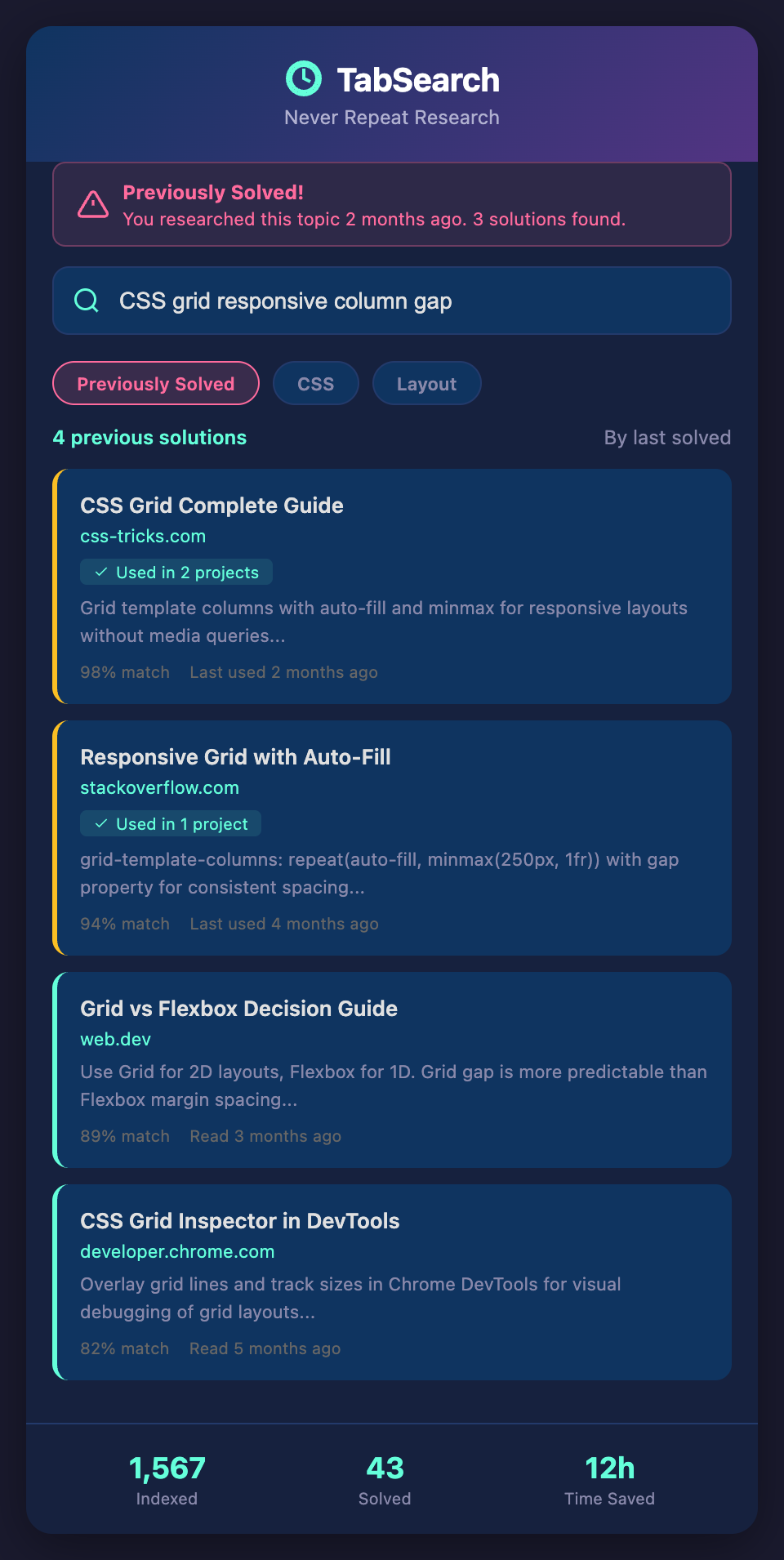
Imagine every solution you've ever researched and implemented being instantly retrievable. You're debugging a specific CSS grid issue. You search "CSS grid column gap responsive design", and instantly see:
-
The blog post that explained grid layout that you read last year
-
The CodePen example you built for yourself
-
The Stack Overflow answer that solved your specific issue
-
Possibly, the actual implementation you built in a past project
Instead of re-searching the web and wading through results, you reference what you already know works.
This changes the research workflow fundamentally:
-
First encounter: You research thoroughly. You read multiple sources. You test the solution. You build something that works.
-
Second encounter: Instead of researching from scratch, you search your previous research. You remember how it works. You implement in 10% of the time.
-
Third encounter: You instantly find your previous solution. You adapt it slightly if needed. You're done in minutes.
The first encounter takes time. Every subsequent encounter becomes trivial.
Real Repetition Scenarios
Scenario 1: Form Validation Across Projects
You've validated forms in at least four projects. Email validation. Password requirements. Number range validation. Phone number formats. Each time, you researched the proper regex, the validation libraries, the error message strategies.
By the third project, you should be reusing solutions. But you don't remember the exact regex. You don't remember which validation library you preferred. So you research again. Not quite as deeply as the first time, but enough time spent on something you've already solved.
With persistent solution retrieval, you search "email validation regex security requirements", and you immediately see every validation approach you've researched. You remember why you chose a particular library, and you reuse it with confidence.
Scenario 2: Async State Management Patterns
You've built async state management (loading, success, error states) in at least five projects. React, Vue, Angular, Svelte. You've learned patterns that transfer across frameworks. But each project, you spend some time remembering the exact pattern, testing error scenarios, and handling edge cases.
With searchable research, you find your previous implementations immediately. You remember how you handled race conditions. You recall which error handling approach you preferred. Instead of reimplementing and retesting, you adapt your proven solution.
Scenario 3: Database Optimization Queries
You've solved slow database queries multiple times. Indexes, query optimization, pagination, data loading strategies. Each time, you read the same articles and documentation about query optimization. Each time, you make similar decisions about indexing strategy.
With searchable previous solutions, you find your optimization analysis from past projects. You remember which approaches worked. You apply proven patterns rather than starting from scratch each time.
Building Unforgettable Knowledge
The mechanism is elegantly simple: Every resource you read, every solution you find, every approach you research gets indexed automatically. Your research becomes a comprehensive, searchable archive of solved problems.
Over time, this archive becomes your primary reference. When you encounter a problem, you search your previous solutions before searching the web. Your archive matches your problems because you've solved those problems before.
The Exponential Time Savings
Consider how often you encounter repeated problems:
-
Small bugs that appear across multiple projects
-
Common validation patterns
-
Authentication approaches
-
Error handling strategies
-
Performance optimization techniques
-
API integration patterns
-
Data transformation utilities
If you encounter a repeated problem once per month on average, and re-researching it takes an hour, that's 12 hours per year. But most developers encounter repeated problems more frequently—maybe 2-3 times per month. That's 24-36 hours per year spent re-solving problems.
With searchable persistent solutions, you spend 15 minutes on that problem—looking up your previous solution instead of researching from scratch. That's 30-45 minutes per year instead of 24-36 hours. The compounding is significant.
Beyond time, there's the quality improvement. Your fourth implementation of a solution is better than your first because you've refined it three times. You're not solving worse; you're solving better, faster.
Remember Everything; Forget Nothing
Your professional experience is too valuable to waste on repetition. Every problem you solve is part of your expertise—make it permanently retrievable.
Join our waitlist to stop repeating research. Build a searchable archive of every solution you've found. Reference instead of re-research. Complete problems faster with confidence that you're applying proven approaches.