Organizing Code Snippets: Building a Searchable Personal Code Library
The Code Snippet Problem Every Developer Faces
You've solved this problem before. Maybe it was a recursive function to flatten nested data, a clever regex pattern for email validation, or an elegant solution to async state management. You remember solving it, but you can't remember where or how. So you solve it again, reinventing the wheel for the fourth time in different projects.
Developers spend enormous amounts of time on solutions they've already built. Without a proper system for capturing and organizing snippets, this redundancy is inevitable. You might have the solution bookmarked somewhere, or maybe it's buried in old project repositories, or perhaps it exists in a blog post you read three months ago and can't find now.
The problem intensifies across multiple projects. A snippet that works perfectly in one React project needs slight modification for another. A utility function you built for one backend works with minor tweaks for another stack. But without a searchable, organized system, you're either forgetting these solutions entirely or spending hours hunting through old code.
Why Traditional Snippet Tools Fall Short
Many developers try to solve this with note-taking apps, GitHub Gists, local code files, or IDE snippet extensions. Each approach has fundamental limitations.
IDE Snippet Extensions are limited to your current project. They don't help you share solutions across projects or find snippets when you're not coding.
GitHub Gists require you to manually copy-paste snippets and remember to upload them. Most developers don't maintain their Gists actively, so they become outdated and disorganized.
Note-Taking Apps can store snippets, but they're not designed for code. Syntax highlighting is poor, testing code snippets is impossible, and searching is suboptimal for technical content.
Local Files solve the search problem but create the organization problem—you have hundreds of loose snippets with confusing naming conventions.
The ideal system would automatically capture snippets from everything you research, make them instantly searchable, keep them organized by context, and let you reuse them across projects without modification. That system doesn't exist in traditional tools—but it should.
Building Your Searchable Snippet Repository
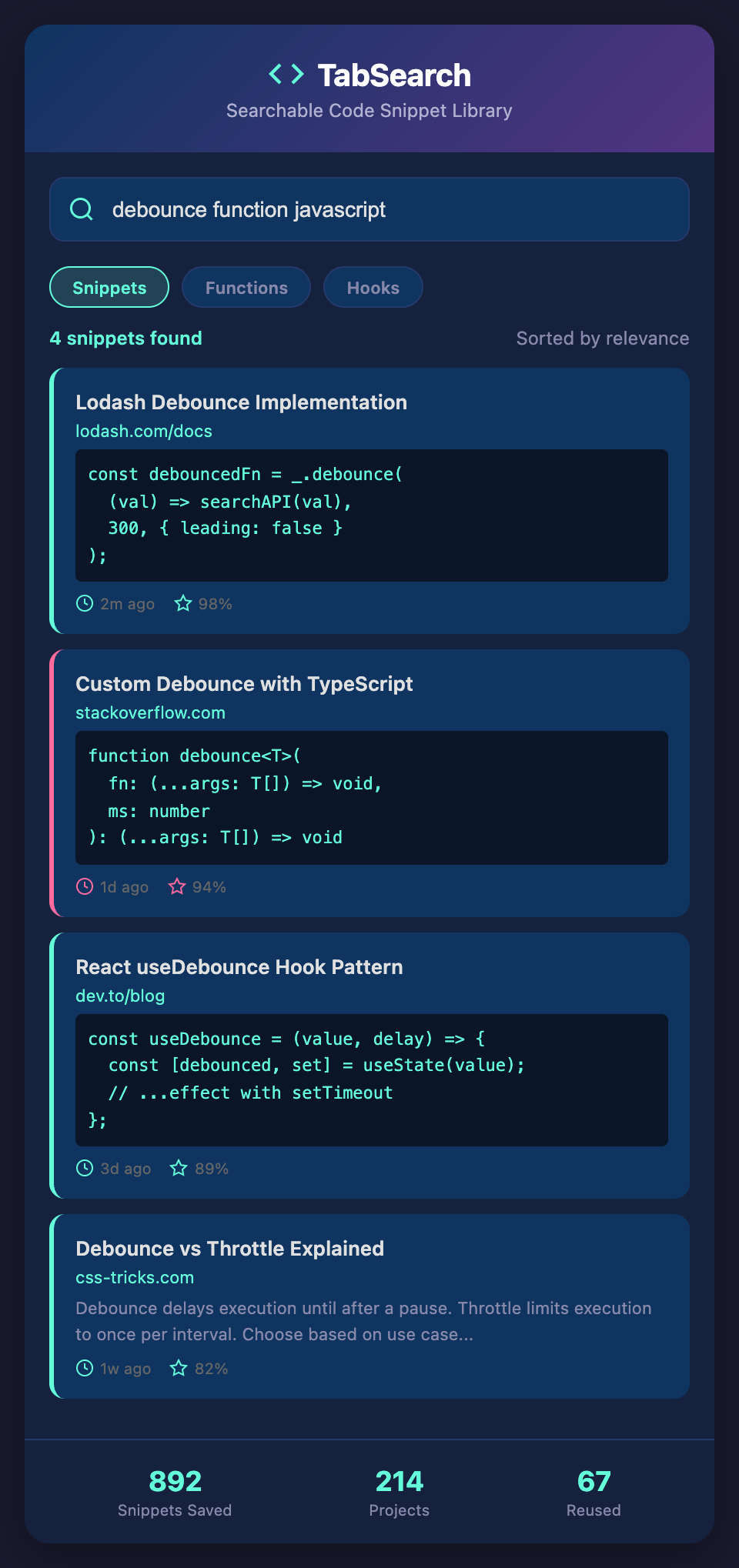
What if every solution you found while researching was automatically indexed and retrievable? What if you could search "debounce function javascript" and instantly get every snippet and blog post example you've ever encountered?
This is where searchable browser research becomes transformative. When you're reading documentation, Stack Overflow answers, blog posts, and GitHub repositories, you're constantly finding useful code snippets. A proper full-text indexing system captures all of this.
Here's what an ideal workflow looks like:
Discovery: You're reading a Stack Overflow answer about implementing pagination, and the answer includes an elegant snippet. Your extension automatically indexes this page.
Organization: The extension groups this snippet by topic (pagination), language (JavaScript), and context (web development), based on which project you were working on when you found it.
Retrieval: Three months later, you're building pagination for a different project. You search "pagination offset limit", and instantly see that Stack Overflow answer, the blog post about performance optimization you found, and any snippets from your own previous implementations.
Reuse: You copy the solution, adjust it for your current project's specific requirements (maybe different database, slightly different API), and you're done in minutes instead of hours.
Real-World Snippet Scenarios
Scenario 1: Date Handling Across Projects
You work on projects spanning Node.js backends, React frontends, and mobile apps. Date handling is different in each environment, but the underlying logic is similar. Instead of reimplementing date utility functions in each project, you search your indexed research for "timezone aware date parsing" and find every implementation you've used, every Stack Overflow solution you bookmarked, and every blog post discussing best practices. You pick the one most suitable for your current stack.
Scenario 2: Framework-Specific Patterns
You're building with a new framework, and you remember solving a similar problem in a different framework last year. You search "form validation error display", and your system returns examples from Vue, React, and vanilla JavaScript. You adapt the pattern you used in your previous project to your current framework, saving development time.
Scenario 3: Algorithm Implementation
You're working on a feature requiring a specific algorithm—maybe a sorting variant or a graph traversal. You've implemented similar algorithms before, but the details escape you. Instead of reopening old projects or searching Stack Overflow from scratch, you search "depth first search graph traversal", and instantly get every implementation, explanation, and variant you've encountered in your research.
Turning Research Into a Knowledge Asset
Every time you research and solve a problem, you're creating valuable intellectual property. But without a system to capture and organize it, that knowledge disappears. You repeat work. You slow down as your experience fails to compound.
A searchable snippet repository changes this. Your research becomes an asset. Your solutions become retrievable patterns. The more you use it, the faster you work because you're never solving problems you've already solved.
The Cumulative Advantage
Individually, each reused snippet saves perhaps 15-30 minutes of development time. But across a career, this compounds dramatically. If you reuse solutions twice per week on average, and each reuse saves 30 minutes, that's one hour per week. Over a year, that's 50 hours of development time recovered—time you can spend on new features, performance optimization, or learning.
More importantly, your code becomes more consistent. You're using the same well-tested patterns across projects. Bugs decrease because you're reusing solutions that already work rather than reimplementing new ones.
Start Building Your Library Today
You don't need to manually organize your snippets. As you research and browse, everything gets indexed automatically. Your personal code library grows without effort, becoming increasingly useful over time.
Join our waitlist to get access to our full-text searchable browser extension. Turn your research into a knowledge asset. Stop reinventing solutions. Start building faster.