Prevent Duplicate Implementations by Searching Previous Solutions
The Duplication Trap
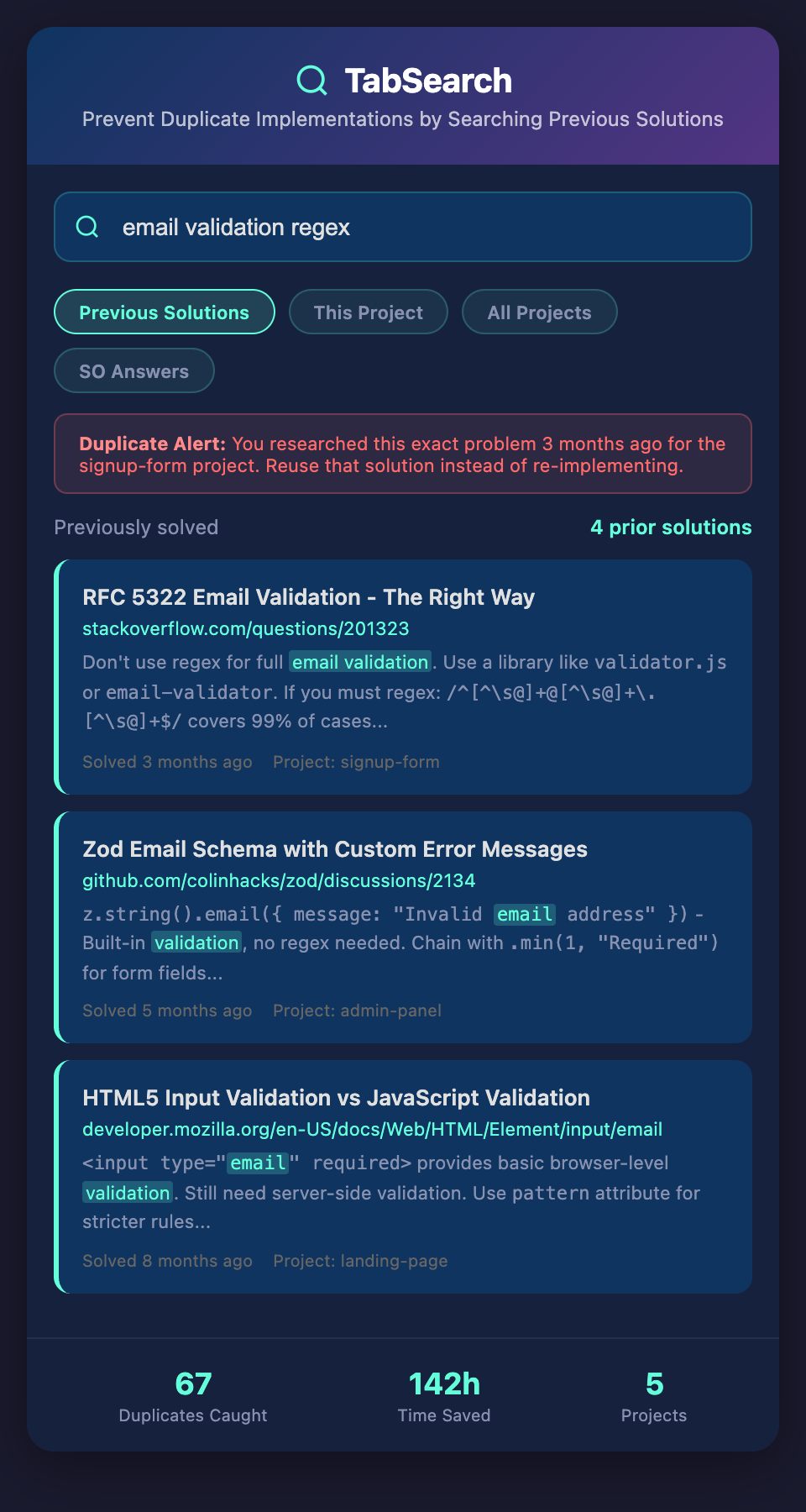
You've implemented API error handling dozens of times. In Project A, you built a middleware that catches errors and logs them with context. In Project B, you built something similar but slightly different. In Project C, you built a third variation because you didn't remember what you did in A and B.
Same with form validation. You've solved "validate an email field" at least five times across different projects. Each time you either copy from somewhere you half-remember or rewrite it from scratch.
This happens because the knowledge of your previous solutions is locked away in closed projects. It's not searchable. It's not accessible.
Why "Just Use a Library" Doesn't Work
You might think: "That's why we have npm packages and shared libraries."
Problem 1: Not everything is worth publishing. That custom error handler you built is perfect for your style and your framework choices, but it's not generic enough to publish. So it stays in one project.
Problem 2: Your needs change across projects. You've built API clients in three different projects. One is synchronous, one is async, one uses generators. Not one library fits all three.
Problem 3: You don't know you have a solution already. You can't search across closed projects. You can't browse "all the ways I've solved authentication." You just search npm and implement from scratch.
Problem 4: Most shared knowledge never gets shared. You solve a problem in Project A. You never document it. You move to Project B. You solve a similar problem differently because you forgot what you did before.
The Cost of Duplication
Let's calculate what this costs:
Assume you work on five active projects per year. Each project has 10 core features where you're probably re-solving something you've solved before. That's 50 repetitions.
For each one, assume you waste 20 minutes because you didn't remember your previous solution and had to either re-search or re-implement. That's 50 × 20 minutes = 1,000 minutes = 16+ hours per year.
For a mid-career developer at $150/hour, that's $2,400 per year in wasted time just from re-implementing things.
Scale that across a 10-person team and you're losing $24,000+ annually in duplicate work on features you've already solved.
Building Institutional Memory
The solution isn't a formal library or process (too much friction). It's a searchable archive of everything your team has built.
When you're starting a new feature:
-
Search your archive for similar implementations across all previous projects.
-
See the solutions your team chose and why (based on context from project commits, comments, PR discussions).
-
Reuse or adapt instead of starting from scratch.
For example, searching "authentication" shows:
-
The OAuth flow you implemented in Project A
-
The JWT token refresh logic you built in Project B
-
The session-based approach you used in Project C
-
The mistakes you documented in Project D that you learned from
You can instantly pick the best approach for your new project instead of deciding from pure research.
Preventing Common Mistakes Through History
Beyond saving time, this prevents repeating mistakes.
You implemented a cache layer in Project A that had race conditions under high load. You fixed it and documented it, but the fix is buried in old code. Now you're implementing caching in Project B, and you make the same mistake because you don't remember what you learned.
If your previous solutions were searchable, you'd instantly see "race condition in caching" from Project A and know what to watch for.
This compounds. Senior developers make fewer mistakes partly because they internalize lessons. Junior developers can learn from the team's history if that history is searchable and accessible.
Cross-Project Pattern Recognition
Beyond preventing duplication, a searchable codebase history reveals patterns:
You notice that you've built six different pagination implementations. Why? Can you standardize on one approach across projects?
You see that every authentication implementation has the same issue with expired tokens. Why haven't you solved this once and shared it?
You realize you've written form validation code eight times with different approaches. Could you build a standard approach and reuse it?
These patterns are invisible when knowledge is scattered. They become obvious and actionable when they're searchable.
Practical Search Scenarios
Scenario 1: New authentication feature. You search "authentication" and see every auth implementation your team has built: OAuth, JWT, sessions, API keys, etc. You see which approaches had issues and which worked smoothly. You choose the best one for your context.
Scenario 2: Debugging a mysterious bug. You search for "race condition" or "concurrency issue" and see every similar bug your team has fixed before. You see the solution pattern and apply it.
Scenario 3: Rebuilding a feature. You search "caching" and see three different caching strategies your team has tried. You understand the trade-offs because they're documented in project context. You pick the best one.
Scenario 4: Onboarding a new team member. Instead of explaining "here's how we handle error handling," you search your codebase history and show them five different error-handling approaches your team uses, the contexts where each is appropriate, and lessons learned.
Implementation Without Bureaucracy
This doesn't require formal processes or a "shared library" that no one maintains. It just requires:
-
Searchable access to your previous projects—code, context, commit messages, documentation.
-
Full-text search—find implementations by what they do, not just by filename.
-
Context preservation—see not just the code, but why it was written and what problem it solved.
The search results guide your decisions. You make choices based on history, not from scratch.
The Compound Effect
After a year, your team stops duplicating core features. You've established patterns through repetition and learning.
After two years, onboarding takes half as long because new developers can search your solution patterns instead of learning through mistakes.
After three years, you've built a searchable knowledge base of solutions that serves as your institutional memory. New projects build on proven patterns instead of experimenting.
Join the waitlist to end duplicate work. Stop solving the same problems across different projects. We're building the system that makes your entire codebase history searchable and accessible, so your team learns from previous solutions instead of repeating them.