Searching Past Solutions Across All Your Projects: Build on What You've Done
The Multi-Project Knowledge Problem
You've built similar features in at least three projects. Authentication flows, user dashboards, data export systems, payment integrations. You remember solving some of these problems. You're confident you've seen approaches that worked well. But the details are fuzzy, and each previous project exists in a different repository, possibly from years ago.
So you build again from scratch. Not entirely—you vaguely remember some patterns—but you don't have the exact implementation, the decisions you made about error handling, or the tradeoff analysis you performed. You spend time re-analyzing problems you've already solved.
This is a severe inefficiency in how developers work. You accumulate professional experience across projects, but you rarely leverage that experience systematically. You solve the same problems repeatedly, never quite reaching the stage where you can say "I've done this before, let me just adapt my previous solution."
Why Cross-Project Knowledge Fails to Leverage
You've probably tried to bridge this gap. You maintain code snippets. You save useful GitHub repositories. You keep personal documentation. But these solutions have fundamental limitations:
Fragmented Storage: Different projects live in different repositories. Useful utilities are scattered across multiple codebases. There's no central place to search for "oh, how did I handle pagination in that other project?"
Temporal Distance: A solution you built two years ago lives in an old repository you don't visit. You've forgotten about it entirely, so you rebuild rather than reuse.
Context Loss: You remember building a feature, but you don't remember the tradeoff analysis, the alternative approaches you rejected, or why you chose a particular implementation. Revisiting that project requires context-switching.
Search Difficulty: Searching across multiple repositories is awkward. Searching your browser history for discussions about solutions is imprecise. You don't have a clean way to ask "where have I solved problems similar to this one?"
What you need is a way to searchably archive solutions and approaches across all your projects, accessible from your research workflow.
Cross-Project Solution Search
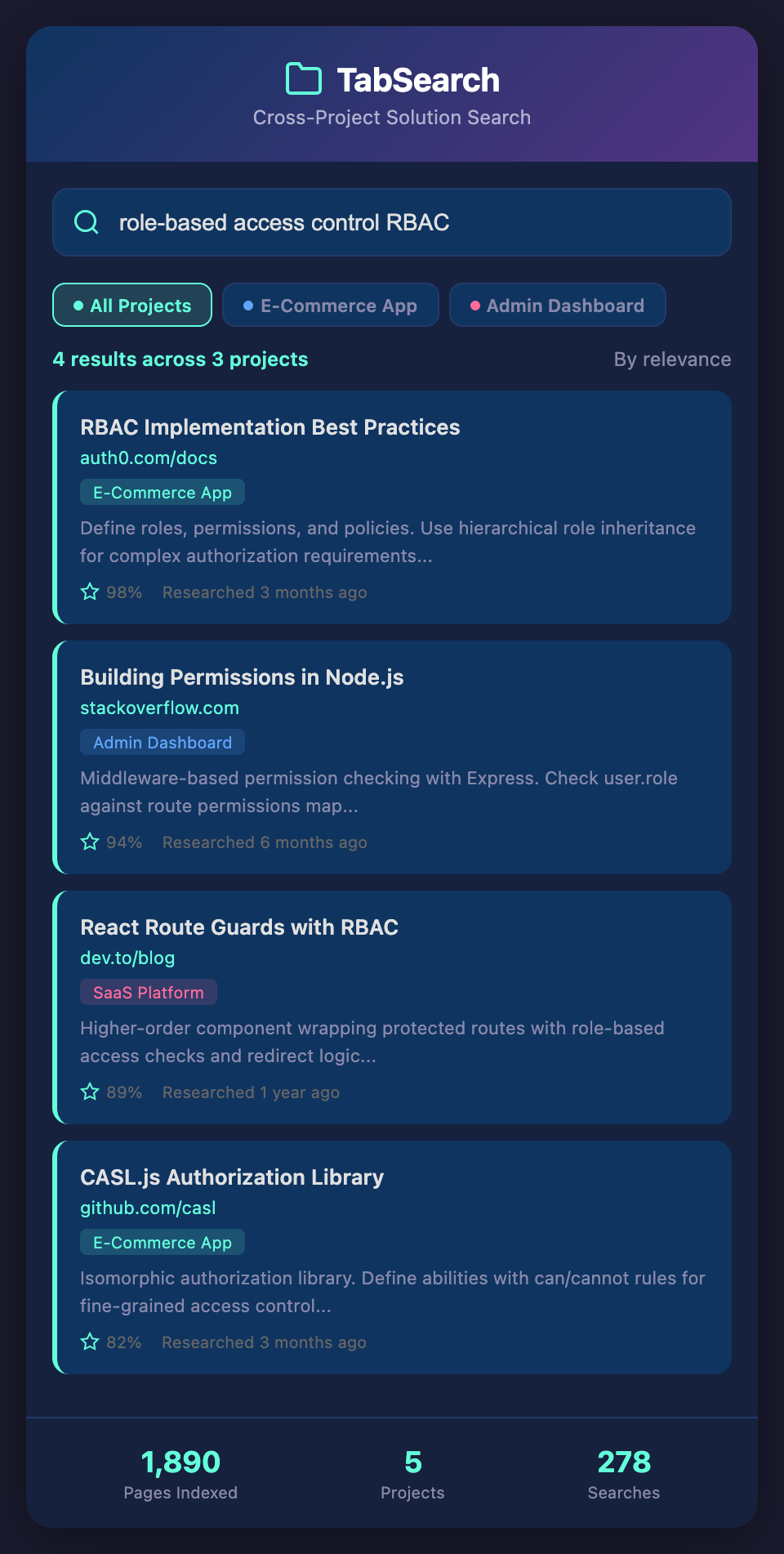
Imagine being able to search your professional experience. You're building a user permissions system. You search "role-based access control RBAC implementation", and immediately see:
-
The blog posts you read about RBAC when building it for Project A
-
The Stack Overflow answers about permission edge cases you bookmarked
-
The documentation pages you referenced when implementing for Project B
-
Possibly, links to the actual implementation in old repositories
You can quickly review what you learned before, reference your decision-making process, and either reuse your previous implementation or make informed modifications.
This is categorically different from solving the problem fresh. You're not re-researching. You're leveraging research you've already done.
Real Cross-Project Scenarios
Scenario 1: Authentication System Improvements
You've built authentication in three projects using two different stacks. Each time you went through similar research: learning about session management, understanding token expiration, reading about OAuth vs custom auth. Each time you made slightly different decisions based on the project's specific constraints.
Now you're building authentication for a fourth project. Instead of starting from scratch, you search "session token expiration security best practices", and your system shows you the documentation, blog posts, and Stack Overflow discussions you read before. You quickly remember your previous tradeoff analysis and apply the best approach from past projects.
Scenario 2: Data Export Architecture
Exporting data from an application—CSV, JSON, large dataset handling—appears in many projects. You've researched stream-based processing, pagination approaches, error handling during exports, and user experience for large exports multiple times.
When you need to build this feature again, you search "streaming JSON export large datasets", and you see every relevant resource from your previous research. The blog post comparing approaches. The GitHub issue discussing performance. The documentation on stream error handling. You leverage your previous learning instead of repeating it.
Scenario 3: Performance Optimization Patterns
You've optimized database queries, reduced API calls, implemented caching, and profiled CPU usage across different projects and languages. You've learned patterns that transfer across contexts: caching strategies, batch processing, lazy loading patterns.
When you encounter a new performance problem, you search "database query optimization N+1 problem pagination", and you find every resource discussing this problem from across your professional research history. You apply proven patterns rather than experimenting again.
Building a Searchable Professional Knowledge System
The mechanism is straightforward: As you research solutions for projects, everything you read gets indexed. Your documentation, your Stack Overflow answers, your blog posts, your GitHub explorations—all of it builds a searchable archive of your professional experience.
This archive becomes increasingly valuable as it grows. After six months of development, it contains hundreds of resources. After two years, it contains thousands of solutions to problems you've faced.
Most importantly, it's organized by what you actually research, not by what you remember to save. Your archive is comprehensive and implicitly organized by context—the browser tabs you had open during a project, your search patterns, the tools you were building with.
The Compounding Advantage
Leverage from past solutions compounds dramatically:
-
First project: You research thoroughly, solve the problem well.
-
Second project: You research somewhat, but you reference your first project too. Time spent is 60% of the first project.
-
Third project: You reference both previous projects. Time spent is 40% of the first project.
-
Fourth project: You're drawing from three previous implementations. Time spent is 30% of the first project.
This efficiency isn't hypothetical. Developers who effectively reuse solutions across projects complete features 3-5 times faster than developers building from scratch each time.
Beyond speed, code quality improves. Your fourth implementation of a feature incorporates lessons from three previous attempts. Your architecture decisions are more informed. Your error handling is more comprehensive.
Stop Reinventing; Start Leveraging
Every problem you solve teaches you something. Every solution you build is part of your professional knowledge. The question is: are you leveraging that knowledge or losing it?
Join our waitlist to get searchable access to your solutions across all projects. Build on what you've done. Reference past approaches. Complete features faster with confidence that you're applying proven patterns.