Documenting Your Actual Play Campaign World for Your Audience
Why World Documentation Matters
Your show reveals its world incrementally — a detail here, a location there, a piece of history mentioned in passing. Listeners absorb these details while also tracking plot, characters, and relationships. Inevitably, they miss things. They forget things. They want to look things up.
World documentation serves three audiences simultaneously:
New listeners who need orientation. A world guide helps them understand the setting without relying entirely on context clues from episodes.
Current listeners who want reference material. When a location is mentioned that first appeared twenty episodes ago, they want to look it up rather than re-listen to an old episode.
Lore enthusiasts who want to go deeper. These are your most engaged fans — the ones who read every piece of supplementary content, build theories, and evangelize your show to others.
What to Document
Not everything in your world needs documentation. Focus on what serves the audience:
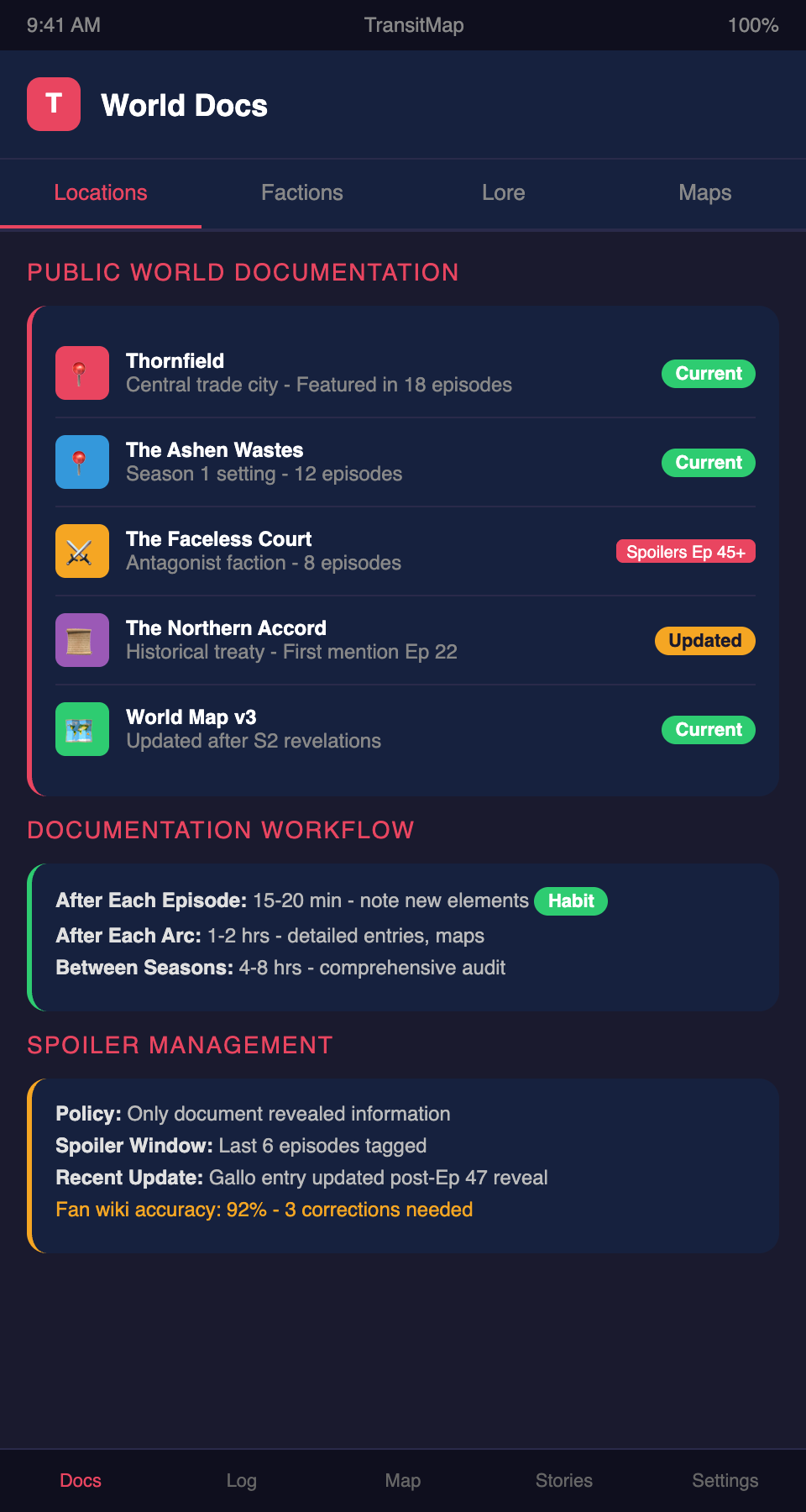
Locations that appear in the show. For each significant location, provide a description, its role in the story, and which episodes feature it. Do not document locations that have not appeared or been mentioned on air — this avoids spoiling future content.
Factions and organizations. Their goals, leadership, relationship to the party, and current status in the story. Update these as the show reveals new information about each faction.
Key NPCs. Public-facing NPC profiles that include what has been revealed on air — no behind-the-scenes secrets. Include their role, personality, and episode appearances.
World history and lore. Background information that has been mentioned or implied on the show. A timeline of major historical events. Cultural details that help the audience understand the world's context.
Terminology and language. If your world uses invented terms, organizations names, or cultural concepts, define them. An audience that does not understand the vocabulary cannot follow the story.
Maps. Visual representations of the world, regions, cities, or dungeons that have appeared in the show. Maps are consistently the most popular piece of supplementary content for fantasy and science fiction shows.
Documentation Formats
Choose formats that match your production capacity:
Wiki-style website. The most comprehensive option. Tools like Notion, World Anvil, or a self-hosted wiki allow structured, searchable, interlinked world documentation. Best for shows with large, complex worlds and dedicated audiences.
Blog posts or articles. Individual lore articles published alongside episodes or between seasons. Lower production overhead than a full wiki. Works well for shows that reveal lore gradually.
Social media posts. Brief lore drops shared on social platforms. A map, a character portrait, a historical tidbit. These serve double duty as marketing content and world documentation.
PDF guides. Downloadable world guides released at season boundaries. These can be offered as Patreon rewards or free downloads. Good for shows with stable world elements that do not change frequently.
In-show recaps. Brief world-building segments within episodes that orient the audience. "Previously on" segments, narrator introductions, or character journal entries that provide context.
The Spoiler Management Challenge
World documentation for an ongoing show has a unique challenge: you cannot document what has not been revealed yet:
Only document revealed information. Every piece of world documentation should be sourced to a specific episode or public statement. If it has not been said on air, it does not go in the documentation.
Spoiler-tag recent revelations. Information from recent episodes should be spoiler-tagged for listeners who are behind. Define "recent" based on your audience — typically the last four to eight episodes.
Update documentation after major revelations. When a major plot twist recontextualizes world information, update the documentation to reflect the new understanding. Note when information was updated so returning readers understand what changed.
Separate canon from speculation. If your community theorizes about unrevealed world details, keep community speculation clearly separated from official documentation.
Production Workflow
Integrate documentation into your regular production workflow:
After each episode:
- Note any new locations, NPCs, factions, or lore revealed
- Add brief entries for new elements
- Update existing entries affected by the episode's events
- Time investment: fifteen to twenty minutes per episode
After each arc:
- Review all documentation for the arc's content
- Write or update detailed entries for major arc elements
- Create any new maps or visual content needed
- Time investment: one to two hours per arc
Between seasons:
- Comprehensive documentation audit
- Update all entries to reflect current story state
- Create season summary documents
- Publish any major new documentation (world guides, maps, timelines)
- Time investment: four to eight hours per season
Community-Driven Documentation
Your audience can be your documentation team:
Fan wikis. Encourage community members to build and maintain documentation. Provide editorial oversight to ensure accuracy but let the community do the heavy lifting.
Documentation bounties. Offer small rewards (shout-outs, bonus content access) for community members who create quality documentation.
Official endorsement. When community documentation reaches high quality, endorse it officially. Link to it from your show's website and social media.
Accuracy review. Regardless of who creates the documentation, review it for accuracy. Fan-created content sometimes includes assumptions or theories presented as fact.
Documentation as Content
Well-produced world documentation is content in its own right:
Lore episodes. Dedicated episodes exploring world history, culture, or geography. These can be produced between seasons as bonus content.
Interactive content. Quizzes, polls, or interactive maps that engage the audience with the world between episodes.
Cross-promotional material. World documentation shared on other shows' feeds or communities introduces your world to potential new listeners.
Documenting your show's campaign world? Join the TransitMap waitlist — build your world documentation directly from your narrative map, with locations, factions, NPCs, and lore all connected to the episodes where they appear.