NPC Continuity Tracking for Your Actual Play Show
The NPC Memory Problem
In a home game, NPC inconsistencies are minor hiccups. A shopkeeper's name changes between sessions and everyone laughs it off. In an actual play show, that same inconsistency becomes a permanent error in a published recording. Listeners will notice. They will comment. And repeated inconsistencies erode the audience's trust in the show's world.
The challenge scales with your show's length. By Episode 50, you may have introduced over a hundred named NPCs. Each has a voice, a personality, relationships with the party, knowledge of events, and a current status. Tracking all of this from memory is impossible.
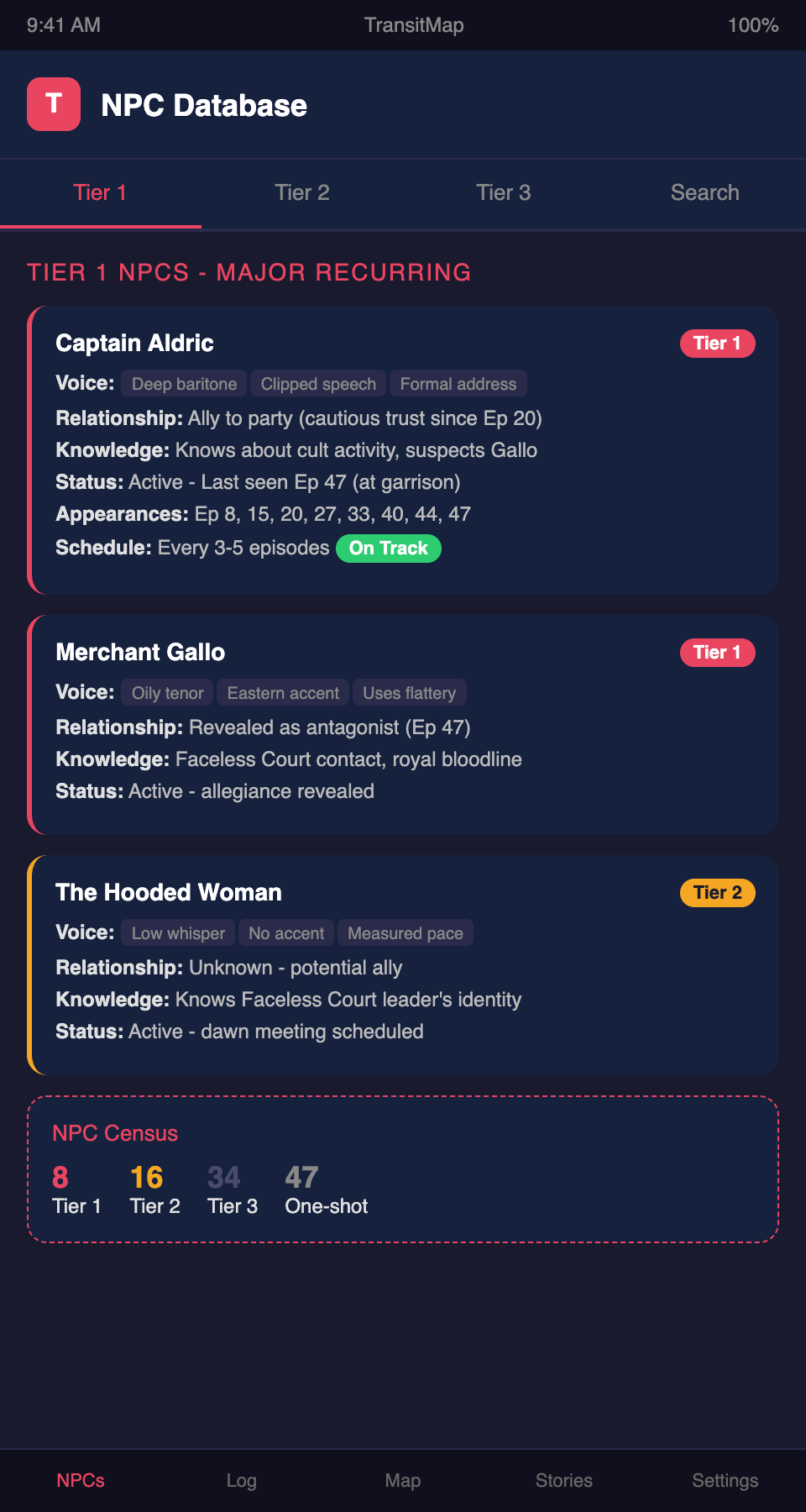
What to Track for Each NPC
Build an NPC entry for every named character who appears on the show:
Identity basics:
- Full name and any aliases
- Voice notes (accent, pitch, speech patterns, verbal tics)
- Physical description as given on air
- Role in the world (occupation, faction, social position)
Relationship map:
- Relationship to each PC (ally, enemy, neutral, unknown)
- Relationship to other NPCs
- How the relationship has changed over time
Knowledge state:
- What this NPC knows about the main plot
- What this NPC knows about each PC
- What secrets this NPC holds
- What the NPC has been told by PCs (which may include lies)
Appearance log:
- Every episode in which this NPC appeared
- Key interactions and outcomes
- Promises made (by the NPC or to the NPC)
- Last known location and status
Voice Consistency
Voice is the most immediately noticeable continuity element for NPCs in audio:
Record voice notes immediately. After introducing a new NPC, write down the voice choices: "Gravelly baritone, slight Eastern European accent, speaks slowly, uses formal address." Do this before the session ends, while the voice is fresh.
Create voice reference clips. If possible, save a short audio clip of the NPC's first appearance. When you need to reprise the character, listen to the clip before recording.
Group similar NPCs by voice type. If you have limited vocal range, track which voice type each NPC uses. This prevents accidentally giving two important NPCs the same voice.
Evolve voices deliberately. An NPC's voice might change over the course of the show — they age, they suffer trauma, they gain confidence. Track these changes so they happen consistently rather than accidentally.
Relationship Tracking
NPCs do not exist in isolation. They have relationships with PCs that evolve through play:
Track relationship direction. An NPC might consider a PC a close ally while the PC views the NPC with suspicion. Track both sides of every significant relationship.
Note relationship-changing moments. When an interaction significantly shifts an NPC's relationship with a PC, log it with the episode number. These moments are the foundation for future scenes.
Track NPC-to-NPC relationships. When two NPCs have a relationship that matters to the story, track it. The audience will notice if the rival merchants are suddenly friendly without explanation.
Update after every session. NPC relationships change through play. Update your tracker after every recording session, while the interactions are fresh.
The Recurring NPC Schedule
Not every NPC needs to appear regularly, but important NPCs should not disappear for dozens of episodes:
Tier 1 NPCs (major recurring): Appear every three to five episodes. These are the quest givers, allies, antagonists, and mentors who drive the story.
Tier 2 NPCs (supporting): Appear every eight to twelve episodes. These are faction leaders, important contacts, and characters with ongoing storylines.
Tier 3 NPCs (minor recurring): Appear when the story returns to their location or context. These are shopkeepers, guards, and local figures who provide world texture.
Tier 4 NPCs (one-shot): Appeared once and may never return. Track them anyway — the audience remembers them, and bringing back a minor NPC from thirty episodes ago creates a satisfying callback.
Continuity Error Prevention
Common NPC continuity errors and how to prevent them:
Name drift. "Aldric" becomes "Aldrin" becomes "Aldric" again. Prevention: Keep a master name list that you reference before every session.
Status errors. Referencing an NPC who was killed or imprisoned. Prevention: Update NPC status immediately when it changes.
Knowledge leaks. An NPC knows something they should not know based on the events of the show. Prevention: Track each NPC's knowledge state and review it before scenes involving that NPC.
Personality shifts. A cautious NPC suddenly acts recklessly without narrative justification. Prevention: Include personality notes in your NPC entries and review them before reprisal scenes.
Timeline errors. An NPC references events in the wrong order or claims to have been somewhere when the show established they were elsewhere. Prevention: Log every NPC appearance with episode number and context.
Handling NPC Continuity Mistakes On Air
Despite your best tracking, mistakes will happen during live recording:
If you catch it immediately: Correct it in character. "Wait — that is not right. I misspoke. Let me try that again." A quick correction is better than a persistent error.
If a player catches it: Thank them and correct it. Your players are your first line of continuity defense.
If you catch it in post-production: Add a brief editor's note if the error is significant, or let minor errors pass. Not every mistake needs correction.
If the audience catches it: Acknowledge it gracefully. A brief social media post or start-of-episode correction shows the audience you care about consistency without derailing the show.
Building an NPC Database
For long-running shows, a simple document is not sufficient. Build a searchable NPC database:
Organize by faction or location for quick access during sessions when the party visits a specific area.
Tag NPCs by storyline so you can quickly review all NPCs relevant to a particular plot thread.
Include cross-references between related NPCs so you can maintain consistency in NPC relationships.
Archive retired NPCs rather than deleting them. A dead NPC might be referenced, appear in flashbacks, or be connected to future characters.
Tracking dozens of NPCs across your actual play show? Join the TransitMap waitlist — map every NPC as a stop on your narrative transit map, with voice notes, relationship connections, appearance history, and knowledge states all tracked visually.