Maintaining Narrative Momentum in Your Actual Play Podcast
What Momentum Sounds Like
Narrative momentum in an actual play podcast is not constant action. It is the persistent feeling that the story is moving forward, that things are happening, that the next episode will advance the situation in a meaningful way.
An episode with momentum leaves the audience wanting more. An episode without momentum leaves the audience wondering if they need to keep listening. The difference is rarely about content intensity — a quiet character conversation can have tremendous momentum if it changes something. A dramatic combat encounter can have zero momentum if it does not advance the story.
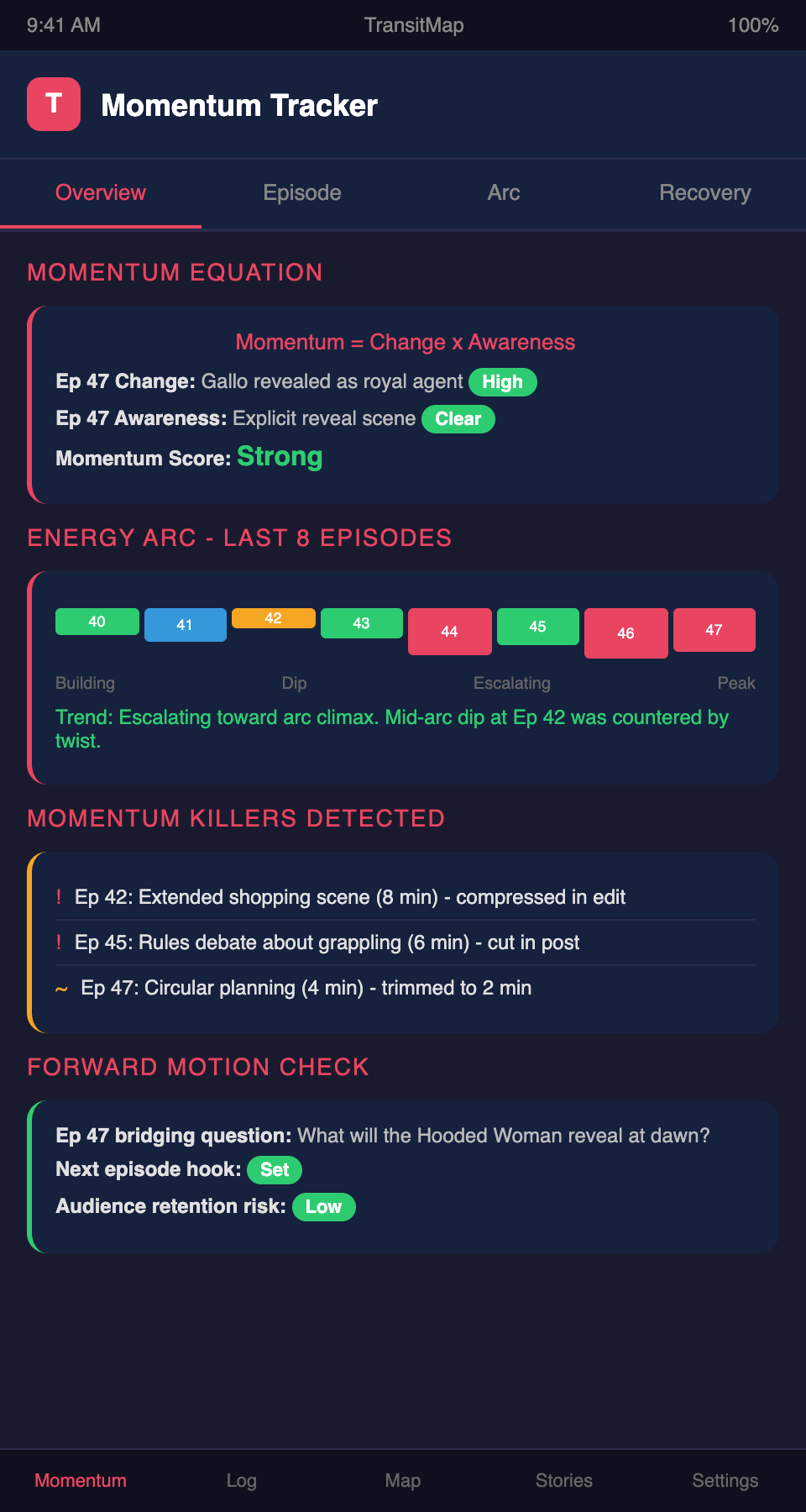
The Momentum Equation
Momentum = Change per episode × Audience awareness of that change
Both components matter. If things change but the audience does not realize it, the episode feels stagnant. If the audience is told things changed but nothing actually shifts, the episode feels hollow.
Change per episode means that by the end of every episode, at least one of these should be different from the beginning:
- The characters' situation (new information, new location, new ally or enemy)
- A character's internal state (a decision made, a belief challenged, a relationship shifted)
- The audience's understanding (a revelation, a recontextualization, a new question)
Audience awareness means the change is communicated clearly enough that listeners recognize it happened. Subtle changes need to be surfaced through character dialogue, narration, or reaction.
Momentum Killers
Identify and eliminate the common momentum killers in actual play:
Extended shopping and logistics. Characters spending thirty minutes buying equipment and planning travel routes. These scenes feel productive at the table but are dead air for the audience. Compress logistics to brief narration: "You spend the morning outfitting yourselves for the journey north."
Rules debates. Mechanical discussions about how a spell works, whether an ability applies, or what the rules say about a specific situation. Resolve these quickly or table them for after the session. In post-production, edit them down or remove them entirely.
Circular planning. The party discusses a plan, then discusses the plan again, then modifies the plan, then reconsiders the original plan. Set a planning time limit: "You have five minutes of in-character planning before the situation forces a decision."
Recap overload. Spending the first fifteen minutes of every episode recapping what happened last time. Keep recaps to two to three minutes. If your audience needs more context, provide written summaries separately.
Combat without stakes. A random encounter that the party will obviously survive, fought to completion with full mechanical detail. If the outcome is not in doubt and the combat does not advance the story, narrate through it quickly.
Aimless exploration. Characters wandering through a location without a clear objective. Exploration is compelling when the characters are searching for something specific. It stalls momentum when it is undirected.
Building Momentum Between Episodes
The gap between episodes is where momentum is most vulnerable. Listeners have a week (or more) to lose interest:
End every episode with forward motion. The last five minutes should point toward the next episode. A cliffhanger is ideal, but even a clear next objective works: "The informant says she will meet you at the docks at midnight."
Start every episode with energy. The first five minutes should grab attention immediately. Resolve the cliffhanger. Introduce a new situation. Drop a piece of information. Do not start with administrative discussion or extended recap.
Create episode-bridging questions. Plant a question at the end of an episode that can only be answered in the next one. This gives the audience a specific reason to return.
Use social media between episodes. Post content that maintains engagement during the gap — character art, in-world documents, behind-the-scenes discussion. Keep the show present in your audience's mind.
Pacing Across Arcs
Momentum operates at the arc level as well as the episode level:
Escalation within arcs. Each episode in an arc should escalate the situation. The stakes should be higher in Episode 4 of the arc than in Episode 1. If the tension plateaus, inject a complication.
The mid-arc energy dip. Most arcs experience a natural energy dip around Episodes 3-4, after the initial excitement has faded but before the climax builds. Prepare a mid-arc twist or revelation to counteract this dip.
Arc transitions. The episodes between arcs are momentum danger zones. The previous arc's energy has dissipated and the next arc has not yet generated its own. Use transition episodes to:
- Resolve the previous arc's emotional consequences
- Seed the next arc with intriguing hooks
- Feature character development that has been deferred during high-plot episodes
The Momentum Tracker
Track momentum indicators across your episodes:
For each episode, note:
- What changed? (situation, character, understanding)
- What question carries into the next episode?
- What was the episode's energy arc? (building, sustained, declining)
- Were there any momentum-killing segments? (for future avoidance)
For each arc, note:
- Is tension escalating episode over episode?
- When is the mid-arc dip expected?
- What twist or revelation will counteract the dip?
Recovery From Momentum Loss
If you have lost momentum — the audience is disengaging, the story feels stalled — you can recover:
Inject urgency. Introduce a time pressure that forces action. A deadline. A threat. A countdown. Urgency is the fastest momentum generator.
Skip ahead. If the current situation is bogged down, narrate through it: "After three days of travel, you arrive at the city gates." Do not make the audience sit through low-momentum content just because it happened in the game.
Reveal information. Drop a significant revelation that recontextualizes the situation. New information is inherently momentum-generating because it demands response.
Change the scene. If a scene is stalling, end it. Cut to a different location, a different set of characters, or a different situation. Film and television do this constantly — actual play can too.
Tracking narrative momentum across your show? Join the TransitMap waitlist — visualize your story's forward motion as a transit line with clear stops, momentum indicators, and energy tracking across episodes and arcs.