Session Planning for Actual Play Podcasts: Prep That Serves the Show
The Dual-Purpose Prep
When you prep a session for a home game, you are preparing content for four to six people who are in the room with you. When you prep for an actual play podcast, you are preparing content for those same players AND for an audience of hundreds or thousands who will experience the session differently.
This dual purpose changes your prep priorities:
Home game prep priorities:
- Is the session fun for my players?
- Does it advance the campaign?
- Is it mechanically sound?
Actual play prep priorities:
- Is the session fun for my players?
- Does it advance the campaign?
- Will it make a compelling episode?
- Does it serve the show's narrative structure?
- Will it maintain audience engagement?
Notice that the first two priorities are identical. Player enjoyment always comes first. But the additional priorities for a show require additional prep consideration.
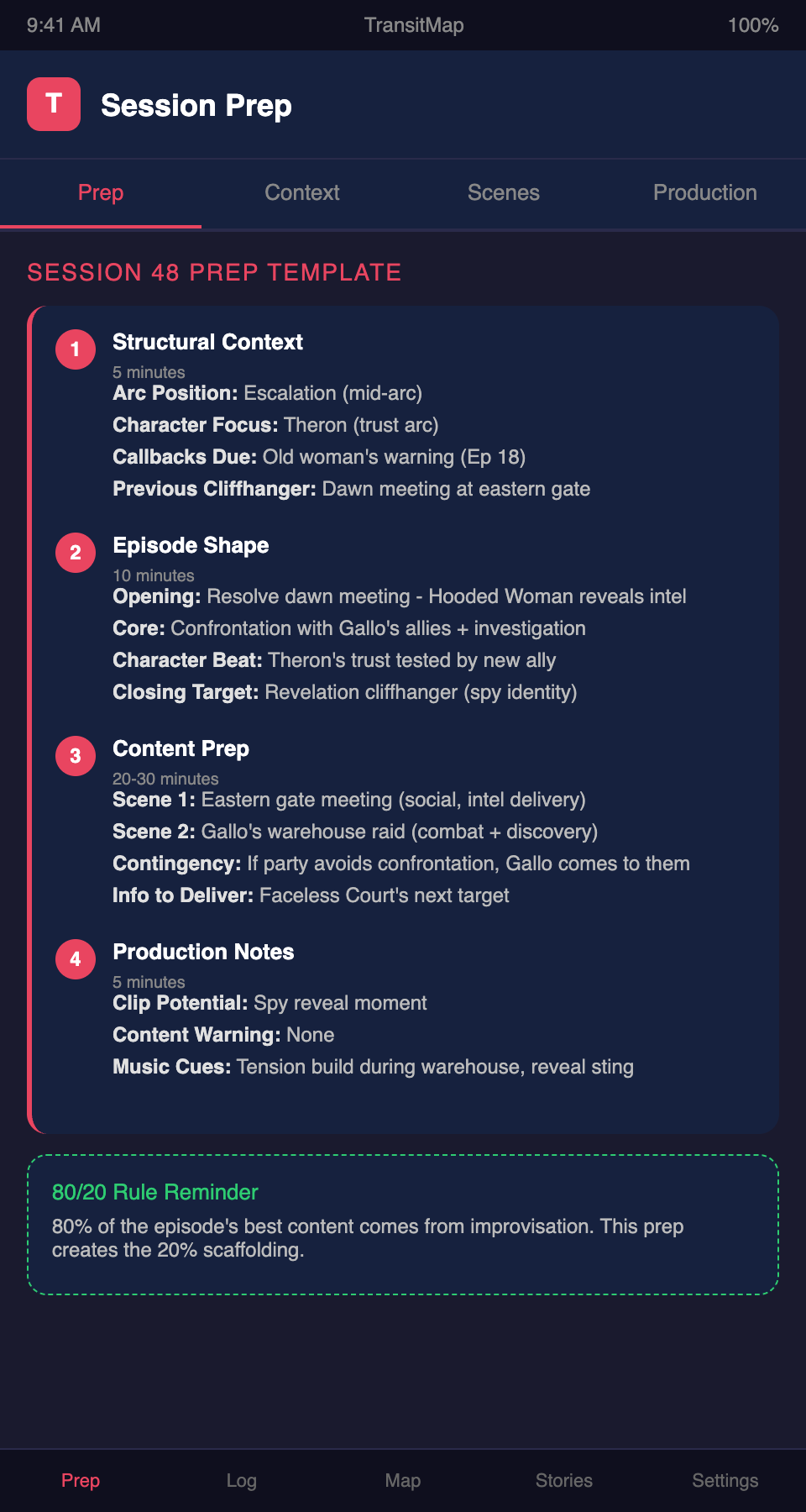
The Actual Play Session Prep Framework
Step 1: Structural Context (5 minutes)
Before prepping content, orient yourself within the show's structure:
- Where are we in the current arc? (Beginning, middle, approaching climax?)
- What is this session's role within the arc? (Setup, development, climax, transition?)
- Which character arcs should receive attention this session?
- Are any callbacks or payoffs scheduled for this session?
- What was the last episode's cliffhanger or hook?
This context shapes every other prep decision.
Step 2: The Session's Episode Shape (10 minutes)
Design the session with episode structure in mind:
- Opening moment — What grabs attention in the first five minutes? This might be resolving the previous cliffhanger, introducing a new situation, or dropping a piece of information.
- Core content — What is the main substance of this session? One to two major scenes or encounters.
- Character beat — Which character gets a personal moment this session?
- Closing moment — What is the potential cliffhanger or hook for the end?
You cannot control exactly how the session will unfold (players will improvise), but having this shape in mind helps you pace the session toward a strong ending.
Step 3: Content Prep (20-30 minutes)
Prepare the actual content — encounters, NPCs, locations, information:
- Scenes — Prepare two to three scenes with clear situations, NPCs, and decision points
- NPC prep — For any NPC who will appear, review their series bible entry and note their current state, motivation, and what they know
- Information to deliver — What does the audience need to learn this session? Which clues, revelations, or world details should be communicated?
- Contingency — One alternative scene or encounter in case the players go in an unexpected direction
Step 4: Production Notes (5 minutes)
Prep notes specific to the show's production:
- Potential clip moments — Scenes that might produce shareable social media clips
- Recap needs — What should be recapped at the start based on the previous episode's content?
- Guest considerations — If a guest player is joining, what integration scenes are needed?
- Content warnings — Does any planned content warrant a listener content warning?
- Music and sound cues — If you use music or sound effects, note where they would enhance the episode
Pacing for Audio
Certain pacing adjustments specifically serve the audio audience:
Narrate visually. In a home game, you can gesture at a map or reference a miniature. On a podcast, everything must be described in words. Prep more descriptive language for key locations and moments.
Name characters clearly. In person, you can indicate which NPC is speaking through posture and gesture. On audio, you need vocal differentiation and clear attribution. Prep distinct voice notes for each NPC who will appear.
Manage crosstalk. In a home game, everyone talking at once is chaotic but manageable. On a recording, it is unintelligible. During recording, gently moderate turn-taking during high-energy moments.
Pace for editing. Leave natural pauses between scenes that serve as edit points. These pauses feel normal at the table but give your editor clean transition points in post-production.
The 80/20 Prep Rule
For actual play podcasts, the 80/20 rule applies: 80% of the episode's best content will come from improvisation and player interaction, not from your prep. Your prep's job is to create the 20% of scaffolding that enables the 80% of spontaneous content.
Do not over-prep. An over-prepped session feels rigid and performative. Your audience listens to actual play for the authentic table experience. Your prep should enable that authenticity, not replace it.
Prep Templates
Create a reusable session prep template:
SESSION [NUMBER] PREP

STRUCTURAL CONTEXT:
- Arc position: [beginning/middle/climax/transition]
- Character focus: [character name]
- Callbacks/payoffs: [list]
- Previous cliffhanger: [summary]

EPISODE SHAPE:
- Opening: [description]
- Core: [scene 1], [scene 2]
- Character beat: [description]
- Closing target: [cliffhanger type]

CONTENT:
- Scene 1: [situation, NPCs, decision point]
- Scene 2: [situation, NPCs, decision point]
- Contingency: [alternative scene]
- Information to deliver: [list]

PRODUCTION:
- Clip potential: [description]
- Content warnings: [if any]
- Music cues: [if any]
This template takes thirty to forty-five minutes to complete and provides everything you need for a well-structured recording session.
Want a session prep system designed for actual play production? Join the TransitMap waitlist — prep each session within the context of your show's visual narrative map, with structural position, character focus, and production notes all integrated.