Maintaining Worldbuilding Consistency in Your Actual Play Podcast
The Worldbuilding Consistency Tax
Every actual play show builds its world in real time. The GM improvises a detail — the name of a tavern, the color of a deity's symbol, the distance between two cities — and that detail is instantly canonical. It is recorded, published, and memorized by an audience that will remember it long after the GM has forgotten it.
This is the worldbuilding consistency tax: every improvised detail adds to a growing body of canonical facts that must be maintained indefinitely. In a home game, this tax is manageable because the audience is small and forgiving. In a published show, the tax is relentless because the audience is large, attentive, and has access to every previous episode.
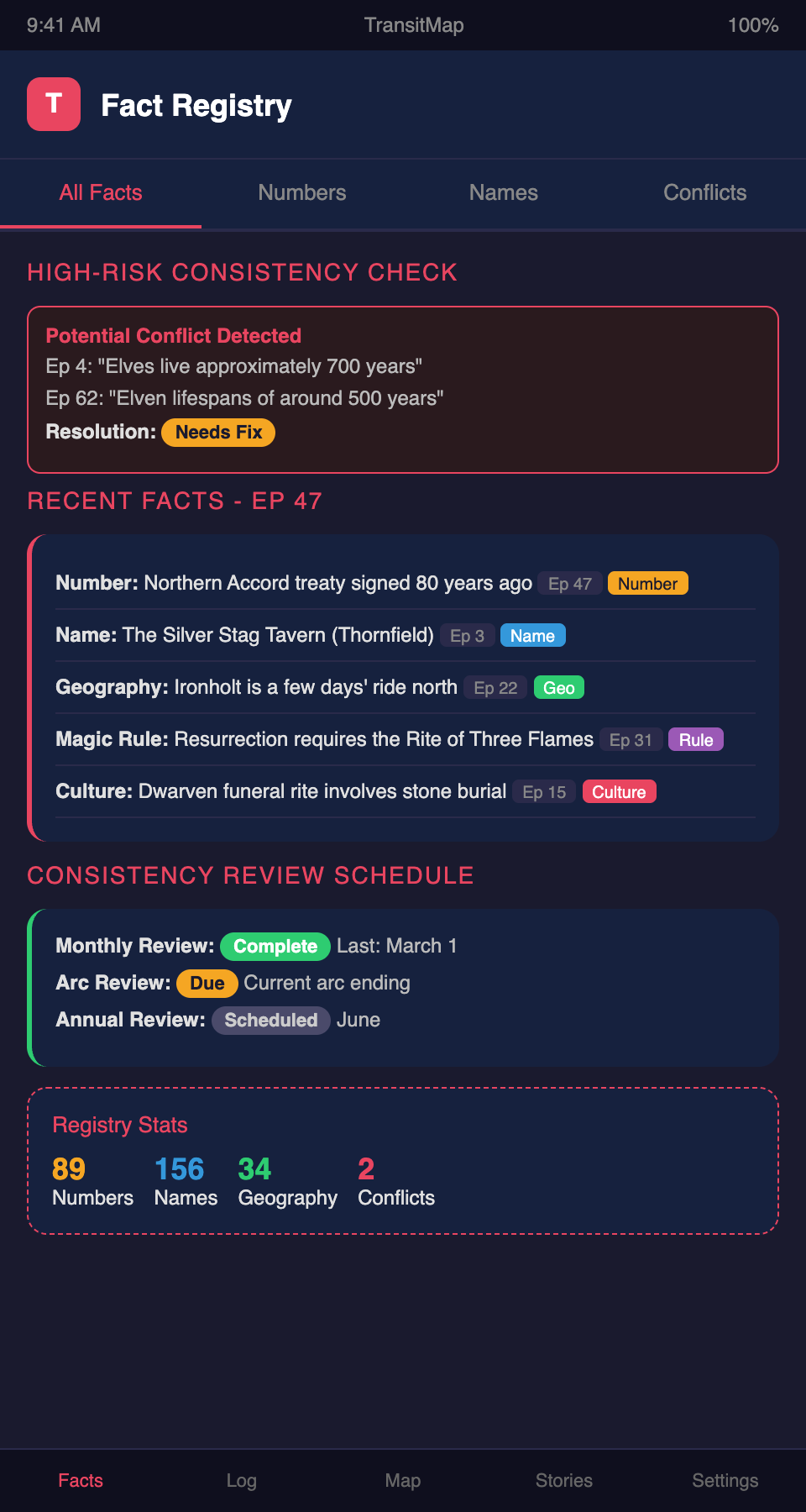
The High-Risk Consistency Categories
Certain categories of worldbuilding are most prone to consistency errors:
Numbers. Populations, distances, dates, prices, ages, durations. Numbers are improvised quickly, forgotten immediately, and contradicted easily. "The capital is about two days' ride" becomes "we rode for a week to reach the capital" three episodes later.
Names. Character names, place names, organization names. The tavern was "The Silver Stag" but somehow became "The Golden Stag." The NPC's last name changes from Alderton to Alderman.
Geography. Spatial relationships between locations. City A is north of City B, except in Episode 34 when someone mentioned it is to the east. Travel times between locations shift based on narrative convenience.
Rules of magic. How spells work, what is possible and impossible, the limitations of magical systems. "Magic cannot raise the dead" except when an NPC does exactly that twelve episodes later.
Cultural details. Customs, religions, social structures, languages. The dwarven funeral rite described in Episode 15 is completely different from the one in Episode 45.
Prevention: The Real-Time Documentation Habit
The single most effective prevention strategy is documenting every improvised detail immediately after the recording session. Not the next day. Not the next week. Immediately after, while the details are fresh.
Use the post-session documentation ritual:
- Listen for numbers. Did you state any specific numbers? Record them exactly.
- Capture new names. Any new character, place, or organization name. Include pronunciation.
- Note geographic relationships. Any statement about where things are relative to each other. Distances. Directions. Travel times.
- Record rule declarations. Any statement about how the world works — magical rules, social customs, natural laws.
- Flag uncertain details. Any detail you improvised that you are not confident about. These are your highest-risk items for future contradictions.
This documentation feeds directly into your series bible and fact registry.
The Hedging Technique
When you are unsure about a detail during recording, hedge rather than commit:
Instead of: "The temple was built 300 years ago." Say: "The temple has stood for centuries — the exact date is debated by scholars."
Instead of: "The capital has about 50,000 people." Say: "The capital is one of the largest cities in the region."
Instead of: "It takes three days to reach Ironholt." Say: "Ironholt is a few days' ride to the north."
Hedging gives you flexibility without sacrificing narrative quality. Your audience will not notice the vagueness, but they will notice if you contradict a specific number later.
The Consistency Review Cycle
Beyond per-session documentation, establish periodic consistency reviews:
Monthly review (30 minutes). Scan your fact registry for potential conflicts. Check recent episodes against established facts. Flag any inconsistencies for resolution.
Arc review (1 hour). At the conclusion of each story arc, review all worldbuilding details established during the arc. Verify consistency with previously established facts. Add new facts to the series bible.
Annual review (2-3 hours). For long-running shows, review the entire fact registry annually. Check for drift, contradictions, and gaps. Update the series bible. This is also a good time to review audience feedback for consistency complaints you may have missed.
Handling Worldbuilding Contradictions
When a contradiction is discovered:
Before publication (during editing). If you catch it during editing, fix it:
- Edit the audio to remove or replace the contradicting detail
- Add a brief correction in post if the edit is not clean
- Note the correction in your fact registry
After publication (audience noticed). Address it directly:
- Acknowledge the error in show notes or social media
- Establish which version is canonical going forward
- If possible, provide an in-narrative explanation in a future episode
After publication (audience did not notice). Quietly correct your records and use the correct version going forward. Do not draw attention to an error nobody caught.
Leveraging Audience Knowledge
Your audience is a worldbuilding consistency resource:
- Fan wikis capture details you may have missed in your own documentation
- Audience questions reveal which worldbuilding elements your listeners are tracking closely
- Theory discussions sometimes surface inconsistencies that your audience has noticed but not formally reported
- Dedicated fans who volunteer as "lore keepers" can be valuable consistency partners — share your fact registry format and let them help maintain it
Accept audience corrections graciously. A listener who catches an inconsistency is an engaged listener — and engaged listeners are your show's most valuable asset.
Want to keep your actual play world consistent across hundreds of episodes? Join the TransitMap waitlist — track every world fact, rule, and geographic relationship on a visual map that grows with your show and flags potential contradictions before they reach the air.