Planning Seasonal Finales for Your Actual Play Show
The Weight of the Finale
A seasonal finale carries narrative obligations that no other episode does. It must resolve the season's central conflict. It must deliver emotional payoff for character arcs that have been building for months. It must satisfy the audience's investment while leaving them eager for the next season. And it must accomplish all of this through improvised gameplay at the table.
This is the hardest episode to produce well — and the most important to get right.
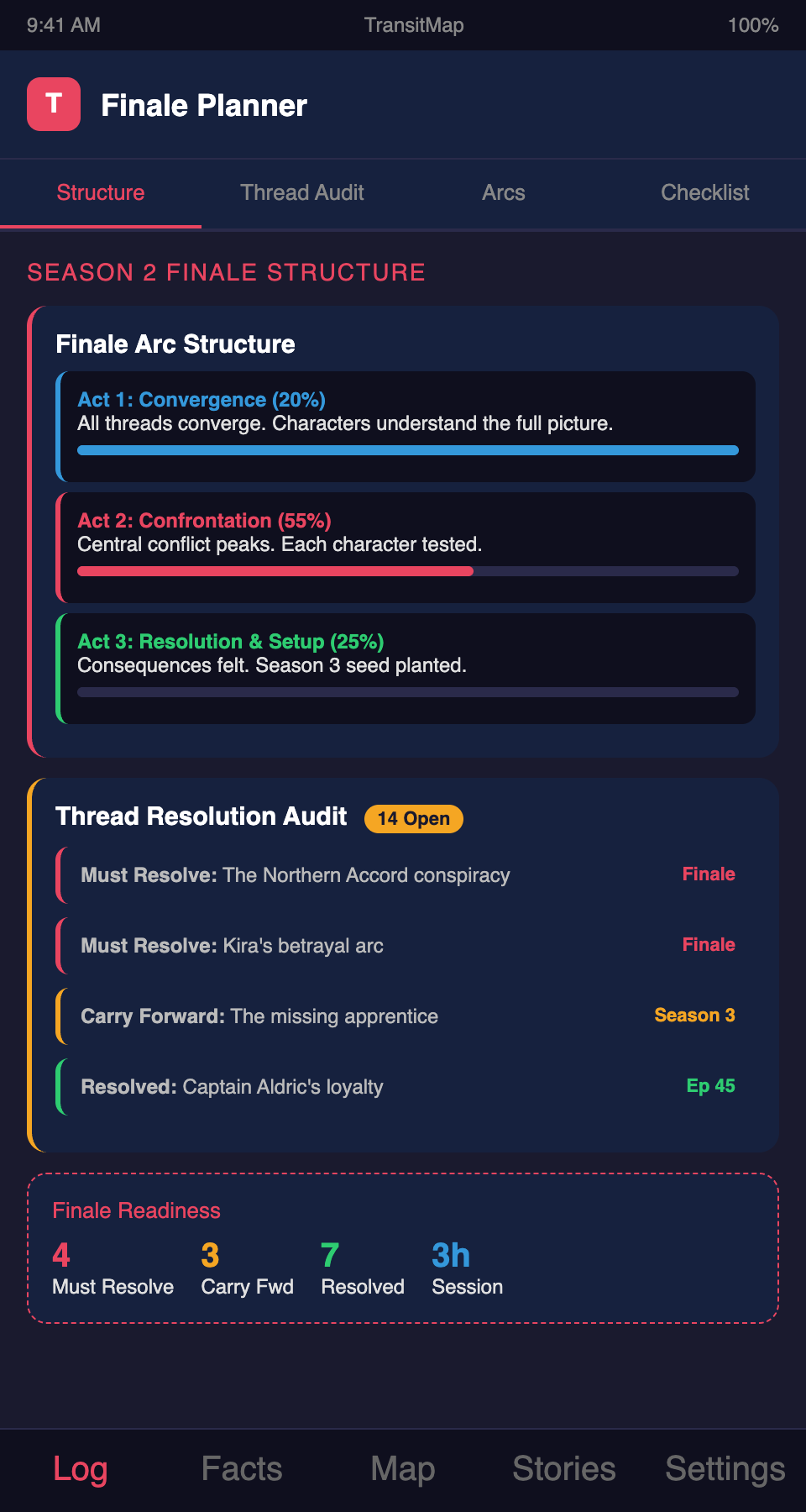
Finale Structure
Plan your finale with a deliberate structure that accommodates both the narrative requirements and the improvisational reality:
Act 1: Convergence (first 20-25%)
All the season's threads converge. The characters understand what they must do. The stakes are clear. The audience sees the full picture for the first time.
This act should:
- Resolve any remaining information gaps so characters can act with full knowledge
- Establish the specific objective for the finale's central conflict
- Create a sense of inevitability — this confrontation has been building all season
Act 2: The Confrontation (middle 50-60%)
The central conflict plays out. This might be a climactic battle, a critical negotiation, a desperate heist, or a final investigation. Whatever form it takes, this act is where the season's tension peaks.
This act should:
- Test each character in a way that relates to their season-long arc
- Include genuine uncertainty about the outcome
- Feature the season's most dramatic moments
- Allow each player a significant contribution
Act 3: Resolution and Setup (final 20-25%)
The aftermath. The conflict is resolved. The consequences are felt. Characters react to what has changed. And somewhere in the resolution, a seed is planted for the next season.
This act should:
- Show the immediate consequences of the confrontation's outcome
- Give each character a moment to reflect on their season-long journey
- Provide emotional closure for the season's themes
- Include one element that points toward the future
Preparing Your Players
Your players need to know a finale is coming without knowing its specific content:
Signal the approach. Two to three sessions before the finale, let your players know: "We are heading toward the season finale in the next few sessions." This gives them time to think about their character's emotional state and any personal arc moments they want to pursue.
Solicit character intentions. Ask each player: "What does your character most want to accomplish before the end of the season?" This helps you design finale content that serves each character's arc.
Discuss tone. Talk about the emotional tenor of the finale. Is this going to be triumphant? Bittersweet? Tragic? Players who understand the tone can lean into it at the table.
Manage expectations about stakes. If character death is possible in the finale, discuss this in advance. Players should consent to the possibility of losing their character, not be blindsided by it.
Thread Resolution Planning
Before the finale, audit your open threads:
Must resolve in the finale:
- The season's central conflict
- Each primary character arc's current phase
- The season antagonist's storyline
- Any thread that has been explicitly promised a resolution
Should resolve before the finale:
- Secondary threads that would clutter the finale
- Information gaps that the characters need filled before the climax
- Relationship tensions that need to be addressed before characters can work together in the finale
Can carry into next season:
- Tertiary threads that serve the long-term story
- Character development threads that are ongoing
- World-building elements that do not affect the finale
Must NOT resolve before the finale:
- The central conflict itself — premature resolution deflates the finale
- Key character moments that are best served by the finale's heightened emotional context
- The season's final revelation or twist
The Finale Session Itself
Practical preparation for the recording session:
Extended session time. Finales often need more time than regular sessions. Schedule an extra hour or two if possible. A finale that feels rushed is worse than a finale that runs long.
Minimal interruptions. Reduce table chatter, phone checks, and out-of-character discussion. The finale demands sustained immersion.
Music and atmosphere. If you use music or sound design, prepare finale-specific selections. The audio production should match the elevated stakes.
Emotional readiness. Finales can be emotionally intense for players. Check in before the session starts. Make sure everyone is in a good headspace for potentially heavy content.
Recording quality. Double-check recording equipment. A technical failure during the finale is devastating. Record backup audio if possible.
Post-Finale Content
The finale is not just an episode — it is a content event:
Recap and discussion. Release a post-finale discussion episode where the cast talks about the season, their favorite moments, and what they are excited about for next season.
Community engagement. Open discussion channels for audience reactions. Host a live post-finale event if possible.
Behind-the-scenes. Share how the finale was planned, what surprised you, and what the players did that you did not expect. This content is fascinating to engaged audiences.
Season retrospective. A written or audio retrospective covering the season's journey from premiere to finale. This helps new listeners decide whether to start the show.
Planning a seasonal finale for your actual play show? Join the TransitMap waitlist — visualize all converging storylines, track thread resolution status, and map your finale's structure against your season's complete narrative journey.