Narrative Structure for Actual Play Series: Beyond "What Happened Next"
From Recorded Game to Structured Show
Many actual play podcasts are simply recorded tabletop sessions published with minimal editing. This approach has its charm — authenticity, spontaneity, the unfiltered table experience. But it also produces shows that meander, stall, and lose listeners during slow stretches.
The shows that break out — the ones that build dedicated audiences and sustain them across years — have narrative structure layered over the improvisational gameplay. This structure does not replace the improvisation. It shapes it, giving each episode a purpose within a larger narrative architecture.
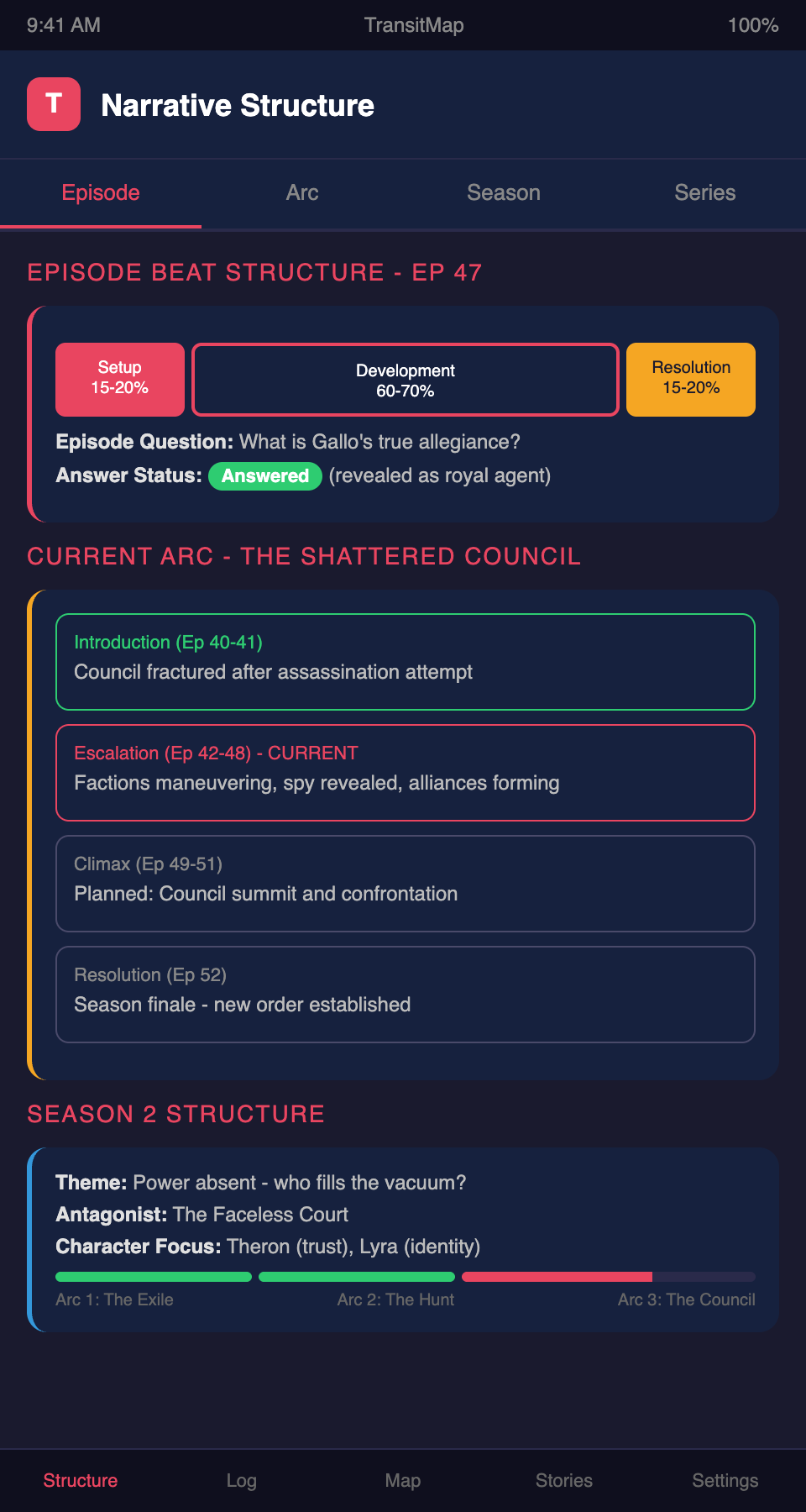
The Episode as a Unit of Story
Each episode should function as a discrete unit with its own internal arc:
The episode question. Every episode should pose a question that is either answered by the end or deliberately left unanswered as a cliffhanger. "Will the party survive the ambush?" "Will the negotiation succeed?" "What is behind the sealed door?" The question gives the episode focus and the audience a reason to listen to the end.
The episode beat structure. Within an episode, content should follow a loose three-beat pattern:
- Setup (first 15-20%) — Establish the episode's situation. Recap if needed. Orient the audience.
- Development (middle 60-70%) — The episode's core content. Investigation, combat, roleplay, exploration. The episode question is explored.
- Resolution or cliffhanger (final 15-20%) — The episode question is answered or escalated. The episode ends with either closure or anticipation.
This structure does not need to be rigid. Some episodes are all development. Some are all setup for the next episode's payoff. But having a default structure prevents episodes from being shapeless.
The Arc as a Unit of Season
Group episodes into arcs — multi-episode sequences with their own narrative trajectory:
Arc length. Most arcs should span four to eight episodes. Shorter arcs feel rushed. Longer arcs risk losing momentum.
Arc structure. Each arc follows the classic story shape:
- Introduction — The arc's central conflict is established
- Escalation — The conflict intensifies through complications and developments
- Climax — The conflict reaches its peak
- Resolution — The conflict resolves, setting up the next arc
Arc transitions. Between arcs, include a transitional episode — a breather that resolves the previous arc's loose ends and seeds the next arc. These transitional episodes often feature the best character development content because the plot pressure is temporarily low.
The Season as a Unit of Series
Each season should tell a complete story:
Season theme. What is this season about, thematically? The season theme should resonate through every arc and every significant character moment.
Season antagonist. The season should have a primary antagonist whose arc parallels the season structure — introduction, escalation, climax, resolution.
Season character focus. Which character arcs receive primary development this season? Plan this deliberately to ensure every character has a season where they are central.
Season resolution. The season finale should resolve the season's central conflict while setting up the next season. The resolution should feel complete — a listener who stops at the end of the season should feel satisfied, even if the series continues.
Structural Planning for the GM
Plan your structure at three levels:
Before the season: Define the season theme, the season antagonist, the major arcs, and the character development focus. This is your strategic plan.
Before each arc: Define the arc's conflict, the key beats, and the expected episode count. Identify which seeds and callbacks will be planted or paid off during this arc.
Before each session: Design the session to serve its role within the current arc. Is this a setup session, a development session, or a climax session? Pace accordingly.
This planning does not eliminate improvisation — it channels it. The players still drive the story through their choices. But the GM guides those choices through a structure that creates satisfying listening.
Common Structural Mistakes
- No episodes, just sessions — Publishing raw session recordings without considering episode structure. Some sessions contain two episodes' worth of climactic content; others contain half an episode's worth.
- Arcs without shape — Multi-episode sequences that do not escalate. The conflict is the same intensity in Episode 3 of the arc as it was in Episode 1.
- Seasons without resolution — The season ends on a cliffhanger that is actually just the midpoint of an arc that continues into the next season. Audiences need seasonal closure.
- Structure over authenticity — Forcing the game into a rigid structure that sacrifices the spontaneity that makes actual play special. Structure should support the game, not replace it.
- Ignoring the players' story — Building structure around the GM's planned narrative while the players are creating a different story through their choices. Structure must be adaptive.
Want to give your actual play show deliberate narrative structure? Join the TransitMap waitlist — map episodes, arcs, and seasons as nested routes on a visual timeline, with structural beats, character focuses, and narrative milestones all visible at a glance.