Actual Play Show Pacing: Editing the Rhythm of Your Campaign for an Audience
The Dual Pacing Problem
Actual play shows must satisfy two audiences simultaneously: the players at the table and the listeners on the other side of the microphone. These audiences have different pacing needs.
Players need:
- Time to think, discuss, and make decisions
- Combat encounters that feel tactical and meaningful
- Freedom to explore tangents and character moments
- Breaks for food, drinks, and rules lookups
Listeners need:
- Consistent narrative momentum
- Combat that is dramatic, not tedious
- Tangents that are entertaining or relevant
- No extended dead time
The shows that struggle with pacing are usually optimizing for one audience at the expense of the other. Shows that serve only the table feel unedited and indulgent to listeners. Shows that serve only the audience feel pressured and performative to players.
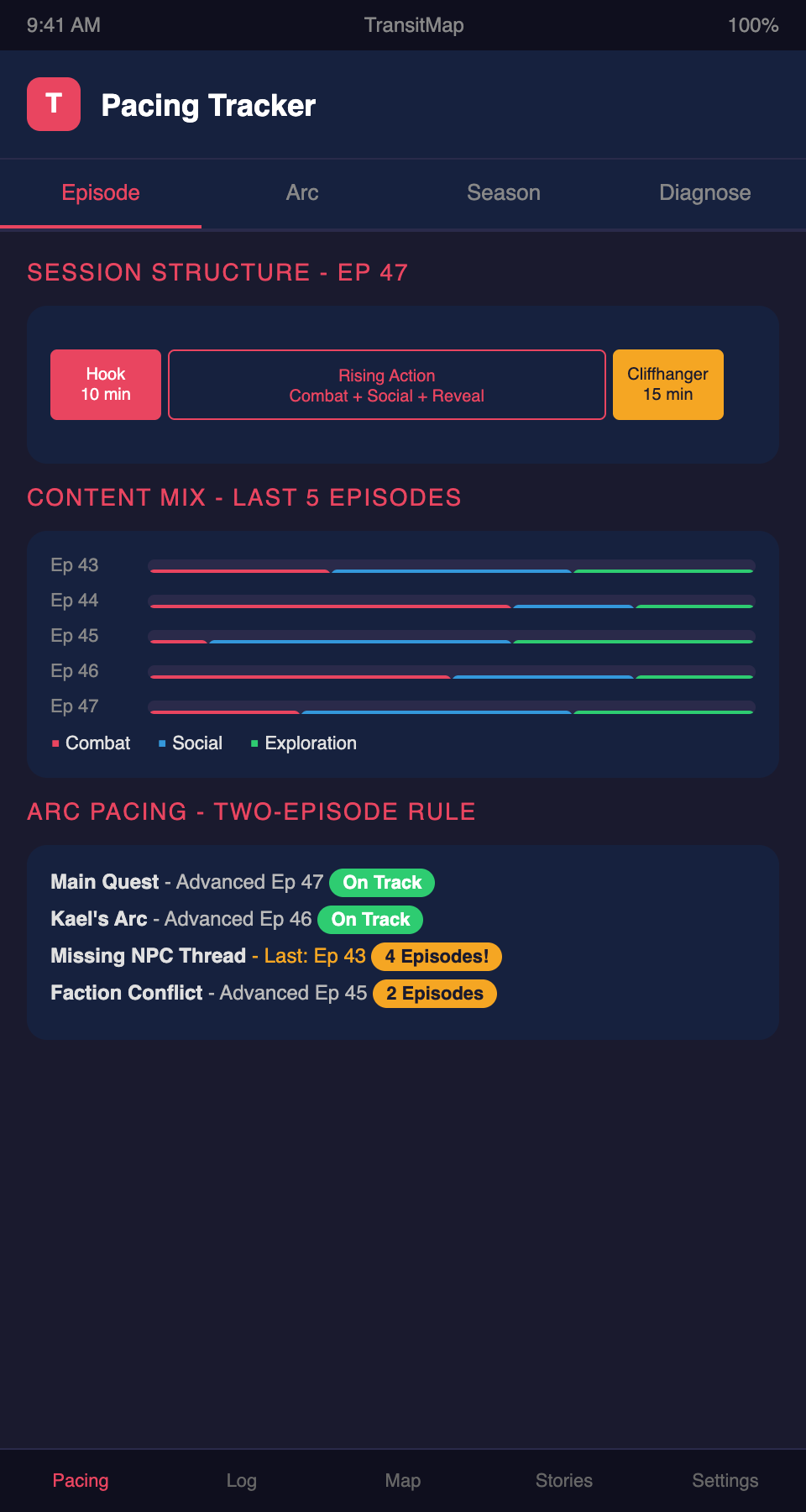
Table-Side Pacing Techniques
These techniques improve pacing at the table, making the raw recording better before editing:
The scene question. Before every scene, ask yourself: "What is the question this scene answers?" When the question is answered, the scene is over. Transition to the next scene. This prevents scenes from lingering past their purpose.
Combat narration. Describe combat with narrative color, not just mechanical outcomes. "The orc swings wide and you duck under the blade" is better than "the orc misses." Narrative combat is more interesting to listen to and naturally moves faster because the GM is focused on storytelling rather than mechanics.
The 15-minute rule. If the party has been discussing a plan for more than fifteen minutes, call for a decision. Extended planning sessions are engaging for players but deadly for listeners. "You've scouted the area and discussed options. What's the plan?"
Energy management. Monitor the table's energy. When energy dips — players are distracted, conversations drift off-topic, attention wanders — introduce a change: a new scene, a surprise development, an NPC interruption. The energy shift at the table translates to pacing improvement in the recording.
Session structure. Design each recording session with an internal arc:
- Opening hook (first 10 minutes): Something that grabs attention immediately
- Rising action (middle 60-90%): The meat of the session, varied between exploration, social, and combat
- Climactic moment or cliffhanger (final 10-15 minutes): End on a high point or an unresolved tension
Post-Production Pacing Techniques
These techniques improve pacing during editing:
Strategic cutting. Cut content that serves the table but not the audience:
- Extended rules discussions
- Bathroom and food breaks
- Repetitive combat rounds where nothing changes
- Side conversations about scheduling or logistics
- Moments where players are looking up information
Compression. Some content is relevant but too long. Compress it:
- A thirty-minute shopping scene becomes five minutes of highlights
- A two-hour dungeon crawl becomes forty-five minutes of key moments
- A long rest conversation is trimmed to the essential character beats
Pacing through music and sound. Music underscoring affects perceived pacing. Uptempo music accelerates perceived pace during slow scenes. Ambient music slows perceived pace during fast scenes. Silence can create dramatic pauses that enhance climactic moments.
Episode boundary placement. Choose where episodes begin and end based on pacing, not recording session boundaries. A recording session might end mid-scene — break the episode at a natural cliffhanger point, even if it means the next episode starts in the middle of the recording session.
Arc-Level Pacing for Audiences
Beyond individual episodes, manage pacing across story arcs:
The two-episode rule. Every storyline should advance meaningfully within two episodes. If three episodes pass without progress on an active storyline, listeners forget about it and lose investment. Your storyline tracker should flag threads that have not advanced in two or more episodes.
Combat density. Avoid back-to-back combat-heavy episodes unless you are in a climactic arc. Two consecutive combat episodes feel repetitive. Alternate between combat, social, and exploration content.
Revelation spacing. Space major revelations at least three to four episodes apart. Too many revelations in quick succession overwhelm the audience. Too few make the show feel like it is treading water.
Quiet episode placement. Every arc needs at least one quiet episode — character development, relationship building, worldbuilding exploration. Place these after high-intensity episodes to give the audience emotional recovery time.
Diagnosing Pacing Problems
"The show feels slow." Possible causes:
- Episodes are too long (cut more aggressively)
- Too many episodes between plot developments (advance storylines faster)
- Combat is dominating session time (streamline combat or cut repetitive rounds)
- The current arc lacks urgency (introduce a ticking clock)
"The show feels rushed." Possible causes:
- Not enough time for character moments (protect roleplay scenes from cuts)
- Major revelations are not given space to breathe (let the table react before moving on)
- Episodes are too short (give content room to develop)
- Too many storylines advancing simultaneously (focus on fewer threads per episode)
"Individual episodes are fine but the arc feels flat." Possible causes:
- No escalation between episodes (each episode is the same intensity)
- The arc lacks a midpoint shift (introduce a complication or reversal)
- The stakes have not been raised since the arc began (escalate visibly)
Want to visualize your show's pacing across episodes and arcs? Join the TransitMap waitlist — map intensity levels, storyline advancement, and episode boundaries on a visual timeline that reveals your show's rhythm at a glance.