Using Story Arc Tracking to Drive Audience Engagement
The Connection Between Story Tracking and Audience Growth
Most actual play producers treat narrative management and audience engagement as separate activities. The GM tracks storylines. The social media manager promotes episodes. They rarely talk to each other.
This is a missed opportunity. Your storyline tracker contains the information your marketing needs. It tells you which episodes contain major revelations (promote these). Which storylines are building tension (tease these). Which character moments resonated (clip these). When a callback will land (prime the audience).
Turning Arc Awareness Into Content Strategy
Identifying Promotable Moments
Your storyline tracker shows you which episodes contain narratively significant events. These are your highest-value promotional assets:
- Reveals — Episodes where a major secret is uncovered. These generate social media discussion and drive new listeners to start from the beginning.
- Turning points — Episodes where the story changes direction. These create urgency for listeners who have fallen behind.
- Character moments — Episodes with powerful roleplay moments. These generate emotional engagement and sharing.
- Cliffhangers — Episodes that end on unresolved tension. These drive immediate listening for the next episode.
Flag these moments in your tracker as they happen. Your social media strategy should prioritize promoting episodes with the highest narrative significance.
Creating Anticipation Content
Your tracker shows you what is coming. Use this knowledge to build anticipation:
Teasers based on dormant threads. When a dormant storyline is about to reactivate, release teaser content: "Something from the party's past is about to catch up with them..." This drives speculation and re-listening.
Callback priming. When a callback is approaching, subtly remind the audience of the original seed. Share a clip from the original episode. Post a "throwback" social media post. This primes the audience to recognize the callback when it lands.
Arc milestone countdowns. When a major arc is approaching its climax, create countdown content: "Three episodes until the Season 2 finale." This builds event-like anticipation around your narrative milestones.
Timing Your Best Content
Your pacing tracker tells you when the show's energy peaks and valleys. Use this for content scheduling:
- High-energy arcs — Increase promotion frequency. Run social media campaigns. Engage with audience theories.
- Low-energy arcs — Focus on character content, behind-the-scenes material, and community engagement rather than episode promotion.
- Between seasons — Release supplementary content: character spotlights, world lore deep dives, cast interviews, one-shot specials.
Community Engagement Through Narrative Awareness
Theory-Crafting Facilitation
Audiences love to theorize about where the story is going. Your storyline tracker tells you which theories are close to correct, which are wildly wrong, and which are accidentally brilliant.
- Encourage theorizing — Ask discussion questions that align with active storylines: "What do you think the symbol on the door means?"
- Acknowledge without spoiling — When audience theories are close, acknowledge the engagement without confirming: "Some of you are on to something..."
- Incorporate audience ideas — When an audience theory is better than your planned development, consider adapting your storyline. The audience feels heard and the story improves.
Recap and Catch-Up Content
Your episode log and storyline tracker are the source material for audience catch-up content:
- Storyline summaries — Written or video summaries of each major storyline for listeners who want to start from a recent season
- Character guides — Up-to-date character profiles for new listeners
- Timeline content — Visual timelines of the campaign for lore-focused fans
- "Essential episodes" guides — Curated lists of must-listen episodes for each major storyline
This content serves both new listeners (lowering the barrier to entry) and existing listeners (reinforcing their knowledge and investment).
Metrics and Arc Correlation
Track how narrative events correlate with audience metrics:
- Download spikes — Which episodes generated above-average downloads? Cross-reference with your storyline tracker to identify which narrative events drive listening.
- Social media engagement — Which episodes generated the most discussion? What was the narrative content of those episodes?
- Listener drop-off — At what points do listeners stop subscribing? Do drop-off points correlate with narrative pacing issues (slow arcs, resolved tension, between-season gaps)?
- New listener influx — When do new listeners join? Do promotional efforts around narrative events outperform general promotion?
Over time, these correlations tell you what your audience responds to most — and your storyline tracker helps you plan more of it.
Building the Engagement Pipeline
Map your narrative events to your engagement calendar:
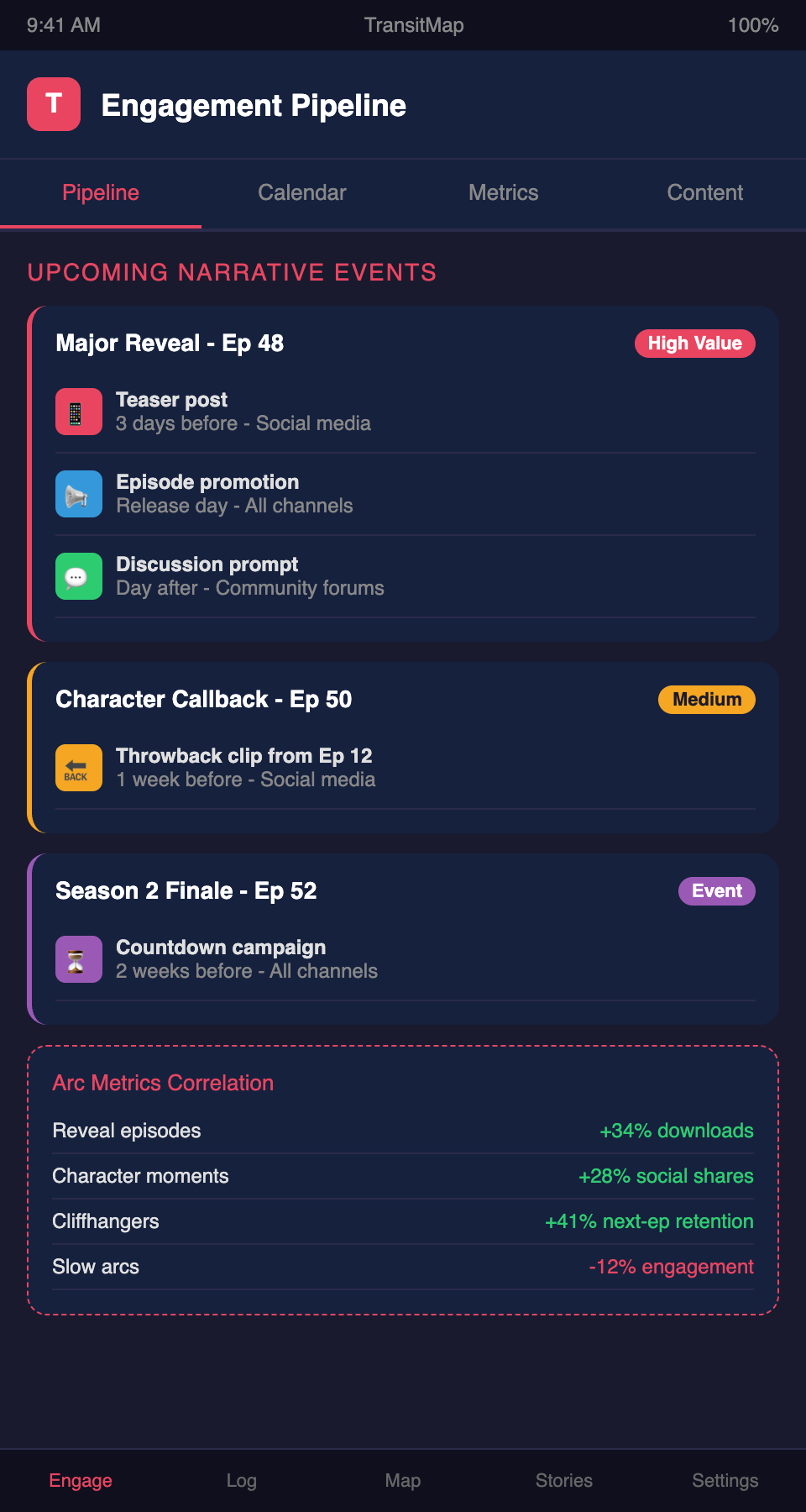
| Narrative Event | Engagement Action | Timing | Channel |
|---|---|---|---|
| Major reveal (Ep 45) | Teaser post | 3 days before | Social media |
| Major reveal (Ep 45) | Episode promotion | Release day | All channels |
| Major reveal (Ep 45) | Discussion prompt | Day after | Community forums |
| Character callback (Ep 47) | Throwback clip from original episode | 1 week before | Social media |
| Season finale (Ep 52) | Countdown campaign | 2 weeks before | All channels |
| Between seasons | Supplementary content series | Duration of break | Podcast feed |
This pipeline ensures that every significant narrative moment receives corresponding audience engagement — maximizing the return on your storytelling investment.
Want to turn your storyline tracker into an audience engagement engine? Join the TransitMap waitlist — visualize your show's narrative milestones alongside your content calendar, so every major story moment gets the promotional attention it deserves.