Creating Audience Recap Content for Your Actual Play Show
The Backlog Problem
Successful actual play shows face an ironic growth challenge: the longer and better the show becomes, the harder it is for new listeners to start. An 80-episode backlog represents roughly 160 hours of content. Even enthusiastic potential listeners balk at that commitment.
Recap content solves this by providing multiple entry points at different commitment levels. A potential listener can read a five-minute summary, listen to a thirty-minute recap episode, or start from a recent season premiere with a catch-up guide — each option dramatically reduces the barrier to entry.
Recap Content Types
Written Episode Summaries
Brief text summaries of each episode, published alongside the episode.
Format: Three to five paragraphs covering key events, decisions, and revelations. Spoiler-tagged for listeners who have not heard the episode yet.
Use case: Listeners who missed an episode and want to catch up without re-listening. Listeners who want to verify a detail from a past episode.
Production time: Ten to fifteen minutes per episode.
Best practice: Focus on plot-relevant events and skip table banter, rules discussions, and combat play-by-play. Include which NPCs appeared and any new information revealed.
Arc Summaries
Multi-episode summaries covering entire story arcs.
Format: One to two pages covering the arc's key events, character developments, and resolution. Written as narrative rather than episode-by-episode.
Use case: New listeners who want to start from a recent arc. Returning listeners who took a break and need orientation.
Production time: Thirty to sixty minutes per arc.
Best practice: Write these as compelling narratives, not dry summaries. A well-written arc summary should make a reader want to go back and listen to the arc in full.
Catch-Up Episodes
Dedicated audio episodes that summarize previous content for new listeners.
Format: A twenty to forty-minute episode featuring the cast summarizing the story so far, with clips from key moments.
Use case: New listeners who prefer audio to text. Published at season transitions or when the backlog reaches a significant milestone.
Production time: Three to five hours (scripting, clip selection, recording, editing).
Best practice: Release catch-up episodes at natural entry points — season premieres, major arc beginnings. Label them clearly as catch-up content so existing listeners can skip them.
Essential Episodes Guides
Curated lists of the most important episodes for each storyline.
Format: A list of ten to fifteen episodes (out of eighty) that cover the essential plot developments, organized by storyline.
Use case: New listeners who want to experience the show's highlights without the full backlog. Also useful for returning listeners who want to revisit specific storylines.
Production time: One to two hours to curate and write descriptions.
Best practice: Include brief context for each essential episode explaining why it matters. For storylines with many essential episodes, note which are truly critical versus "nice to have."
Character Guides
Stand-alone profiles for each major character, covering their development across the show.
Format: One page per character with personality, backstory (as revealed on air), key relationships, major character moments (with episode references), and current status.
Use case: New listeners who want to understand who the characters are before starting. Existing listeners who want to review a character's journey.
Production time: Twenty to thirty minutes per character.
Best practice: Write these from the audience's perspective, not the GM's. Only include information that has been revealed on air.
Visual Timelines and Maps
Graphical representations of the show's timeline, world map, or relationship web.
Format: Infographics, interactive maps, or timeline graphics published on the show's website or social media.
Use case: Visual learners who process information better graphically. Lore-focused fans who want to see the world and its history.
Production time: Several hours per piece (requires design skills or tools).
Best practice: Keep visuals updated as the show progresses. An outdated map is worse than no map because it creates false expectations.
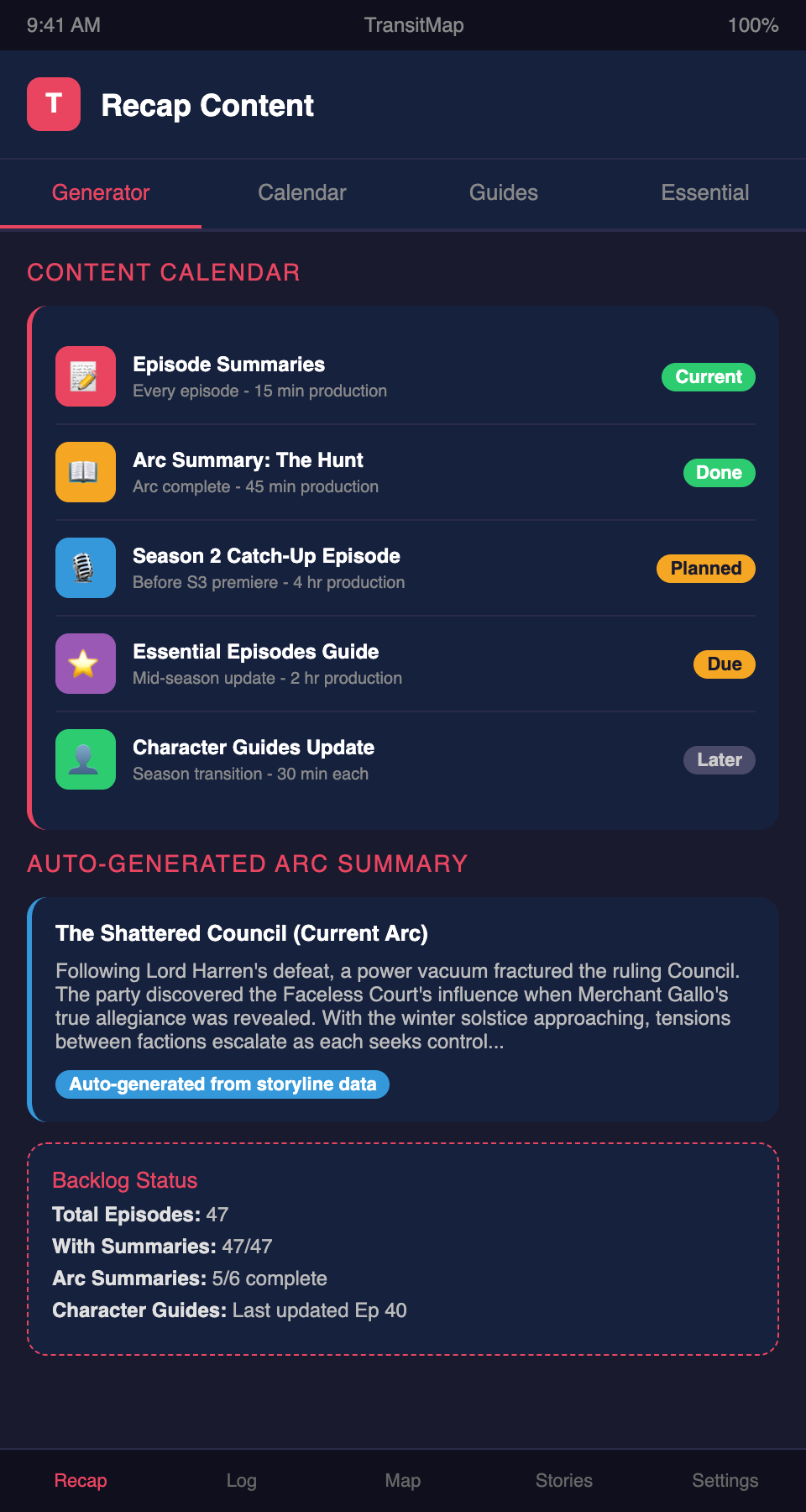
The Recap Content Calendar
Schedule recap content production alongside your regular episode schedule:
| Content Type | Frequency | Publish Timing |
|---|---|---|
| Episode summaries | Every episode | Same day as episode release |
| Arc summaries | End of each arc | Within one week of arc conclusion |
| Catch-up episodes | Once per season | Before the new season premiere |
| Essential episodes guide | Twice per year | Before season premiere and mid-season |
| Character guides | Once per season | Updated at season transitions |
| Visual content | As needed | When significant world changes occur |
Delegating Recap Content
Recap content production can be delegated to community volunteers, paid assistants, or AI tools — with editorial oversight:
- Community volunteers often produce enthusiastic, detailed recaps but may require accuracy review
- Paid assistants produce consistent quality but need onboarding on the show's content
- AI transcription and summarization can generate first drafts that are refined by a human editor
Regardless of who produces the recap content, the GM or show producer should review it for accuracy before publication. Incorrect recap content creates more confusion than no recap content.
Want to create recap content from your storyline tracking data? Join the TransitMap waitlist — generate arc summaries, character guides, and essential episode lists directly from your show's visual narrative map.