Balancing Player Spotlight Time in Your Actual Play Show
Why Spotlight Balance Matters More on a Show
In a home game, spotlight imbalance is a table management issue. In an actual play show, it is an audience retention issue. Listeners who connect with a specific character will disengage during episodes where that character has nothing to do. If the imbalance persists, they stop listening.
Spotlight balance also affects your cast. Players whose characters are consistently sidelined become less engaged, and that disengagement is audible. The energy drops. The roleplay becomes passive. The audience can hear the difference between a player who is invested and one who is waiting for their turn.
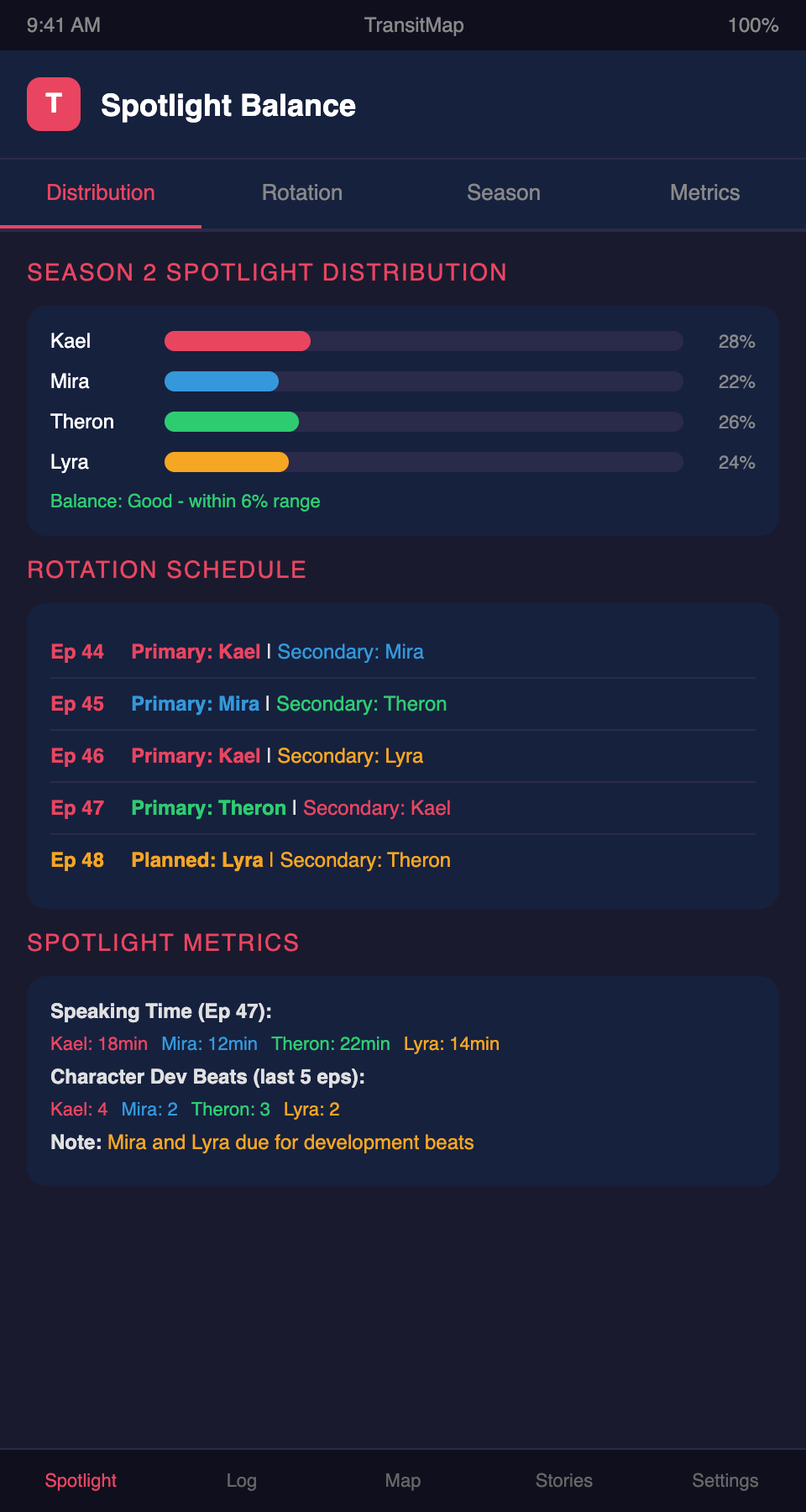
Measuring Spotlight Time
You cannot balance what you do not measure. Track spotlight distribution using these metrics:
Speaking time. How many minutes does each player speak per episode? This is the most basic metric and the easiest to measure during editing.
Initiative moments. How many times does each character initiate action, make decisions, or drive the scene forward? A character can have significant speaking time while still being reactive rather than proactive.
Character development beats. How many scenes per episode focus on a character's personal storyline, backstory, or emotional arc? These are the high-value moments that deepen audience investment.
Mechanical spotlight. How many significant skill checks, combat turns, or mechanical moments does each character have? Some characters are mechanically spotlighted (the fighter in combat) while others are narratively spotlighted (the bard in social scenes).
The Rotation System
Design your sessions with deliberate spotlight rotation:
Primary focus character. Each session should have one character who receives the most spotlight through personal storyline development, key decisions, or featured scenes. Rotate this focus deliberately across sessions.
Secondary focus character. A second character who has meaningful contributions and at least one significant scene. This character is often the one whose storyline intersects with the primary focus character.
Ensemble moments. Scenes where all characters contribute. Combat, group planning, and party-wide decisions provide ensemble spotlight. These scenes should make up the majority of most episodes.
A practical rotation schedule:
| Session | Primary | Secondary | Notes |
|---|---|---|---|
| 1 | Character A | Character C | A's backstory quest begins |
| 2 | Character B | Character A | B's faction contact appears |
| 3 | Character C | Character D | C's personal conflict escalates |
| 4 | Character D | Character B | D's secret is revealed |
| 5 | Ensemble | Ensemble | Arc climax — all characters central |
Scene Design for Inclusion
Design scenes that naturally include multiple characters:
Multi-skill challenges. Create obstacles that require different character abilities. The locked door needs the rogue. The magical ward needs the wizard. The guard needs the bard. Everyone has a role.
Split-party scenes with purpose. Occasionally split the party so that each group has a focused scene. This guarantees spotlight for characters who might be overshadowed in full-party scenes.
NPC connections to different characters. When introducing NPCs, connect them to the character who has received the least recent spotlight. This naturally pulls the spotlight toward the underserved character.
Reactive moments. After a major event, go around the table and ask each character for their reaction. This ensures every character has a voice in significant moments, even if they were not the primary actor.
Managing Dominant Players
Some players naturally dominate table conversation. This is not a character problem — it is a player dynamic:
Direct address. Instead of asking "What do you all do?", ask specific players: "Kira, what is your character doing while this happens?" Direct address guarantees a response.
Scene framing. Frame scenes that specifically feature quieter characters: "While the others are shopping, Theron — you notice something in the alley." This creates spotlight without requiring the player to compete for attention.
Private conversations. Between sessions, talk with dominant players about sharing space. Frame it as a show quality issue, not a personal criticism: "The audience loves seeing all the characters equally. Can you help me create space for the others during busy scenes?"
Editing as a tool. In post-production, you can trim extended monologues and tighten scenes to create more balanced spotlight distribution in the published episode.
Spotlight and Character Arcs
Long-term spotlight balance should be tracked across arcs and seasons, not just individual episodes:
Arc-level balance. Each arc should feature at least two characters prominently. An arc that focuses entirely on one character for six episodes leaves three or four characters without development.
Season-level balance. Over a full season, every character should have at least one arc where they are the primary focus. Plan this during season prep.
Cumulative tracking. Maintain a running total of spotlight episodes per character. If one character has been primary focus for five sessions and another for only two, adjust your upcoming plans accordingly.
When Imbalance Is Intentional
Sometimes spotlight imbalance serves the story:
Character introduction arcs. A new character joining the show needs extra spotlight to establish themselves with the audience.
Climactic personal arcs. When a character's major storyline is reaching its climax, they naturally receive more spotlight. This is expected and satisfying — as long as other characters had similar treatment during their climactic arcs.
Player absence. When a player misses a session, their character's spotlight shifts to others. Track these absences and compensate with extra spotlight when the player returns.
The key is that intentional imbalance is temporary and acknowledged in your planning. Accidental, persistent imbalance is the problem.
Communicating With Your Cast
Discuss spotlight balance openly with your players:
Set expectations. Let players know that you track spotlight rotation and that every character will get their time.
Invite feedback. Ask players privately if they feel they are getting enough spotlight. Players who feel sidelined may not speak up without prompting.
Celebrate other characters' moments. Encourage a culture where players are excited for each other's spotlight moments. The best actual play casts cheer for each other's dramatic scenes.
Balancing spotlight across your show's cast? Join the TransitMap waitlist — track character focus per episode, visualize spotlight distribution across arcs, and ensure every character's journey is mapped on your show's narrative transit system.