Tracking Character Development Arcs in Your Actual Play Show
Characters Are Your Show's Core Asset
The plot of your actual play show might be brilliant, but it is the characters that keep your audience coming back. Listeners form parasocial relationships with the PCs. They root for them, worry about them, and feel genuine emotion when characters succeed or fail. Your show's most shared clips are almost always character moments, not plot developments.
This means character development is not a side benefit of your campaign — it is your show's primary product. And like any primary product, it needs deliberate tracking and management.
What Character Development Looks Like in Actual Play
Character development in actual play is different from character development in scripted media because it is emergent. The player makes choices in the moment, and those choices accumulate into an arc that was not scripted in advance.
This makes character arcs in actual play both more authentic and harder to manage. The arc is real — the player genuinely grappled with decisions and grew through experience. But it is also unplanned, which means it can stall, meander, or accidentally reverse without anyone noticing.
The Character Arc Tracker
For each player character, maintain an arc tracker:
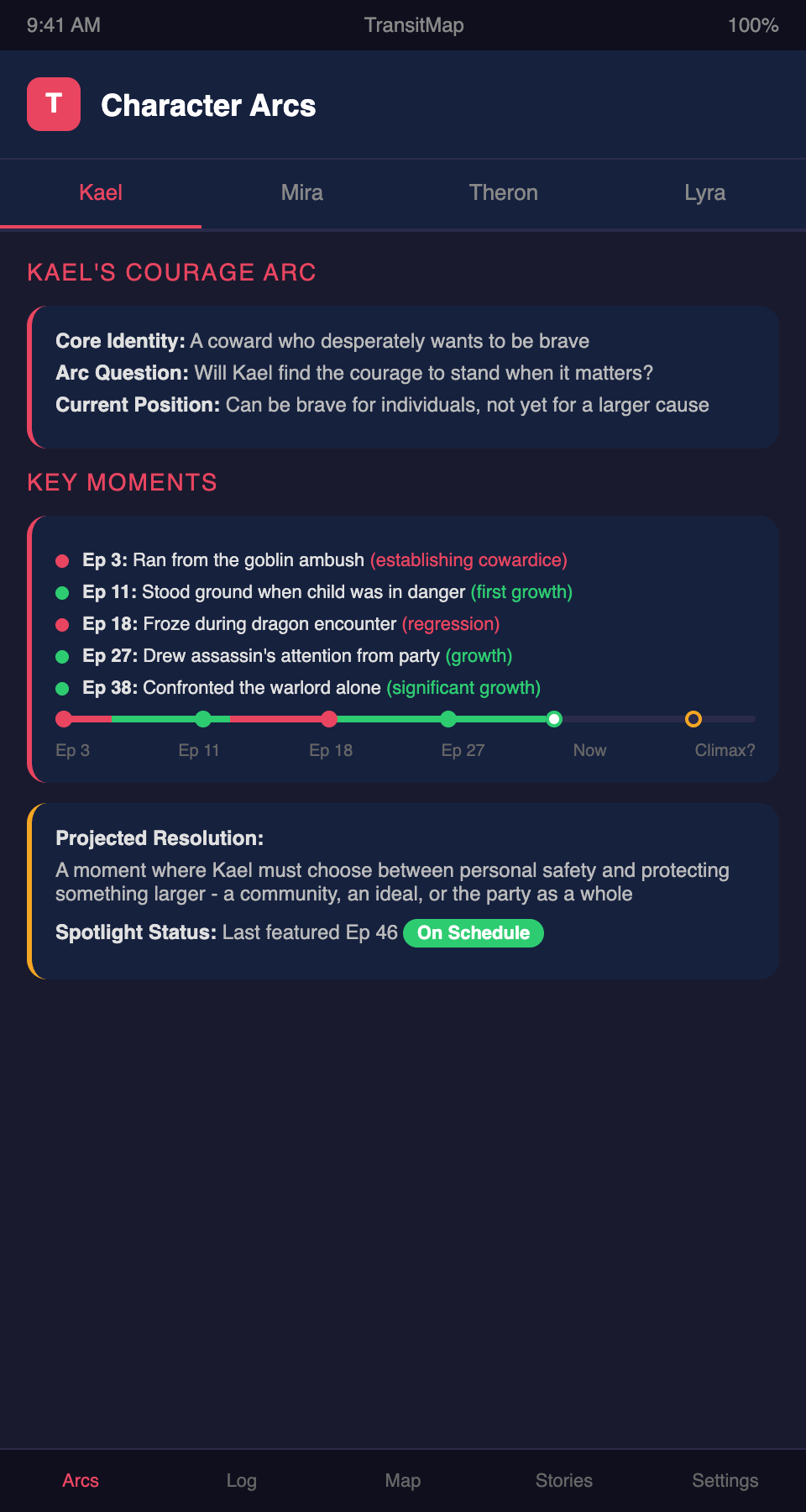
Core Identity. Who is this character at their core? What defines them? This should be a brief statement that captures the character's essential nature as established through play (not backstory).
Example: "Kael is a coward who desperately wants to be brave."
Arc Question. What question is this character's arc exploring? Every meaningful character arc is a question being answered through play.
Example: "Will Kael find the courage to stand when it matters, or will his fear define him?"
Key Moments. A chronological list of moments where the character demonstrated growth, regression, or a defining choice. Include episode numbers.
- Ep 3: Kael ran from the goblin ambush while the party fought (establishing cowardice)
- Ep 11: Kael stood his ground when the child was in danger (first sign of potential courage)
- Ep 18: Kael froze during the dragon encounter, letting an ally take a hit (regression under extreme pressure)
- Ep 27: Kael deliberately drew the assassin's attention away from the party (growth — risking himself for others)
Current Position. Where is the character on their arc right now? One sentence.
Example: "Kael has shown he can be brave for individuals he cares about, but has not yet faced a situation where courage was required for a larger cause."
Projected Trajectory. Where is the arc heading? What kind of climactic moment would resolve the arc question?
Example: "Kael's arc climax should be a moment where he must choose between personal safety and protecting something larger than himself — a community, an ideal, or the party as a whole."
Facilitating Character Development as GM
As the GM of a published show, you have a responsibility to facilitate character development that you do not have in a private game. Your audience is invested in these arcs. Letting them stagnate is a narrative failure.
Create arc-relevant situations. Design encounters and scenes that test the character's arc question. For Kael, create situations where courage is the clear but costly choice. Do not tell the player what to do — present the situation and let them choose. Their choice advances the arc regardless of which direction they go.
Space character moments. Every two to three episodes, each character should have at least one moment that is primarily about their development. Rotate the spotlight so no character goes more than four episodes without a significant personal moment.
Respond to player choices. When a player makes a choice that advances their character's arc, ensure the world responds. If Kael stands his ground, an NPC should notice and comment. If Kael runs, there should be consequences — not punishment, but natural outcomes that the character must process.
Protect character moments from plot pressure. When a character is having a developmental moment — a confession, a breakdown, a declaration — do not interrupt it with plot events. Let the moment breathe. These are the scenes your audience will remember and share.
Balancing Multiple Character Arcs
With four to six PCs, managing multiple arcs simultaneously requires deliberate balance:
The spotlight rotation. Track which character's arc received focus in each episode. Ensure equal distribution over time. An imbalanced spotlight creates a "main character" dynamic that frustrates other players and their fans.
Arc phasing. Not every character arc needs to be active simultaneously. Phase arcs so that one to two characters are in their arc's active development phase while others are in a maintenance phase. This prevents narrative overload and gives each arc room to breathe.
Inter-character arc connections. Look for connections between character arcs. Kael's courage arc might connect to another character's trust arc — Kael proves himself trustworthy by being brave. These connections enrich both arcs and create scenes that serve multiple characters simultaneously.
The Arc Resolution
Every character arc needs a resolution — a moment that definitively answers the arc question. In a long-running show, this resolution usually coincides with the campaign's climax.
Planning the resolution. Work with each player individually to understand what they want for their character's arc resolution. Some players want triumph. Some want tragedy. Some want transformation. The player's vision should inform the resolution's design.
Earning the resolution. The resolution must be earned through the accumulated weight of the character's journey. A coward who becomes brave in the finale only works if the audience has seen the character struggle with fear for dozens of episodes. The key moments in your arc tracker are the evidence of this journey.
Delivering the resolution. The resolution should be:
- Visible — the audience witnesses the defining moment
- Clear — the arc question is answered unambiguously
- Emotional — the accumulated investment pays off in a moment of genuine feeling
- Connected — the resolution connects to the broader campaign narrative
Tracking character arcs across your show's entire run? Join the TransitMap waitlist — map each character's journey as a personal transit line with key moments, growth milestones, and arc resolution stations all tracked visually.