Weaving Cross-Character Storylines in Your Actual Play Podcast
Why Cross-Character Storylines Matter
Solo character arcs are engaging. Cross-character storylines are compelling. When one character's quest intersects with another character's backstory, when two characters' goals conflict, when a shared history between characters surfaces at a critical moment — these are the scenes that generate the most audience discussion, the most social media sharing, and the most emotional investment.
Cross-character storylines work because they:
- Create organic conflict between characters the audience cares about
- Force player-to-player roleplay that is often more authentic than player-to-GM roleplay
- Generate dramatic irony when the audience knows connections that the characters do not
- Deepen the sense that the characters are part of an interconnected world, not parallel solo adventures
Types of Cross-Character Connections
Shared history. Two characters have a connection from before the campaign began. They grew up in the same town. They served in the same war. They were trained by the same mentor. These connections can be established in backstories or discovered through play.
Opposing goals. Two characters want things that conflict. One wants to destroy the artifact; the other wants to use it. One wants to ally with the faction; the other wants to oppose it. These conflicts do not need to split the party — they create tension within the party that is resolved through roleplay.
Parallel arcs. Two characters are dealing with similar themes through different circumstances. Both are grappling with trust. Both are questioning their identities. Both are dealing with loss. When these parallel arcs are acknowledged, they enrich each other.
Dependency chains. One character's storyline requires something from another character — information, a skill, an emotional confrontation. These dependencies force interaction and create moments of vulnerability.
Secrets and revelations. One character has a secret that affects another character. The rogue is working for the organization that destroyed the fighter's village. The cleric received a vision about the wizard's fate. These secrets create tension that builds toward explosive revelation scenes.
Designing Cross-Character Intersections
Step 1: Map existing connections. Review all character backstories and in-play developments. Create a relationship map showing existing connections between PCs.
Step 2: Identify natural intersections. Look for places where character storylines naturally touch:
- Do any characters share a common NPC connection?
- Do any character goals align or conflict?
- Do any character histories overlap geographically or temporally?
- Do any character themes echo each other?
Step 3: Design catalysts. Create situations that activate the connections:
- The shared NPC reappears with information that affects both characters differently
- A quest presents a choice that one character supports and another opposes
- An external event forces characters to confront their shared history
- A revelation surfaces that changes how one character views another
Step 4: Create space for the scene. When the catalyst activates, protect the resulting scene. Do not interrupt it with combat encounters or plot developments. Let the characters interact. Let the players explore the emotional terrain. These scenes are often the best content your show produces.
Working With Players
Cross-character storylines require player cooperation, but not player scripting:
Inform, do not dictate. Tell players about upcoming connections between their characters: "In the next few sessions, some information is going to surface about the rogue's past employer. It may affect the fighter's storyline." This gives players time to think about their character's reaction without scripting the outcome.
Encourage between-session discussion. Players who discuss their characters' relationships between sessions create richer in-session scenes. Facilitate this with specific prompts: "How does your character feel about the rogue after learning about their past?"
Respect player boundaries. Some cross-character connections touch sensitive topics. Always check with both players before designing scenes that involve their characters' relationship. "Would your character react with anger, betrayal, or understanding in this situation? Any of those works — I just want to design the scene appropriately."
Let players surprise you. The best cross-character moments are often the ones you did not plan. When players spontaneously create scenes between their characters, let those scenes run. Do not redirect to plot content.
Tracking Cross-Character Storylines
Your storyline tracker should include cross-character threads:
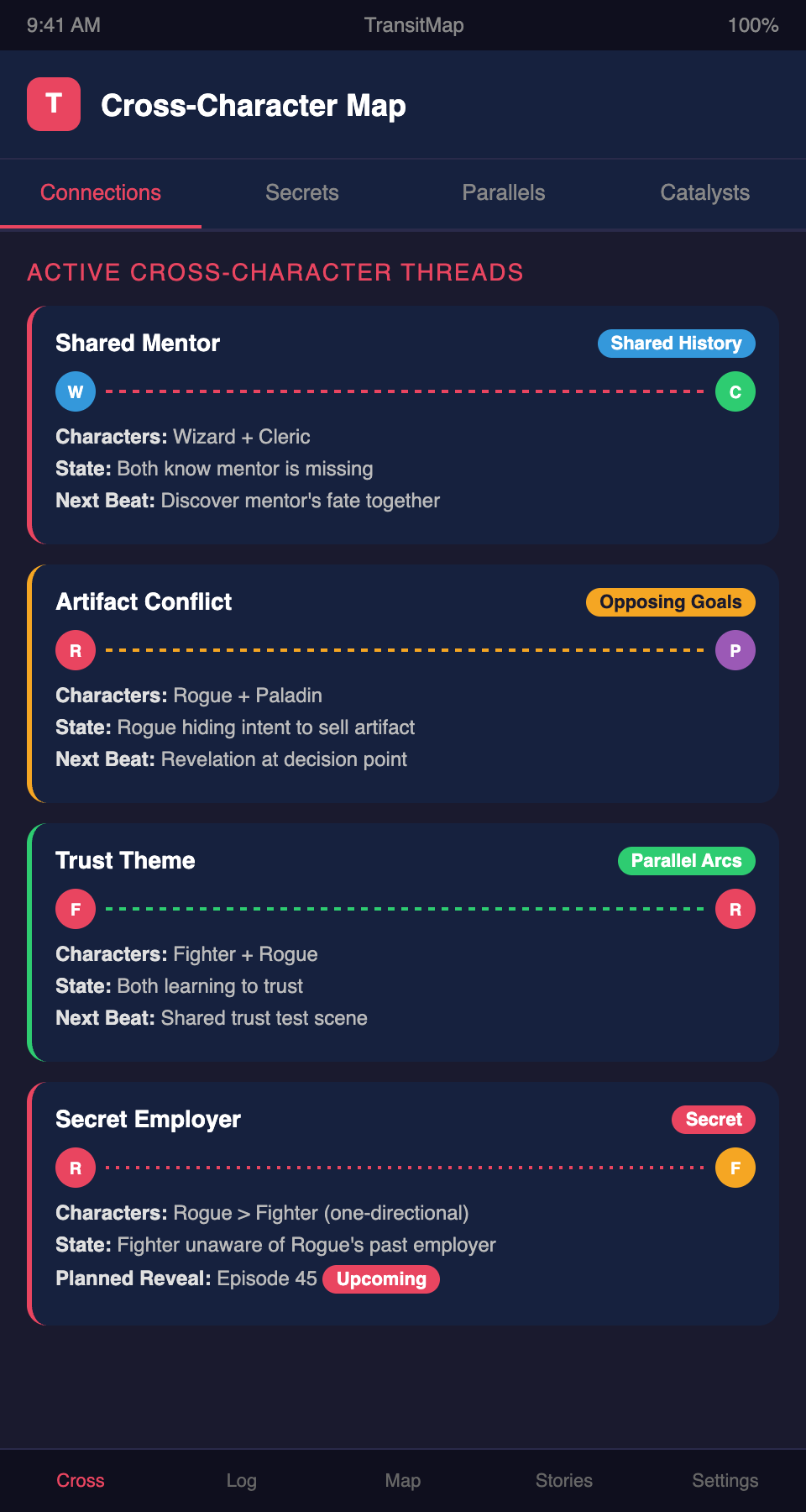
| Connection | Characters | Type | Current State | Next Beat |
|---|---|---|---|---|
| Shared mentor | Wizard + Cleric | Shared history | Both know mentor is missing | Discover mentor's fate |
| Artifact conflict | Rogue + Paladin | Opposing goals | Rogue hiding intent to sell | Revelation at decision point |
| Trust theme | Fighter + Rogue | Parallel arcs | Both learning to trust | Shared trust test |
| Secret employer | Rogue + Fighter | Secrets | Fighter unaware | Planned reveal Ep 45 |
Review this tracker during prep to ensure cross-character storylines receive regular attention and do not stagnate.
Common Cross-Character Storyline Mistakes
- Forcing PvP — Not every cross-character storyline needs to result in conflict. Cooperation, understanding, and forgiveness are equally compelling outcomes.
- Sidelining other characters — A cross-character scene between two PCs can exclude the others at the table. Design scenes that involve the full party or alternate between focused cross-character scenes and full-party content.
- Revealing secrets too early — A secret between characters needs time to build tension before the reveal. Rushing to the revelation robs the audience of anticipation.
- No consequences — A major cross-character revelation that changes nothing is worse than no revelation at all. Ensure that cross-character moments have lasting effects on both characters and their relationship.
- Only negative connections — Not every cross-character storyline needs to be about conflict. Positive connections — loyalty, love, mentorship — are equally powerful narrative tools.
Weaving cross-character storylines across your show? Join the TransitMap waitlist — map the connections between characters as intersecting transit lines, with shared moments, secrets, and revelation points all tracked on a single visual map.