Planning Episode Cliffhangers for Your Actual Play Show
Why Cliffhangers Matter for Actual Play
In serialized audio storytelling, the episode ending is your most valuable real estate. It is the last impression before the listener decides whether to continue. A strong ending creates urgency. A weak ending creates permission to stop.
Actual play shows face a unique cliffhanger challenge: sessions end when time runs out, not when the narrative reaches a natural break point. A tabletop session that ends mid-combat because it is midnight does not automatically create a compelling episode ending. The cliffhanger must be designed — either through session pacing that builds to a climactic moment, or through post-production editing that cuts at the right moment.
Types of Cliffhangers
The Revelation Cliffhanger
The episode ends with a piece of information that changes everything — but before the characters can react.
"You open the locket and inside you find... a portrait of yourself." "The messenger hands you the letter. It reads: 'Your father is alive.'" "As the dust clears, you see the face of the traitor. It's [name]."
Why it works: The audience desperately wants to see the reaction and the consequences. The gap between revelation and response is pure narrative fuel.
Best for: Episodes that end a mystery or investigation sequence.
The Threat Cliffhanger
The episode ends with the arrival of danger — but before the confrontation.
"You hear the war horn from the north. Then another from the east. Then a third from behind you." "The door at the end of the hall opens, and something steps through that you have never seen before." "Roll initiative."
Why it works: The audience's fight-or-flight instinct activates. They need to know what happens next.
Best for: Episodes transitioning from exploration or social scenes to combat or crisis.
The Decision Cliffhanger
The episode ends with a choice posed — but before the decision is made.
"The dragon offers you a deal. Everything you want — but at a price only you can pay. What do you do?" "You stand at the crossroads. Left leads to the kingdom that exiled you. Right leads to the people who need your help. Which way?"
Why it works: The audience begins debating the decision themselves. They form opinions and theories about what the character will choose.
Best for: Character development episodes with high-stakes personal choices.
The Emotional Cliffhanger
The episode ends on a moment of raw emotion — but before the emotion resolves.
"The cleric drops to their knees, the holy symbol clattering to the ground. 'My god has abandoned me.'" "The rogue looks at the party — the people who saved their life, who became their family — and says 'I have to go. I can't tell you why.'"
Why it works: Emotional investment demands resolution. The audience needs to know if the character recovers, if the relationship survives, if hope returns.
Best for: Character-focused episodes with relationship or identity themes.
Engineering Cliffhangers in Play
Since actual play is improvised, you cannot script cliffhangers. But you can engineer them:
Session pacing toward a climactic moment. Design each session to build toward one major moment in the final thirty minutes. If the session naturally peaks at that moment, end the session (and the episode) there.
The GM's clock. Keep track of remaining session time. When you have thirty minutes left, start steering toward a cliffhanger-worthy moment. Introduce the revelation. Deploy the threat. Pose the question.
The natural break scan. During play, watch for moments that would make strong cliffhangers. When one occurs naturally, consider ending the session there — even if time remains. "I think that's a great place to stop." Five minutes of unused session time is a small price for a powerful episode ending.
Post-production cliffhanger placement. If the session did not end on a cliffhanger, find one during editing. A moment mid-session that was followed by a transition or a break might work as an episode boundary. Cut the episode at the cliffhanger moment and start the next episode with the continuation.
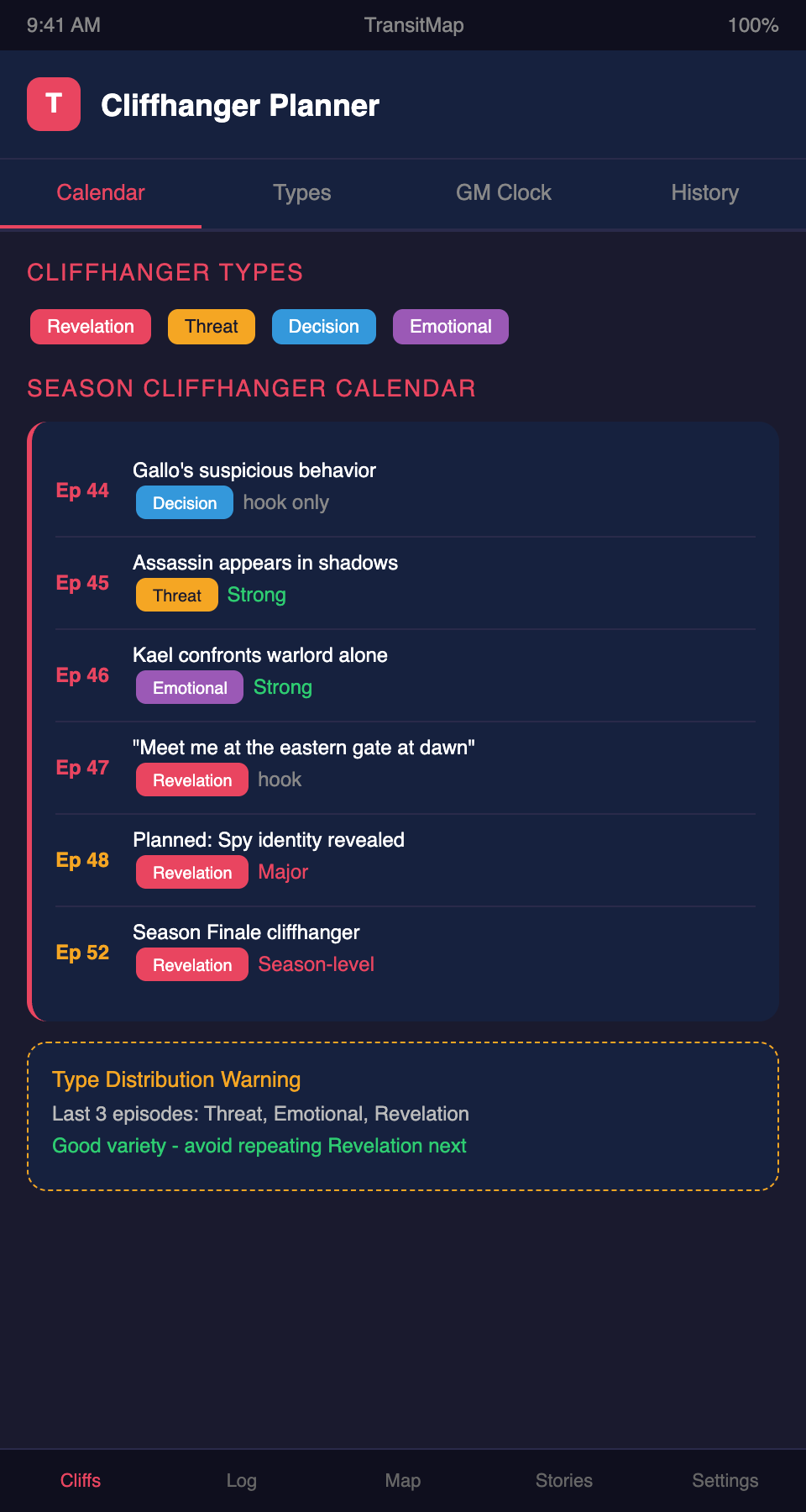
The Cliffhanger Calendar
Plan your cliffhangers across the season:
- Every episode should end on some form of hook — at minimum, an unresolved question or a pending scene
- Every 3-4 episodes should feature a strong cliffhanger from one of the four types above
- Arc-ending episodes should have the season's most powerful cliffhangers
- Season finales should have cliffhangers that sustain audience engagement through the between-season break
Track which types of cliffhangers you have used recently. If the last four episodes all ended on threat cliffhangers, vary the type. Repetition diminishes impact.
Common Cliffhanger Mistakes
- The false cliffhanger — Ending on something that sounds dramatic but is immediately resolved at the start of the next episode with no real consequence. Audiences learn to distrust your cliffhangers.
- The confusing cliffhanger — The audience does not understand what just happened, so the cliffhanger creates confusion rather than anticipation. Clarity is essential.
- The stakes-free cliffhanger — "Roll initiative" against an enemy the audience knows the party will defeat easily. Cliffhangers need genuine uncertainty.
- Cliffhanger fatigue — Every single episode ends on a dramatic cliffhanger. The audience becomes desensitized. Reserve your strongest cliffhangers for key moments.
- The unresolved cliffhanger — A cliffhanger from ten episodes ago that was never resolved. The audience has stopped caring.
Planning cliffhangers across your show's season? Join the TransitMap waitlist — mark cliffhanger points on your episode timeline and see how they create the rhythm of tension and release that keeps your audience hooked.