Managing Plot Threads in a Long-Running Actual Play Show
The Plot Thread Accumulation Problem
Every episode of your show generates new plot threads. An NPC mentions a rumor. A character makes a promise. A mysterious event goes unexplained. A faction shifts its position. Each of these is a thread that your audience expects to be addressed eventually.
In a short campaign, these threads naturally resolve within a few sessions. In a long-running show, they accumulate. By the time your show reaches its fiftieth episode, you may have dozens of open threads — some major plot drivers, some minor details that a listener might ask about, and some that you have genuinely forgotten about.
The audience, however, has not forgotten. They have a collective memory that exceeds your own, supplemented by episode notes, wikis, and community discussions. If you drop a thread, someone will notice.
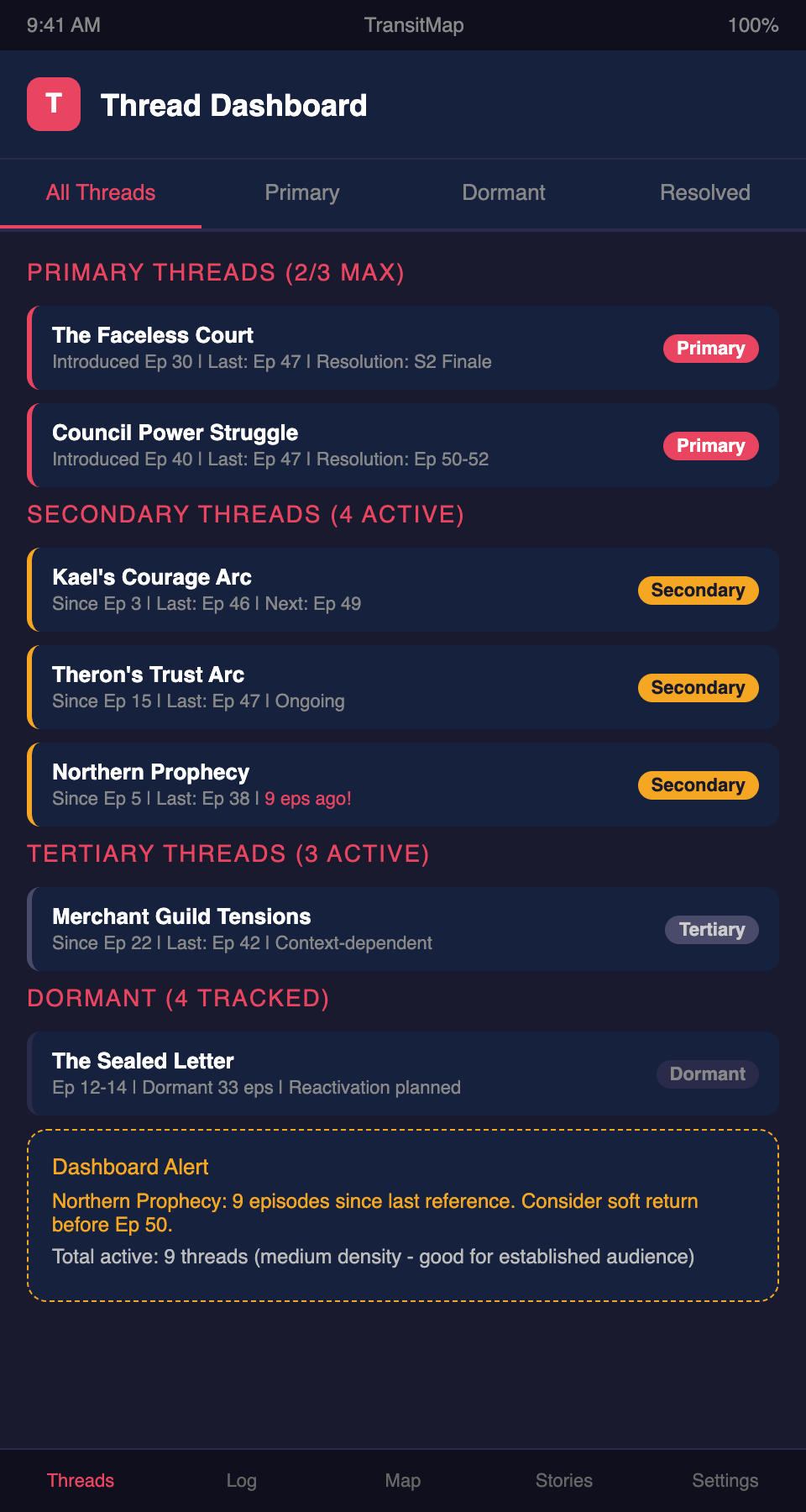
Thread Classification
Not all threads are equal. Classify your open threads by priority:
Primary threads. The main storylines driving the current arc and season. These should receive attention in every episode or every other episode. Examples: the main quest, the season antagonist's plans, the central mystery.
Secondary threads. Important storylines that are active but not currently driving the plot. These should surface every three to five episodes. Examples: a character's personal quest, a faction conflict simmering in the background, a prophecy being gradually fulfilled.
Tertiary threads. Minor storylines or details that have been established but are not currently active. These should be referenced every ten to fifteen episodes or when the story returns to their context. Examples: a minor NPC's personal problem, a regional conflict in a distant location, a piece of lore that has been mentioned but not yet relevant.
Dormant threads. Threads that have been intentionally set aside for future use. These do not need regular attention but should be tracked so they can be activated when appropriate. Examples: a character's unresolved backstory element, a villain who escaped, a prophecy that applies to a future arc.
The Thread Dashboard
Maintain a dashboard that gives you a quick overview of all open threads:
For each thread, track:
- Thread name and one-sentence description
- Classification (primary, secondary, tertiary, dormant)
- Episode introduced
- Last episode referenced
- Episodes since last reference
- Next planned beat
- Target resolution episode or arc
Dashboard review schedule:
- Before every session: Review primary and secondary threads
- Before every arc: Review all threads including tertiary and dormant
- Before every season: Audit all threads for relevance and planned resolution
Preventing Thread Overload
Too many active threads overwhelm both you and your audience:
Limit active primary threads. No more than two to three primary threads should be active simultaneously. More than that fractures audience attention and makes each individual thread feel underserved.
Resolve before introducing. Before opening a new major thread, resolve or dormant an existing one. This maintains a manageable thread count and gives the audience the satisfaction of closure.
Bundle related threads. When multiple threads touch the same theme, faction, or location, combine them. The faction conflict and the NPC's betrayal and the mysterious artifact can all be aspects of one larger thread rather than three separate ones.
Prune dead threads. Some threads will naturally become irrelevant as the story evolves. When a thread no longer serves the story, resolve it quickly through narration or let it fade. Not every thread needs a dramatic payoff.
Thread Resurrection
Bringing back a dormant thread is one of the most satisfying narrative techniques in long-form storytelling:
The callback. Reference a thread from twenty episodes ago and watch the audience light up. "You recognize the symbol — it is the same one carved into the ruins you explored in Episode 23."
The recontextualization. Reveal that a minor thread from early in the show was actually connected to the current storyline all along. This rewards attentive listeners and makes the world feel deeply interconnected.
The payoff. Finally resolve a thread that has been dormant for an entire season. The longer the thread has been waiting, the more satisfying the resolution — as long as the audience has been given enough reminders to remember it.
The twist. Take a thread the audience assumed was resolved and reveal it was not. The defeated villain is not actually dead. The mystery that was solved had a deeper layer. The ally who was trusted had a hidden agenda all along.
Thread Resolution Strategies
Different threads require different resolution approaches:
Climactic resolution. Major threads deserve dedicated episodes for their resolution. The season antagonist's defeat, the central mystery's solution, a character's personal arc coming to fruition — these are event episodes.
Organic resolution. Secondary threads can resolve naturally through play without dedicated scenes. A faction conflict resolves when the party's actions tip the balance. An NPC's problem is solved as a side effect of the main quest.
Narrated resolution. Minor threads can be resolved through brief narration: "Over the following weeks, the village rebuilds. The mayor you helped sends a letter of thanks." This provides closure without consuming episode time.
Community resolution. Some threads can be resolved in supplementary content — blog posts, social media updates, or bonus episodes — freeing the main show for higher-priority content.
Long-Term Thread Planning
For shows that run multiple seasons, plan thread lifecycles:
Season-scope threads are introduced and resolved within a single season. These provide satisfaction and closure at the season boundary.
Series-scope threads span the entire run of the show. These are your largest storylines — the overarching quest, the ultimate antagonist, the fundamental question the show is exploring. These threads should develop slowly but consistently across every season.
Legacy threads are the consequences of resolved threads. When a major thread resolves, it often generates new threads from its aftermath. Track these connections to maintain narrative continuity.
Managing plot threads across a long-running show? Join the TransitMap waitlist — map every thread as a transit line, track intersections between storylines, and visualize your entire narrative network so nothing gets lost.