Maintaining Mystery Across Episodes in Your Actual Play Podcast
The Long-Form Mystery Advantage
Actual play podcasts have a structural advantage for mystery storytelling that no other medium matches: the investigation unfolds in real time across multiple episodes, with the characters (and audience) piecing together clues session by session. The audience has time between episodes to theorize, discuss, and speculate — deepening their investment in the mystery's resolution.
A well-sustained mystery becomes the engine of audience engagement. Listeners discuss theories on Reddit. They re-listen to old episodes searching for clues. They recruit friends to listen so they have someone to theorize with. A mystery that spans ten episodes generates more sustained engagement than ten episodes of unconnected adventures.
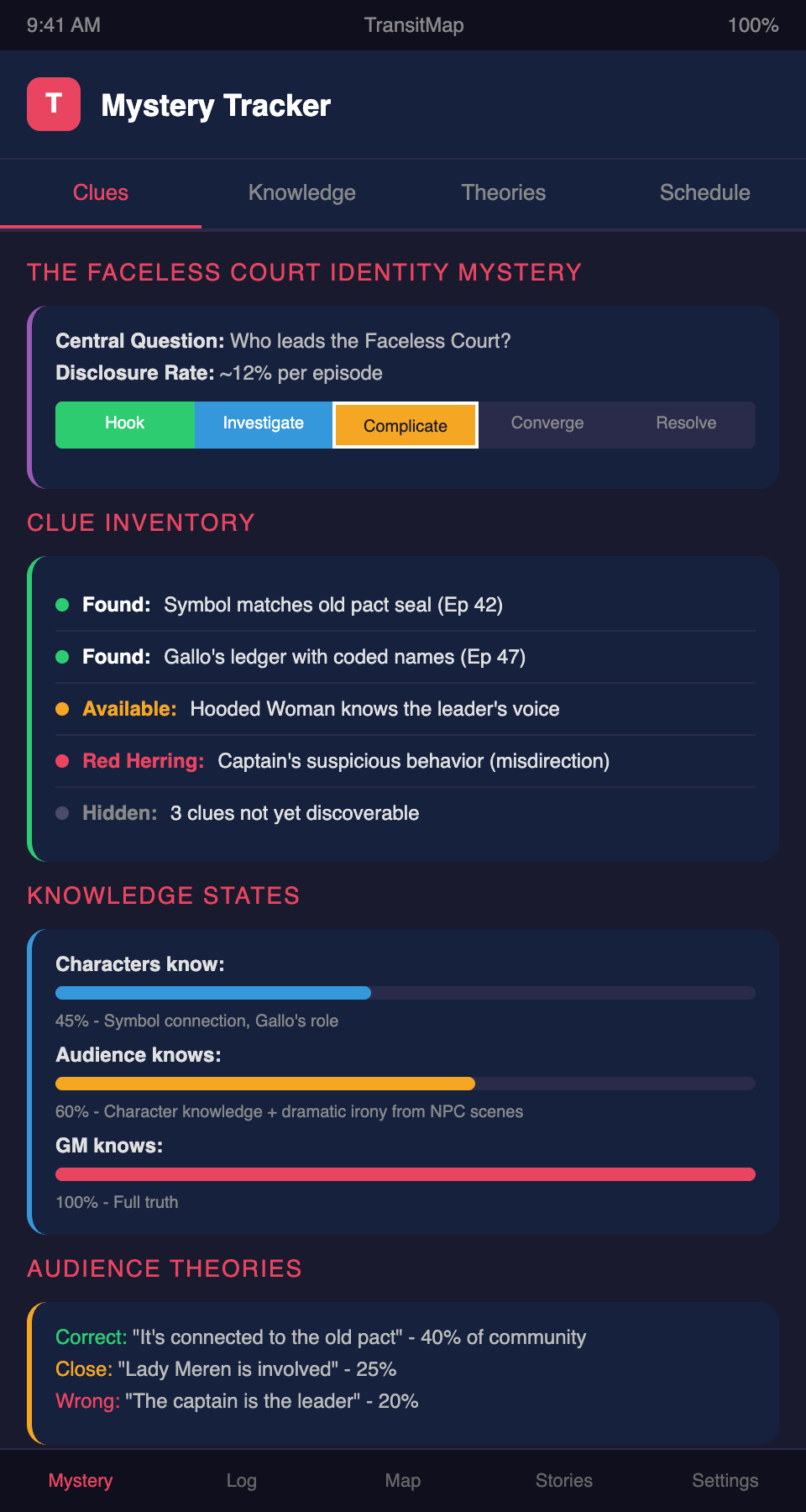
The Mystery Pacing Structure
Pace your mystery across episodes using a structured revelation schedule:
Episode 1-2: The Hook. Establish the mystery. Something is wrong. A question is posed. The characters recognize that something needs investigating. The audience's curiosity is activated.
Episode 3-5: Initial Investigation. Characters gather clues. Some clues point toward the truth; others are misleading. The audience begins forming theories. Each episode should reveal at least one piece of new information that either narrows or expands the possibility space.
Episode 5-7: The Complication. Something changes the nature of the investigation. A new suspect emerges. A clue contradicts an earlier finding. A witness recants. The complication forces the audience to revise their theories and re-engage.
Episode 7-9: Convergence. Clues begin pointing consistently toward the truth. The audience senses the resolution approaching. Tension builds as the remaining possibilities narrow.
Episode 9-10: Resolution. The mystery is solved. The answer should be:
- Surprising — Not the most obvious solution
- Fair — Supported by clues the audience could have assembled
- Satisfying — Worth the investment of ten episodes
- Consequential — The answer changes something meaningful in the campaign
Managing Audience Knowledge
In a mystery podcast, you are managing three knowledge states simultaneously:
What the characters know. The information the PCs have gathered through play. This expands incrementally with each investigation scene.
What the audience knows. Everything the characters know plus anything revealed through GM narration, NPC scenes, or dramatic irony. The audience often knows more than the characters.
What you (the GM) know. The complete truth. Your job is to control the rate at which the other two knowledge states approach yours.
The disclosure rate. How fast you reveal information determines the mystery's lifespan:
- Too fast: The mystery resolves before the audience is invested
- Too slow: The audience gets frustrated and loses interest
- Just right: Each episode advances understanding without collapsing the mystery
A practical guideline: reveal 10-15% of the total mystery per episode. At this rate, a mystery is substantially understood by Episode 7-8 and fully resolved by Episode 10.
Preventing Mystery Frustration
Long-form mysteries risk frustrating the audience if the investigation stalls:
Every episode must advance the mystery. Even in episodes focused on other content, include one mystery-relevant moment — a clue, a suspicion, a conversation that touches on the mystery. This maintains the mystery's presence without requiring full episodes devoted to investigation.
Reward correct audience theories. When the audience correctly deduces a piece of the mystery, let the characters confirm it in play. This validates the audience's investment and builds confidence that the mystery is solvable.
Distinguish between "I don't know yet" and "I'll never know." The audience should always feel that the mystery is progressing, even when answers are not forthcoming. Show the characters making progress — eliminating suspects, discovering new leads, getting closer — even when the final answer remains hidden.
Avoid unnecessary obfuscation. Mystery tension comes from not knowing the answer, not from not understanding the question. Make sure the audience clearly understands what they are trying to figure out, even if they do not yet know the answer.
Clue Design for Audio
Clues in audio must be delivered clearly because listeners cannot re-read a passage (unless they relisten):
Verbalize physical evidence. Instead of "you find a document with interesting markings," describe the markings: "The document bears a seal you've seen before — the same three-pointed star that was carved into the doorway in Episode 12."
Repeat key information. When a crucial clue is discovered, have at least two characters react to it, naturally repeating the information. This ensures the audience catches it.
Connect clues explicitly. When a new clue relates to a previous one, state the connection: "This matches what the informant told you three weeks ago." Do not assume the audience remembers — help them.
Tracking Mystery State
Maintain a mystery-specific tracker:
Clue inventory: Every clue available, found, and interpreted Audience knowledge state: What the audience could reasonably deduce from published episodes Character knowledge state: What the PCs have deduced Theory tracker: Major audience theories (from community discussions) and their accuracy Revelation schedule: Which revelations are planned for which episodes
This tracker prevents you from accidentally revealing too much too soon, or from leaving the mystery stalled for too many episodes.
Sustaining a mystery across your show's episodes? Join the TransitMap waitlist — map your mystery's clue network as interconnected transit stops, with revelation timing and audience knowledge state tracked visually across your episode timeline.