Onboarding Editors for Your Actual Play Podcast
Why Editor Onboarding Matters
Most actual play shows start with the GM editing their own recordings. As the show grows, editing is delegated to someone else — a producer, a freelancer, or a volunteer team member. This transition is where many shows lose quality, not because the new editor lacks technical skill, but because they lack narrative context.
An editor without narrative context makes decisions based solely on audio quality: cut the long pause, trim the crosstalk, equalize the levels. An editor with narrative context makes decisions based on story: keep the long pause because it is dramatic tension, preserve the crosstalk because it captures genuine player excitement, let the quiet moment breathe because the character revelation needs space.
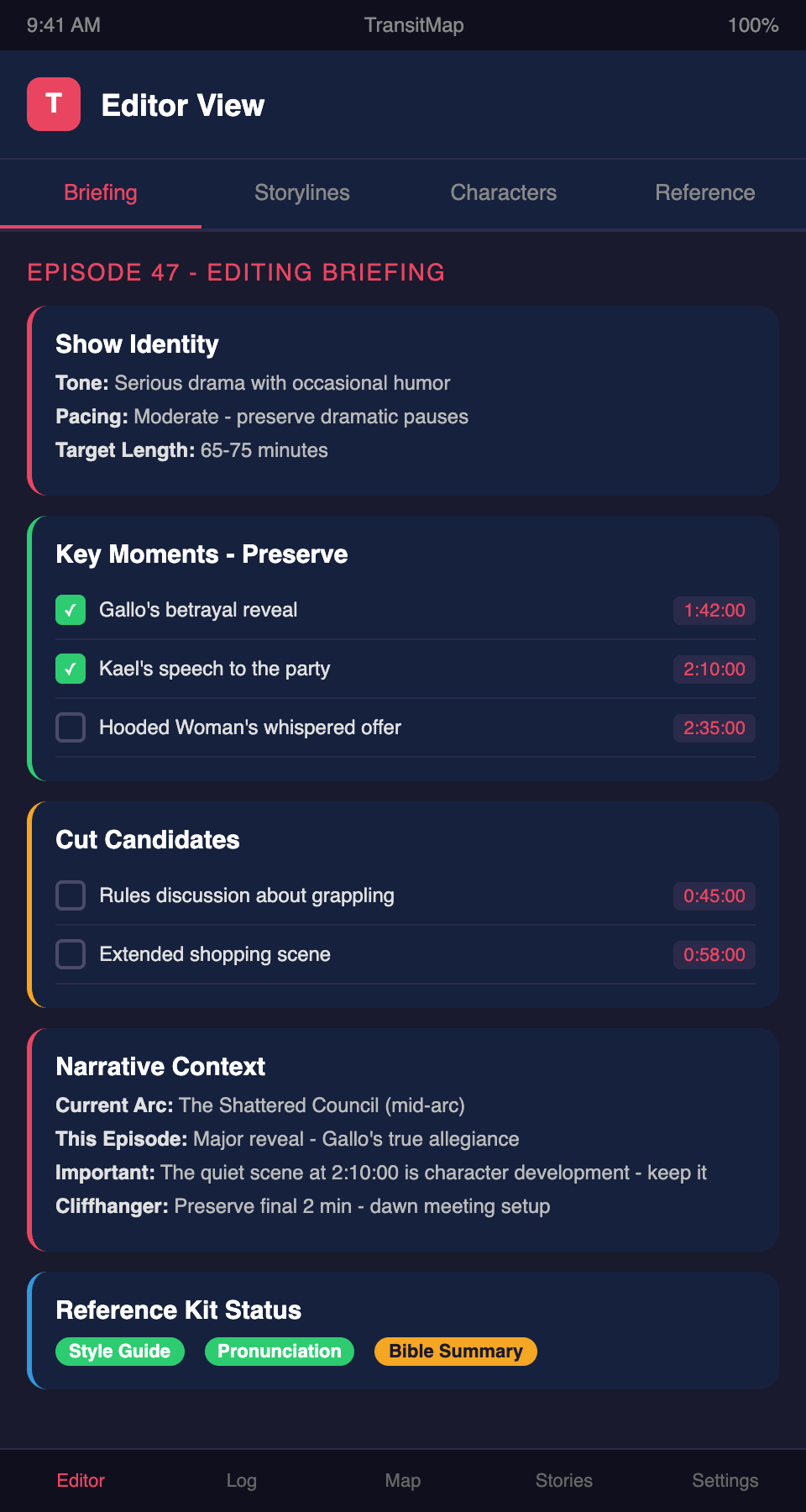
What Editors Need to Know
Your editor needs four categories of information:
Category 1: Show Identity
- Tone — Is the show serious, comedic, a mix? This affects how much table banter is kept versus cut.
- Pacing preference — Do you prefer tight edits with minimal dead time, or a more natural pace that preserves the live-play feel?
- Audio standards — Target loudness, noise floor tolerance, music and sound effect usage.
- Format conventions — Episode length target, intro/outro structure, ad placement, chapter markers.
Category 2: World and Characters
Your editor needs a reference document covering:
- Character names and pronunciations — So they can verify correct names in chapter titles, show notes, and social media clips
- Key NPCs — So they know who is being referenced in dialogue
- Location names — Same as above
- Current storyline summaries — So they understand the narrative context of what they are editing
This does not need to be exhaustive. A one-page reference updated before each editing batch is sufficient.
Category 3: Narrative Priority
For each episode or recording session, provide editing notes that tell the editor:
- Key moments — "The reveal at timestamp 1:42:00 is critical — make sure the audio is clean and the moment has space."
- Cut candidates — "The rules discussion from 0:45:00 to 0:52:00 can be trimmed or cut entirely."
- Preserve moments — "The quiet conversation at 2:10:00 sounds slow but it is character development — keep it."
- Sensitive content — "A player shares something personal at 1:15:00. Check with the cast before including."
These notes take five minutes to write and save the editor hours of guesswork.
Category 4: Production Workflow
- File delivery method — How and where raw recordings are shared
- Editing deadline — When the edited episode is due
- Review process — Who reviews the edit before publication? How is feedback communicated?
- Revision expectations — How many revision rounds are typical?
- Communication channel — How should the editor ask questions or flag issues?
The Editor's Reference Kit
Create a standardized reference kit that you give to every new editor:
- The style guide — Audio standards, pacing preferences, format conventions, music/sound effect library and usage rules
- The series bible summary — A condensed version of your series bible covering current characters, locations, and storylines
- The pronunciation guide — Every proper noun with phonetic pronunciation
- Three example episodes — Episodes that represent your target quality, with annotations explaining why specific editing decisions were made
- The editing workflow document — File delivery, deadlines, review process, communication channels
This kit should take two to three hours to assemble initially and fifteen minutes to update for each new editor.
The Editing Briefing Cycle
For each episode or batch of episodes, provide a brief editing briefing:
Before editing:
- Updated character/storyline reference if anything changed
- Per-episode editing notes (key moments, cut candidates, preserve moments)
- Any special instructions (this episode has a guest player, this episode has sensitive content, this episode has a major plot twist)
After first edit:
- Review the edit with narrative awareness: Did the editor preserve the important moments? Did they cut anything that was narratively significant?
- Provide specific, actionable feedback: "Please restore the conversation at 1:15:00 — it sets up a callback we need later" rather than "the edit feels off."
Ongoing:
- Regular check-ins to align on evolving show needs
- Updated reference materials as the campaign progresses
- Celebration of good editing decisions to reinforce the desired approach
Training for Narrative Editing
Beyond technical skills, train your editor in narrative awareness:
Pacing as storytelling. Teach them to recognize when a slow moment is deliberate (building tension, emotional weight) versus when it is dead air (players checking rules, table conversation).
Emotional beats. Help them identify the emotional beats of each session — the moments that will matter to the audience. These moments should receive clean audio and appropriate space.
Cliffhanger awareness. If the session ends on a cliffhanger, the editor should know to preserve the tension of that final moment and not cut away abruptly.
Continuity assistance. An editor who knows the storylines can catch continuity errors during editing — a name misspoken, a fact contradicted — and flag them for the GM before publication.
Common Onboarding Mistakes
- No written reference materials — Expecting the editor to absorb everything verbally. Verbal instructions are forgotten. Written references persist.
- Over-editing expectations — Expecting the editor to make narrative decisions without narrative context. Either provide context or accept that the editor will make audio-quality decisions only.
- Under-communicating changes — The campaign takes a dramatic turn and the editor is not informed. They edit the post-betrayal episode without knowing a betrayal occurred.
- No example episodes — Telling the editor "make it sound good" without showing them what "good" sounds like for your show.
- Delayed feedback — Waiting until five episodes have been edited to give feedback. The editor has now edited five episodes with incorrect assumptions.
Onboarding a new editor for your actual play show? Join the TransitMap waitlist — give your editor a visual map of your show's storylines so they can understand the narrative context of every scene they edit.