Planning Narrative Callbacks in Your Actual Play Show
Why Callbacks Are Your Most Powerful Narrative Tool
A callback is a narrative moment that references, completes, or recontextualizes something established earlier in the story. It can be as small as repeating a character's catchphrase at a critical moment or as large as revealing that an entire storyline was set up by a scene from fifty episodes ago.
Callbacks are uniquely powerful in actual play shows for several reasons:
-
Audience investment scales with time. A callback that reaches back twenty episodes rewards listeners who have been with you for months. A callback that reaches back one hundred episodes rewards listeners who have been with you for years. The further back the callback reaches, the more powerful the emotional payoff.
-
Callbacks validate attentive listening. Listeners who caught the original detail feel smart and rewarded when the callback lands. This encourages deeper engagement with your show.
-
Callbacks create the illusion of master planning. Even callbacks that were not planned — retroactive connections to earlier details — make your narrative feel deliberate and cohesive. Audiences assume everything is intentional, and callbacks reinforce that assumption.
-
Callbacks differentiate your show. Any show can have exciting combat or funny roleplay moments. A show that weaves narrative threads across a hundred episodes demonstrates a level of craft that sets it apart.
Types of Callbacks
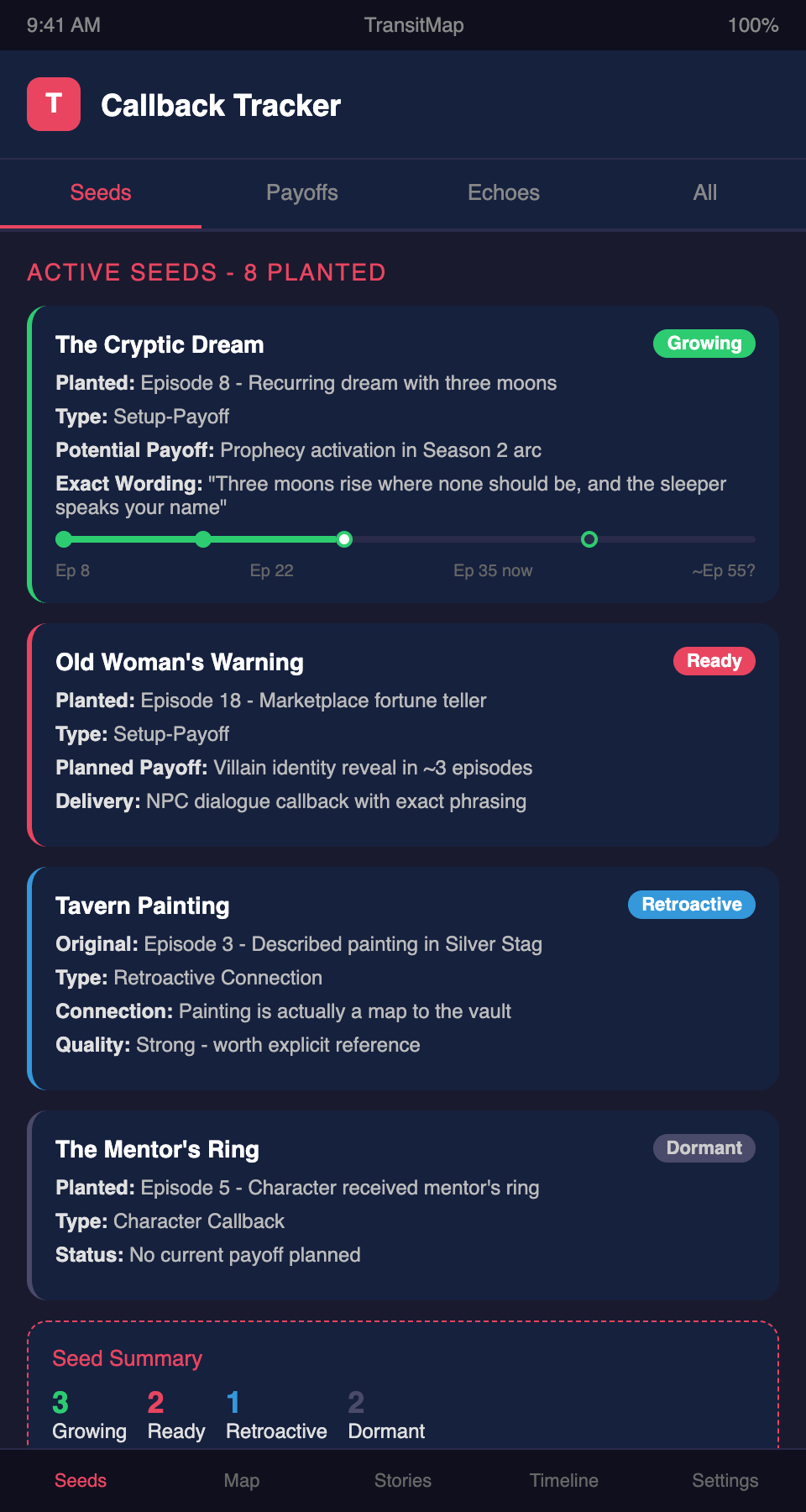
The Setup-Payoff. A detail is planted deliberately in an early episode with the intention of paying it off later. The mysterious symbol on the dungeon wall. The NPC's cryptic warning. The item that seems mundane but is actually significant. This type requires advance planning.
The Retroactive Connection. A detail from an early episode is connected to a later development after the fact. You did not plan the connection — you noticed the opportunity and seized it. The NPC the players befriended in Episode 5 turns out to be connected to the villain introduced in Episode 30. This type requires good record-keeping.
The Echo. A phrase, image, or situation from an earlier episode is deliberately repeated in a new context. The villain uses the same words the mentor used. The final battle takes place where the first adventure began. The character makes the same choice they made before, but with different consequences. This type requires thematic awareness.
The Character Callback. A character trait, decision, or moment from earlier in the campaign is referenced to show how the character has changed (or has not). The cowardly character who ran from the first fight stands their ground in the final battle. The rogue who stole from the party in Episode 3 sacrifices their treasure in Episode 80. This type requires character arc tracking.
Building a Callback Tracking System
The Seed Log
Every potential callback starts as a seed — a detail that might become significant later. Not every seed will grow into a callback, but you need to record them so you can find them when you need them.
After every recording session, review the episode and log seeds:
- What it is — The specific detail (a name, an object, a phrase, a location, a character moment)
- Where it appeared — Episode number and approximate timestamp
- What it could connect to — Your initial ideas for potential payoffs (these may change)
- Status — Planted, growing (you are developing a payoff), paid off, dormant (no current plan)
The Payoff Planner
When you are planning a major story beat, check your seed log for potential callbacks:
- Is there a seed from an earlier episode that could connect to this moment?
- Would the connection feel natural or forced?
- Would the audience need to remember the original detail, or will you provide enough context?
For each planned callback, note:
- The seed — What was established and when
- The payoff — What you plan to do with it
- The delivery method — How will the callback be presented? GM narration, NPC dialogue, environmental detail, player realization?
- Context assistance — Do you need to remind the audience of the original detail? If the seed was planted seventy episodes ago, a brief contextual reminder helps the callback land.
Planting Seeds Effectively
Be specific but not obvious. A seed that is too vague ("something felt wrong about the room") will not be recognizable when the callback occurs. A seed that is too obvious ("the painting's eyes seem to follow you — remember this, it will be important later") kills the surprise. Aim for specific enough to be identifiable but natural enough to pass unnoticed.
Plant in character moments. Seeds embedded in character interactions feel more natural than seeds embedded in GM narration. An NPC who mentions a detail in conversation is more organic than the GM describing a mysteriously significant object.
Plant multiple seeds. Not every seed will be remembered by your audience. If you plant three seeds for the same callback, at least one will be recalled when the payoff arrives.
Record the exact wording. When you plant a seed on air, write down the exact words used. When the callback arrives, using the same (or deliberately altered) phrasing strengthens the connection.
Delivering Callbacks Effectively
Provide context without over-explaining. When a callback arrives, some audience members will recognize it instantly and some will not. Provide enough context for the latter without insulting the former:
Instead of: "Remember when the merchant said this exact thing? Well now it means THIS!" Try: "The phrase echoes in your mind — you have heard these words before. The merchant in Thornfield, the night before everything changed."
Let players discover callbacks organically. The most satisfying callbacks are ones that players recognize themselves. If a player says "wait — that is the same symbol from the cave in Episode 12!" the moment is more powerful than if the GM announces the connection.
Time your callbacks for maximum impact. A callback in the middle of a routine travel scene has less impact than a callback at the climax of a major arc. Save your best callbacks for moments of high emotion.
Layer callbacks. A single scene can contain multiple callbacks — a location callback, a character callback, and a thematic callback simultaneously. Layered callbacks create the richest narrative moments.
Common Callback Mistakes
- Forcing connections that do not work — Not every detail needs to become a callback. Forced connections feel artificial and undermine the callbacks that do work.
- Callbacks without context — Referencing something from Episode 8 in Episode 90 without any contextual cue. Most listeners will miss it entirely.
- Over-planning callbacks — Planting so many seeds that the early episodes feel like a checklist of future plot points rather than organic storytelling.
- Neglecting the seed log — Planting seeds and then forgetting them. The unresolved seed becomes a plot hole rather than a callback.
Want to track every narrative seed and planned callback across your show's run? Join the TransitMap waitlist — map seeds and payoffs as connected stations on your show's timeline, with visual lines showing exactly which early details connect to which later revelations.