Building and Maintaining a Series Bible for Your Actual Play Show
What a Series Bible Is and Why You Need One
A series bible is a comprehensive reference document that contains everything canonically true about your show's world, characters, and storylines. Television writers have used them for decades. Actual play shows need them for the same reason: when multiple people need to maintain consistency across a long-running narrative, everyone needs access to the same reference.
For an actual play show, your series bible serves multiple audiences:
- The GM uses it to verify facts during prep and avoid contradictions
- The players reference it to maintain character consistency and recall past events
- Editors use it to verify proper nouns, spellings, and pronunciations during post-production
- New team members (guest players, substitute editors, social media managers) use it to get up to speed
- The show itself benefits from the disciplined documentation that the bible requires
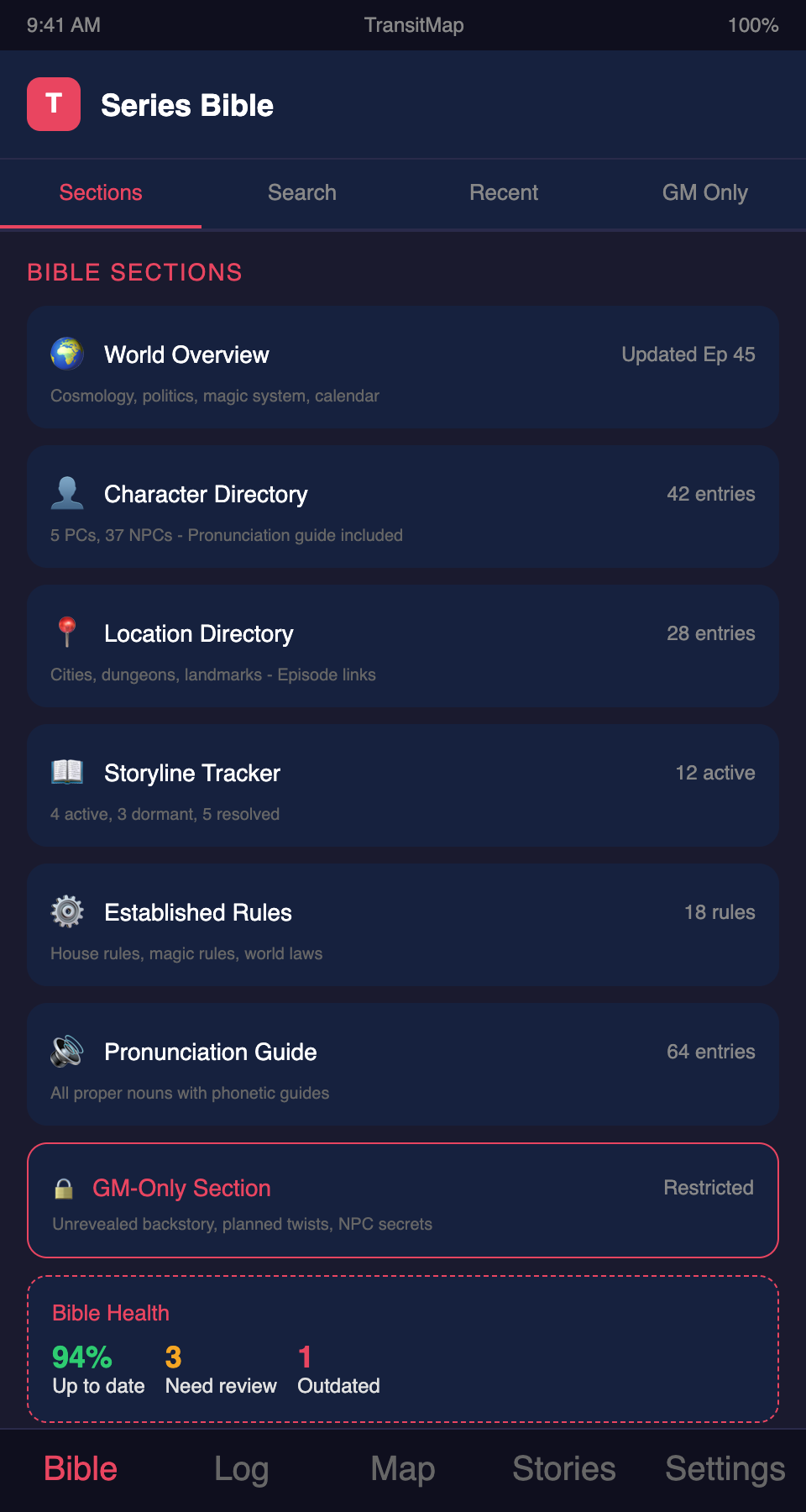
Series Bible Structure
Organize your bible into sections that match how people actually search for information:
Section 1: World Overview
A two-to-three-page overview of the setting:
- The world's name and basic cosmology
- The current political and social landscape
- How magic (or technology, or the supernatural) works
- The tone and genre conventions of the show
- The current in-game date and calendar system
This section should be stable — updated rarely, only when fundamental world facts change.
Section 2: Character Directory
Player Characters: For each PC, maintain:
- Full name (and pronunciation guide if needed)
- Race, class, and level
- Physical description as established on air
- Personality traits as demonstrated in play (not backstory — actual on-air behavior)
- Key relationships with other PCs and NPCs
- Current goals and motivations
- Backstory elements that have been revealed on air (separate from backstory elements known only to the GM)
- Significant items and abilities
NPCs: For each significant NPC:
- Name and pronunciation
- Physical description as established on air
- Location and role
- Personality in three words
- Relationship to the player characters
- Key information they possess
- Current status (alive, dead, missing, transformed)
- First appearance episode number
Section 3: Location Directory
For each significant location:
- Name and pronunciation
- Physical description as established on air
- Key features and landmarks
- Notable inhabitants
- Storyline connections
- Episodes where this location featured prominently
Section 4: Storyline Tracker
For each active storyline:
- Storyline name and brief description
- Current status (active, dormant, resolved)
- Key episodes
- Unresolved questions
- Known connections to other storylines
- Planned developments (GM eyes only — flag this section accordingly)
Section 5: Established Rules
Any rules, mechanics, or world logic that have been established on air:
- House rules
- How specific spells or abilities work in your world
- Legal, social, or magical systems that have been described
- Any "this is how it works in our world" declarations
These are especially important because audiences will remember rule declarations and hold you to them.
Section 6: Pronunciation Guide
A list of every proper noun in the show with its phonetic pronunciation. This is critical for:
- Consistency across episodes (the GM says "AHL-dric" but the player says "al-DRIK")
- Editor reference during post-production
- Fan wiki accuracy
Maintaining the Bible
A series bible that is not maintained is worse than no bible at all — it gives false confidence in outdated information.
Update frequency: After every recording session, spend ten to fifteen minutes updating relevant sections. This is non-negotiable. Build it into your production workflow.
Update responsibility: Assign one person as the bible's maintainer. This can be the GM, a producer, or a dedicated team member. Having a single owner prevents the "I thought you were updating it" problem.
Version control: Track when entries were last updated. An NPC entry that was last updated thirty episodes ago should be flagged for review.
Player contributions: Players should update their own character entries. They know their character's current state better than you do. Provide a simple template and a deadline.
The GM-Only Section
Your series bible should have a restricted section that only the GM can access:
- Unrevealed backstory elements
- Planned plot twists
- NPC secrets
- Future storyline developments
- Player backstory connections that have not been revealed yet
This section ensures you can reference your plans without spoiling your players. If your bible is a shared document, use access controls. If it is a physical document, keep the restricted section separate.
Common Series Bible Mistakes
- Building the bible before you need it — Creating an elaborate bible in Session Zero that goes out of date by Session 5. Start minimal and grow organically.
- Making it too long — A 200-page bible that nobody reads defeats its purpose. Keep entries concise. Link to detailed sub-documents for deep dives.
- Not distinguishing canon from plans — Mixing "what has been established on air" with "what I plan to establish" creates confusion. Clearly mark planned content as non-canonical.
- Ignoring the pronunciation guide — Inconsistent pronunciation is the most noticeable continuity error for audio audiences. Maintain the guide from Episode 1.
- Treating the bible as static — The bible is a living document. If you are not updating it regularly, it is a historical artifact, not a reference tool.
Building a series bible for your actual play show? Join the TransitMap waitlist — organize your show's canonical information as an interconnected map where characters, locations, and storylines are all linked and searchable.