Managing Story Thread Density in Your Actual Play Show
What Is Thread Density?
Thread density is the number of active storylines that your audience is expected to track at any given time. It includes main plots, subplots, character arcs, faction movements, mysteries, and any other narrative element that the audience needs to remember to fully understand the show.
High thread density creates a rich, complex narrative that rewards attentive listening. Low thread density creates a focused, accessible story that is easy to follow. Neither is inherently better — but the wrong density for your show's format and audience will cause problems.
Finding Your Show's Ideal Density
Several factors determine the right thread density:
Episode frequency. Weekly shows can sustain higher thread density because listeners have less time to forget details between episodes. Monthly shows need lower density because the gaps between episodes cause more information loss.
Episode length. Longer episodes can service more threads per episode, keeping more threads active without any single thread going too long without attention. Shorter episodes need to be more selective about which threads receive screen time.
Audience type. Dedicated, binge-listening audiences handle higher density. Casual listeners who catch episodes intermittently need lower density.
Show complexity. A political intrigue show naturally has higher thread density than a dungeon-crawling adventure show. Match your density to your genre.
General guidelines:
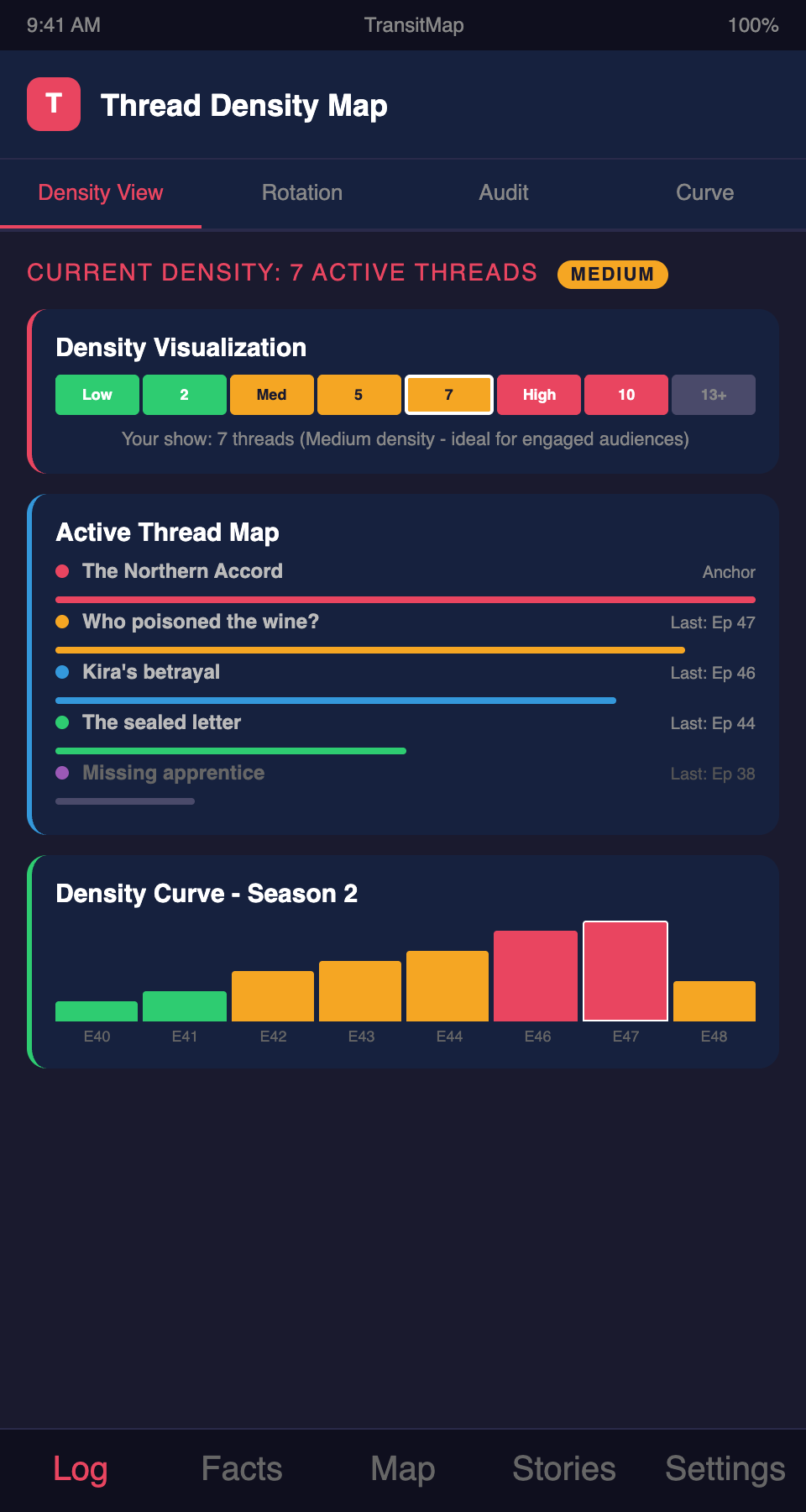
- Low density (2-4 active threads): Best for new shows, casual audiences, and action-focused content
- Medium density (5-7 active threads): Best for established shows with engaged audiences
- High density (8-12 active threads): Best for long-running shows with dedicated, attentive audiences
- Excessive density (13+ active threads): Almost always too many. Even the most engaged audiences struggle beyond twelve simultaneous threads
Measuring Your Current Density
Audit your current thread density:
Step 1: List every storyline, subplot, mystery, character arc, and faction movement that is currently active — meaning the audience has been given information about it and expects further development.
Step 2: For each thread, note when it was last referenced on the show. Threads not referenced in the last five episodes may have faded from audience memory.
Step 3: Count the active threads. Compare to the guidelines above.
Step 4: If your density is too high, identify threads to resolve, dormant, or bundle. If it is too low, identify opportunities to introduce new threads or reactivate dormant ones.
Managing High-Density Shows
If your show has high thread density, use these techniques to keep the audience oriented:
Thread rotation. Not every thread needs attention every episode. Rotate which threads receive focus, ensuring each active thread surfaces at least once every three to four episodes.
Anchor threads. Designate one or two threads as anchors that appear in every episode. These provide continuity while other threads rotate in and out.
Explicit connections. When referencing a thread, explicitly connect it to the current scene: "This reminds you of what the merchant said about the Northern Accord." Do not assume the audience remembers the connection.
Recap integration. Weave brief recaps into natural dialogue: "We still have not figured out who poisoned the well — and now this." This refreshes the audience's memory without breaking immersion.
Visual aids. Publish thread trackers, relationship maps, or storyline timelines as supplementary content. These help the audience manage high density.
Managing Low-Density Shows
Low density is not a problem unless it leads to thin storytelling:
Deepen existing threads. Instead of adding threads, add layers to existing ones. A single quest can have complications, reversals, and discoveries that provide variety without adding new threads.
Character depth. Use the narrative space freed by low thread count to deepen character development. Extended roleplay scenes, personal reflections, and relationship building fill episodes richly without adding plot complexity.
World texture. Add richness through world-building details that do not constitute new threads. The culture of a city, the history of a region, the customs of a faction — these provide depth without demanding tracking.
The Density Curve
Thread density should vary across your show's structure:
Arc beginning: Lower density. Introduce the arc's core thread and let the audience focus on it before adding complexity.
Arc middle: Rising density. Introduce complications, subplots, and connections that enrich the core thread.
Arc climax: Peak density. All threads converge. The audience must hold multiple threads in mind simultaneously as they resolve.
Arc transition: Dropping density. Resolve threads. Close storylines. Give the audience breathing room before the next arc begins.
Season level: The same curve applies at the season level. Season premieres have lower density than mid-season episodes, and season finales bring all threads together before density resets.
Thread Density and New Listeners
High thread density creates a barrier for new listeners. If a new listener tunes into Episode 50 and needs to track nine active storylines with backstory stretching back dozens of episodes, they will likely give up.
Mitigation strategies:
- Provide recap content at natural entry points
- Design some episodes that are accessible without full backstory
- Maintain your supplementary documentation to help new listeners orient
- Consider periodic soft resets where density drops and new listeners can more easily join
Struggling with thread density in your actual play show? Join the TransitMap waitlist — visualize all active storylines as transit lines on a single map, see density at a glance, and plan thread rotation to keep your show balanced and your audience engaged.