Designing Branching Storylines for Tabletop RPGs That Don't Collapse
The Branching Problem
In theory, branching storylines are the ultimate expression of player agency. The players make a choice, and the story splits into different paths based on that choice. Each path leads to new choices, which create more paths, and so on.
In practice, this creates an exponential growth problem. One choice creates two branches. Two choices create four. Three choices create eight. By the fifth decision point, you have thirty-two possible story states to track, and most of them will never be experienced by anyone.
This is why most published adventure modules with branching storylines are either very short or very shallow. The math simply does not allow for deep branching at scale — unless you use design techniques that manage the complexity without eliminating the choice.
Technique 1: The Funnel
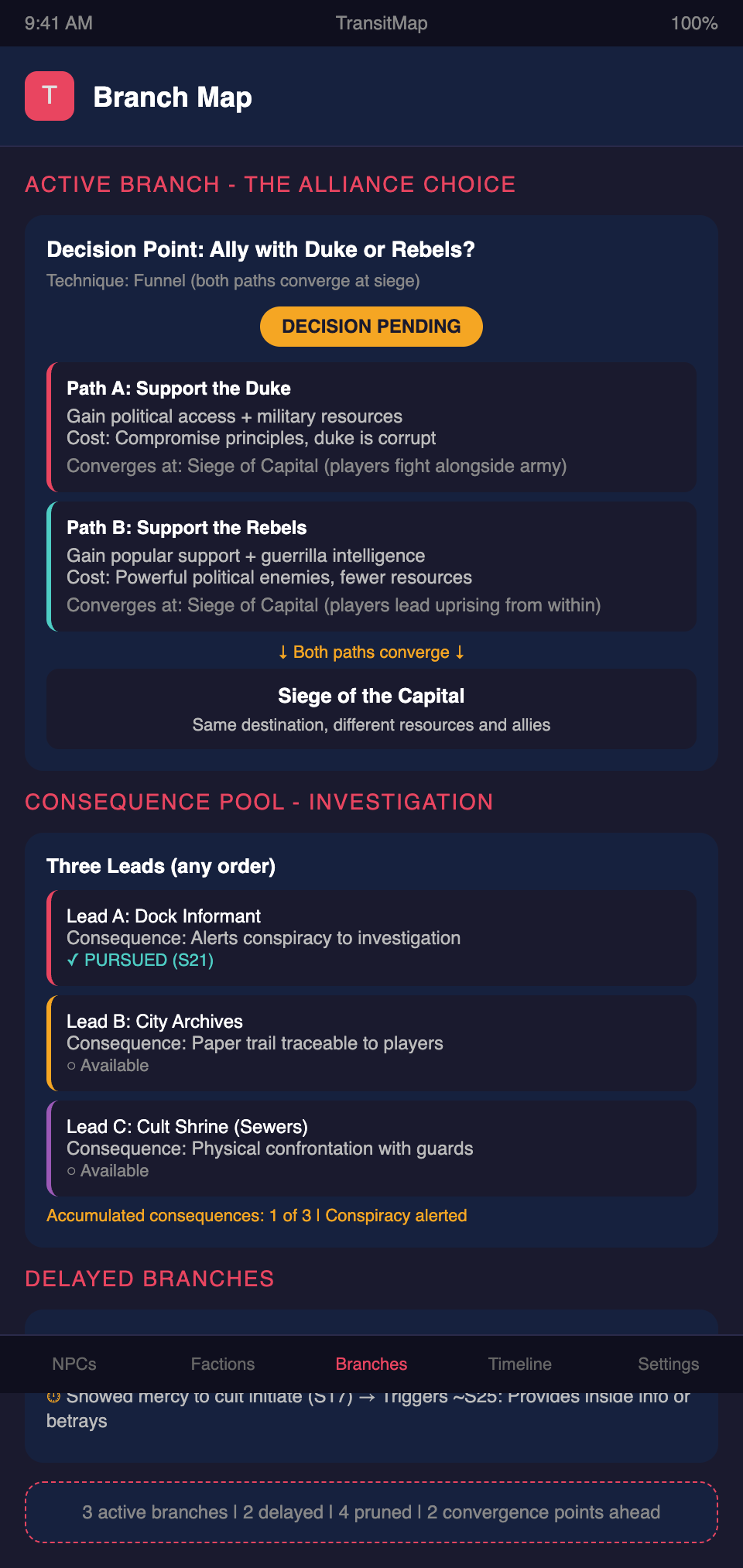
Instead of letting branches diverge forever, design them to reconverge. Players make a choice that creates two paths, but both paths eventually arrive at the same narrative destination — through different means and with different consequences.
Example:
- Choice: Ally with the duke or the rebels
- Duke path: The players gain political access and military resources but must compromise their principles
- Rebel path: The players gain popular support and guerrilla intelligence but make powerful enemies
- Convergence: Both paths lead to the siege of the capital, but the player's alliance determines who they are fighting alongside and what resources they have
The players' choice was meaningful — it changed their experience, their relationships, and their resources. But you only need to prepare one siege, not two completely different scenarios.
Technique 2: The Sliding Scale
Instead of binary branches (path A or path B), design choices as positions on a sliding scale that modify the next scene rather than replacing it.
Example:
- Situation: The players must negotiate a treaty between two nations
- Scale: Their approach ranges from "fully supports Nation A" to "fully supports Nation B" with "balanced compromise" in the middle
- Effect: The treaty is always signed, but the terms shift based on the players' approach. This affects which nation is grateful, which is resentful, and what concessions were made — all of which ripple forward into future sessions
You prepare one treaty negotiation scene. The players' choices slide the outcome along a spectrum rather than splitting into completely separate branches.
Technique 3: The Consequence Pool
Instead of designing specific outcomes for each branch, maintain a pool of consequences that are deployed based on player choices.
Example: The players are investigating a conspiracy. They can pursue three leads:
- Lead A: The informant in the docks district
- Lead B: The records in the city archive
- Lead C: The cult shrine in the sewers
Each lead reveals a piece of the conspiracy and generates a consequence:
- Following Lead A alerts the conspiracy that they are being investigated
- Following Lead B creates a paper trail that the conspiracy can trace back to the players
- Following Lead C triggers a physical confrontation with cult guards
The players can pursue the leads in any order. Each lead they follow adds its consequence to the pool. By the time they have enough information to act, the accumulated consequences create a unique scenario — but you did not need to pre-plan every permutation. You prepared three leads and three consequences, and the combination creates emergent complexity.
Technique 4: The Delayed Branch
Not every choice needs to branch the story immediately. Some choices create delayed branches — consequences that manifest sessions later when the players have forgotten the choice that caused them.
Example: In session 5, the players spare a bandit leader instead of killing them. In session 15, the bandit leader returns — either as a reformed ally (if the players were merciful in how they spared them) or as a vengeful enemy (if they humiliated them). The branch from session 5 does not activate until session 15, giving you ten sessions to prepare for it.
Delayed branches are powerful because:
- They reduce your immediate prep burden — you do not need to resolve the branch now
- They create satisfying callbacks — players love discovering that past choices have consequences
- They give you time to design the branched content thoughtfully
Technique 5: The Pruned Tree
Accept that some branches will never be explored and do not prepare them. When the players choose path A, path B ceases to exist. You do not need to know what would have happened on path B.
This feels wasteful if you have already prepared path B content, which is why you should not prepare detailed content for branches before the choice is made. Instead, prepare:
- The choice itself (clear options with visible stakes)
- A one-sentence summary of what each option leads to (for your own decision-making)
- Detailed content only for the chosen path (prepared after the choice is made)
This means you are always preparing one session ahead on the chosen path rather than multiple sessions ahead on all possible paths.
Combining Techniques
In practice, you will use multiple techniques within the same campaign:
- Major campaign choices use the funnel — paths diverge but reconverge at major plot points
- Scene-level choices use the sliding scale — outcomes shift along a spectrum rather than branching
- Investigation sequences use the consequence pool — players choose which leads to follow and consequences accumulate
- Character moments use delayed branches — personal choices create consequences that manifest later
- Tangential choices use the pruned tree — unchosen paths are not developed
Tracking Branching Storylines
The practical challenge of branching storylines is visibility. You need to see:
- Which branches are currently active
- Which branches have been pruned (and what triggered the pruning)
- Where active branches are scheduled to reconverge
- Which delayed branches are waiting to activate and what triggers them
- How the current state of the story reflects the accumulated choices
A visual system where branches are literally drawn as branching paths — splitting at decision points and merging at convergence points — makes this complexity manageable. When you can see the tree at a glance, you can make informed decisions about where to add new branches, where to force convergence, and where to let consequences accumulate.
Want to design and track branching storylines without drowning in complexity? Join the TransitMap waitlist — map your campaign's branches as transit routes that split at junctions and merge at transfer stations, keeping every possible path visible and manageable.