Campaign Arc Planning: How to Structure a Satisfying Long-Form Story
The Difference Between a Campaign and a Series of Adventures
Many campaigns are really just a string of loosely connected adventures. The players go from dungeon to dungeon, quest to quest, leveling up along the way. This is fine — some groups love it. But if you want your campaign to feel like a story with rising stakes, meaningful turning points, and a climactic finale, you need an arc.
A campaign arc is the overarching narrative structure that gives meaning to individual sessions and adventures. It is the answer to the question your players will ask when the campaign ends: "What was that story actually about?"
The Three-Act Campaign Structure
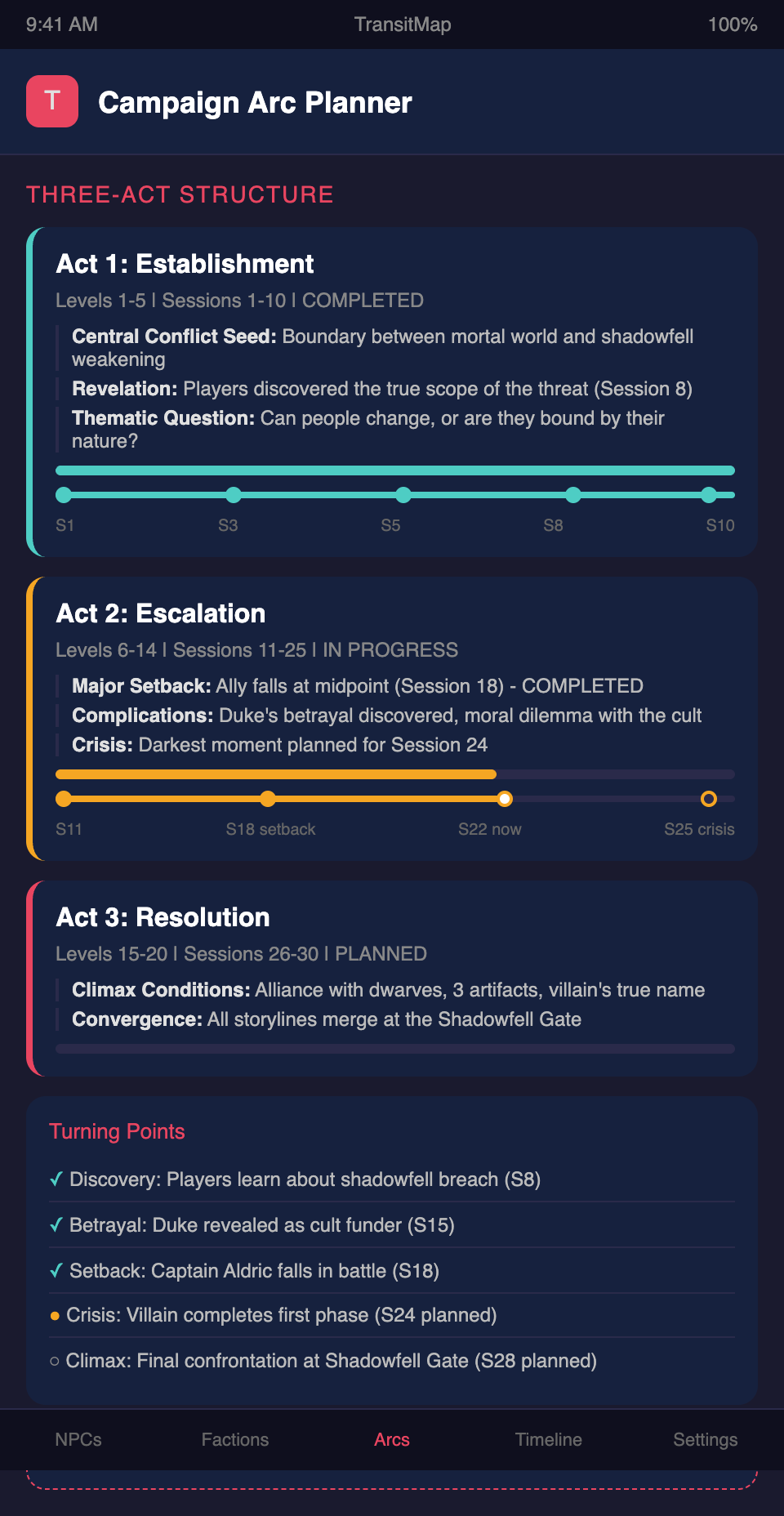
The simplest and most robust arc structure borrows from screenwriting. It works because it maps naturally onto the way D&D campaigns already tend to flow:
Act 1: Establishment (Levels 1-5)
- Introduce the world, the tone, and the core cast of NPCs
- Let the players define their characters through early choices
- Plant the seeds of the central conflict without revealing it fully
- End Act 1 with a revelation — the players discover the true scope of the threat or the true nature of the conflict
Act 2: Escalation (Levels 6-14)
- The stakes rise steadily. Each adventure should raise the difficulty and the consequences
- The players actively pursue the central conflict, making allies and enemies along the way
- Introduce complications — things that make the central conflict harder to resolve. Betrayals, moral dilemmas, unexpected consequences of earlier choices
- The midpoint of Act 2 should feature a major setback — the players lose something important, an ally falls, a plan fails
- End Act 2 with a crisis — the darkest moment of the campaign, where the central conflict seems unwinnable
Act 3: Resolution (Levels 15-20)
- The players rally, using everything they have learned and gained
- Previous storylines converge on the final conflict
- The climax should test not just the players' combat abilities but their relationships, values, and the choices they have made throughout the campaign
- Resolution should feel earned — not a foregone conclusion, but the logical consequence of everything that came before
Planning the Arc Without Over-Planning the Sessions
The biggest mistake GMs make when planning a campaign arc is confusing arc planning with session planning. These are different activities:
- Arc planning answers: What is the overall shape of the story? What are the major turning points? What does the climax look like?
- Session planning answers: What happens Tuesday night?
You can have a detailed arc plan and a loose session plan. In fact, you should. The arc gives you direction; the sessions give you flexibility.
Here is what you should define at the arc level:
-
The central conflict — What is the fundamental problem the campaign is about? Be specific. "Stop the evil wizard" is a goal. "The boundary between the mortal world and the shadowfell is weakening, and someone is deliberately accelerating it" is a conflict.
-
The antagonist's plan — What is the villain doing, step by step, to achieve their goal? This plan should progress regardless of what the players do. If the players do nothing, the villain wins. This creates urgency.
-
Three to five major turning points — These are the big moments that change the direction of the campaign. Plan them as situations, not as outcomes. "The players discover the duke is funding the cult" is a turning point. How they discover it and what they do about it is session-level content.
-
The climax conditions — What needs to be true for the final confrontation to happen? What alliances, artifacts, or knowledge do the players need? This gives you a natural checklist for Act 3.
-
The thematic question — What is the campaign really about, underneath the plot? Power and corruption? The cost of duty? Whether people can change? This theme should resonate through every major decision point.
Building Flexibility Into Your Arc
A rigid arc will shatter on contact with players. A flexible arc bends and holds. Here is how to build in flexibility:
Plan turning points as situations, not scenes. Instead of "In session 15, the duke will reveal his betrayal during the feast," plan "At some point in Act 2, the duke's betrayal becomes known." The timing and circumstances can adapt to what the players are doing.
Create multiple paths to each turning point. The players might discover the duke's betrayal by finding documents, by following a suspicious NPC, by being betrayed directly, or by hearing a rumor. Any of these paths works. Prepare the revelation, not the road to it.
Let the players change the order. If they skip ahead to something you planned for later, let them. If they linger on something you expected to resolve quickly, let them. The arc is a sequence of escalating stakes, not a railroad.
Have the villain react to the players. An antagonist whose plan never changes in response to player interference is not a character — it is a script. When the players disrupt one part of the villain's plan, the villain should adapt, counter, and escalate.
Common Arc Planning Failures
The Invisible Arc — You have an arc in your head but the players cannot see it. They do not know they are in Act 2. They do not sense the escalation. Fix this by making the stakes visible: have NPCs comment on how things are getting worse, show the consequences of the villain's progress, let the players see the clock ticking.
The Runaway Arc — You planned a Level 1-20 arc but the campaign might end at Level 12 due to scheduling or group changes. Fix this by designing your arc in self-contained phases. Each act should have its own mini-climax that could serve as a satisfying endpoint if the campaign stops early.
The Frozen Arc — Side quests and player tangents have stalled the main storyline for months. The players have forgotten what the central conflict is. Fix this by having the central conflict intrude on whatever the players are doing. The villain does not wait politely while the players explore a side dungeon.
The Railroaded Arc — You are so attached to your planned turning points that you are forcing players toward them regardless of their choices. Fix this by remembering that the arc is a framework, not a script. The turning points are destinations; the roads are the players' to choose.
Tracking Your Arc Across the Campaign
The practical challenge of arc planning is maintaining visibility over a structure that spans months or years of real time. By session thirty, the seeds you planted in session three may have been forgotten — by you, not just by the players.
A visual timeline of your arc is invaluable. Map out the major turning points, mark which ones have happened and which are still ahead, and track where you are in the overall structure. When you can see the whole arc at once, you can make better decisions about pacing, about when to advance the main plot versus when to let side stories breathe, and about when to bring dormant threads back into play.
Ready to see your entire campaign arc at a glance? Join the TransitMap waitlist — map your campaign's narrative structure like a transit system and never lose sight of where the story is headed.