Campaign Journal Organization: Methods That Work for Real GMs
The Journal Nobody Reads
Most GM journals are graveyards of good intentions. You start the campaign committed to thorough documentation. By session ten, your entries are getting shorter. By session twenty, you are writing "stuff happened, fought some goblins, went to tavern." By session thirty, you have stopped entirely.
The problem is usually not discipline. It is format. The journal format you chose does not match how you actually use the information. You are writing prose when you need bullet points. You are recording everything when you only need key decisions. You are organizing chronologically when you need topical access.
Method 1: The Session Recap
The most common approach. After each session, write a narrative summary of what happened.
How it works: Write one to three paragraphs describing the session's events in chronological order. Include key decisions, encounters, and revelations.
Strengths:
- Creates a readable narrative history of the campaign
- Useful for players who miss sessions
- Captures the feeling and tone of each session
Weaknesses:
- Time-consuming (15-30 minutes per session)
- Hard to find specific information (Ctrl+F works poorly for narrative prose)
- Buries key facts inside paragraphs
- Becomes a chore that GMs eventually abandon
Best for: GMs who enjoy writing, campaigns with a strong narrative focus, groups where players want to read recaps.
Method 2: The Structured Log
Instead of narrative prose, record each session as a structured set of fields.
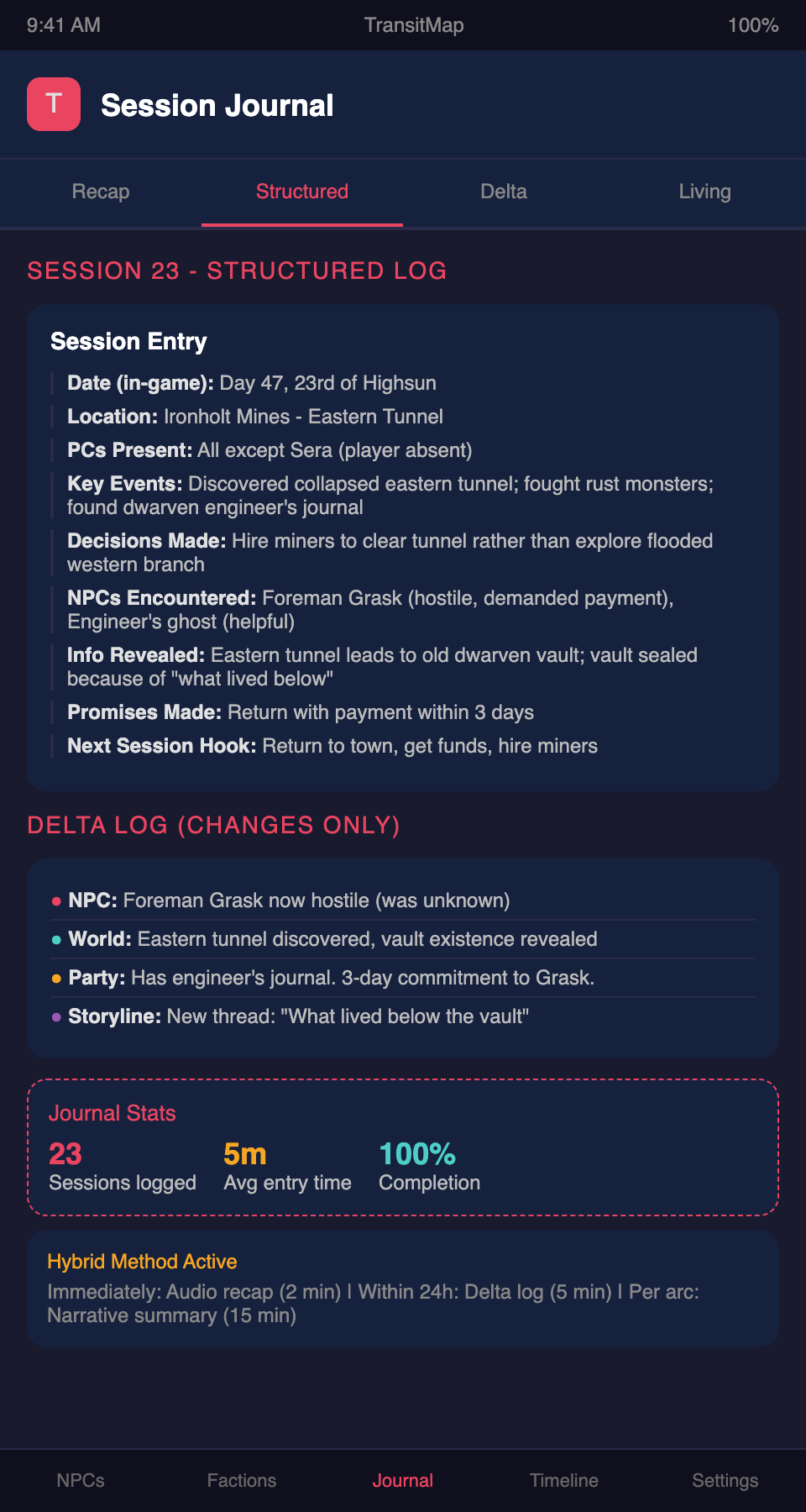
How it works: Use a template for every session entry:
- Date (in-game): Day 47, Month of Storms
- Location: Ironholt Mines
- PCs present: All except Lyra (player absent)
- Key events: Discovered the collapsed eastern tunnel; fought rust monsters; found the dwarven engineer's journal
- Decisions made: Decided to hire miners to clear the eastern tunnel rather than explore the flooded western branch
- NPCs encountered: Foreman Grask (hostile, demanded payment), Engineer's ghost (helpful, gave directions)
- Information revealed: The eastern tunnel leads to the old dwarven vault; the vault was sealed because of "what lived below"
- Promises made: Told Foreman Grask they would return with payment within three days
- Next session hook: Players plan to return to town, get funds, hire miners, and return to the mines
Strengths:
- Fast to write (5-10 minutes)
- Easy to search and reference
- Forces you to capture the information that matters for continuity
- Sustainable long-term because the format is quick
Weaknesses:
- Not enjoyable to read as a narrative
- May miss emotional beats and character moments
- Template can feel constraining for sessions that do not fit the format
Best for: GMs who prioritize utility over narrative, campaigns with complex continuity needs, GMs who struggle with journaling consistency.
Method 3: The Delta Log
Only record what changed from the previous session. If nothing changed about an NPC, do not mention them. If a location was visited but nothing significant happened there, skip it.
How it works: After each session, answer one question: "What is different now compared to before this session?"
- NPC changes: Foreman Grask now hostile (was neutral). Engineer ghost encountered (new NPC).
- World changes: Eastern tunnel discovered. Dwarven vault existence revealed.
- Player changes: Party now has engineer's journal. Party has three-day commitment to Grask.
- Storyline changes: Mine exploration advanced. New thread: "what lived below the vault."
Strengths:
- Extremely fast (3-5 minutes)
- Highlights exactly what you need to know for continuity
- Integrates perfectly with tracking systems — each delta is an update to an existing tracker
Weaknesses:
- Loses context. In six months, you may not remember what session prompted each change.
- Does not function as a recap for absent players
- Requires a separate tracking system to be truly useful
Best for: GMs who maintain a wiki or tracking system and need the journal primarily as an update mechanism.
Method 4: The Audio Recap
Record a brief voice memo after each session summarizing what happened.
How it works: Spend two to three minutes talking into your phone about the session. Cover key events, decisions, and what the players said they would do next.
Strengths:
- Fastest method (2-3 minutes of effort)
- Captures information while your memory is freshest
- Can include emotional nuance and tone that written logs miss
Weaknesses:
- Not searchable without transcription
- Accumulates into an unsearchable audio archive
- Requires listening through recordings to find specific information
- Cannot easily share with players
Best for: GMs who hate writing but want to capture information immediately, as a supplement to another method.
Method 5: The Living Document
Instead of chronological entries, maintain a single document that represents the current state of the campaign. Update it after each session by modifying existing sections rather than appending new entries.
How it works: Your journal is organized by topic, not by session:
- Active Storylines — Updated with current status after each session
- NPC Directory — Entries modified when NPC states change
- Location Notes — Updated when locations are visited or changed
- Player Status — Current quests, commitments, and inventory updates
Strengths:
- Always shows the current state of the campaign — no archaeology needed
- Organizes information by how you use it (during prep) rather than when you recorded it (after sessions)
- Naturally prunes outdated information
Weaknesses:
- Loses campaign history. You cannot look back and see what happened in session 12 because session 12's changes have been merged into the current state.
- Requires discipline to update consistently
- Can lose information if updates are careless
Best for: GMs who care about current state more than history, campaigns where forward-looking prep matters more than backward-looking reference.
Choosing Your Method
Ask yourself three questions:
-
How much time will you actually spend journaling? Be honest. If the answer is "five minutes max," choose the delta log or audio recap. If the answer is "I enjoy it and will spend 20 minutes," the session recap works.
-
How do you use your journal? If you reference it during prep to check continuity, the structured log or living document serves best. If you use it to remind yourself what happened, the narrative recap works.
-
Do your players read your journal? If yes, the session recap is the most player-friendly format. If no, optimize for your own utility.
The Hybrid That Works
Many experienced GMs combine methods:
- Immediately after the session: Audio recap (2 minutes) to capture key points while fresh
- Within 24 hours: Delta log (5 minutes) to update tracking systems
- Once per arc: Narrative summary (15 minutes) for player reference and your own satisfaction
This hybrid captures information at the right times, in the right formats, with a total time investment of about ten minutes per session and a periodic longer writing session.
Want a journaling system that integrates directly with visual storyline tracking? Join the TransitMap waitlist — update your campaign state and see it reflected on your narrative map instantly, so your journal and your tracker are always in sync.