Campaign Tension Escalation: A Pacing Guide for Rising Stakes
The Escalation Imperative
If your campaign's first session involves the players saving a village from goblins, your thirtieth session cannot also involve saving a village from goblins. The stakes must rise. The threats must grow. The consequences must deepen. Otherwise, the campaign stagnates — the players feel like they are running in place, facing the same level of challenge with higher-level characters.
Escalation is not just about bigger monsters. It is about deeper consequences, harder choices, and higher personal stakes. A Level 15 party fighting an ancient dragon is not inherently more dramatic than a Level 3 party fighting a bandit captain — unless the dragon fight involves something the players care about more than the bandit fight did.
The Five Dimensions of Escalation
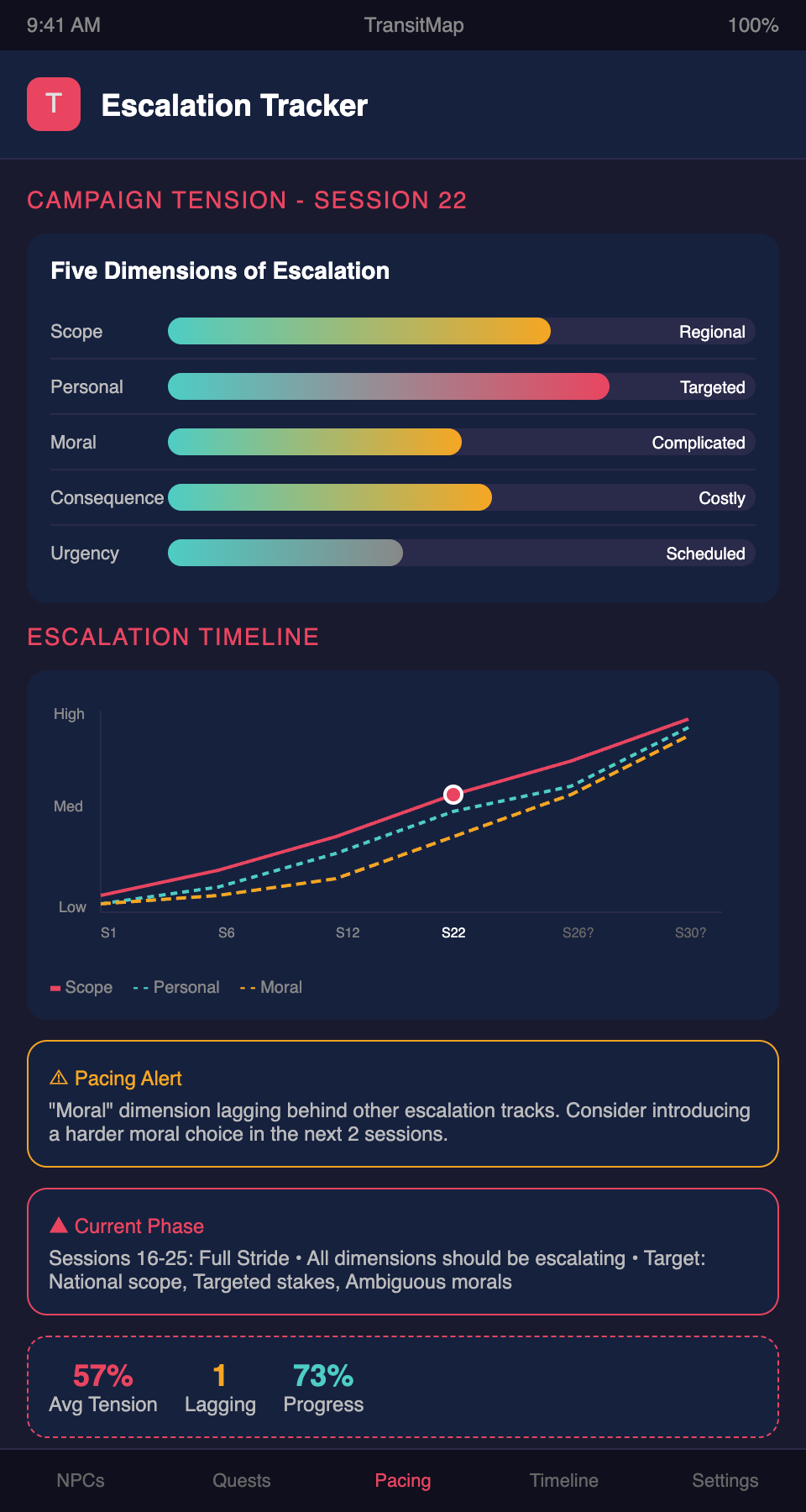
Effective escalation operates across multiple dimensions simultaneously:
1. Scope Escalation
The scale of the threat expands over the campaign:
- Local (Levels 1-4) — A village, a neighborhood, a small community
- Regional (Levels 5-10) — A city, a province, a kingdom
- National (Levels 11-16) — An entire nation, a continent, a civilization
- Cosmic (Levels 17-20) — The world, a plane of existence, reality itself
Scope escalation is the most visible form and the one most campaigns handle naturally. The danger is escalating scope too quickly — if the world is in danger by Level 5, you have nowhere to go.
2. Personal Escalation
The threat becomes increasingly personal to the player characters:
- Impersonal — A distant problem that affects strangers
- Relevant — The problem affects people the players know
- Targeted — The threat is directed at the players specifically
- Intimate — The threat strikes at the players' deepest values, relationships, or identities
Personal escalation is more powerful than scope escalation. A player who shrugs at "the kingdom is in danger" will fight to the death for "the villain has captured your mentor."
3. Moral Escalation
The choices become increasingly difficult:
- Clear — Right and wrong are obvious
- Complicated — The right choice has costs
- Ambiguous — There is no clearly right choice
- Tragic — Every option involves significant sacrifice
Moral escalation forces character development. The paladin who easily smites evil goblins in session 1 must face genuinely difficult moral questions by session 20.
4. Consequence Escalation
The results of failure become increasingly severe:
- Recoverable — Failure means trying again with a setback
- Costly — Failure means permanent loss of resources or advantages
- Devastating — Failure means irreversible harm to people or places the players care about
- Final — Failure means the campaign's central conflict is lost
Consequence escalation creates real tension because the players understand that the safety net is shrinking.
5. Urgency Escalation
Time pressure increases:
- Open-ended — No deadline, pursue at leisure
- Scheduled — A deadline exists but is weeks or months away
- Pressing — The deadline is days away
- Immediate — Action must be taken now or the opportunity is lost
The Escalation Schedule
Map your campaign's escalation across your expected session count:
Sessions 1-5 (25% local, 75% impersonal): Establish the world and the characters. Threats are local and the stakes are modest. Players are learning their characters and the setting. One dimension (usually scope) should begin to escalate by session 5 with the first hint of a larger threat.
Sessions 6-15 (50% regional, 50% relevant): The main conflict is established and the players are actively engaged. Two or three dimensions should be escalating. The scope expands to regional. The threat becomes personal. Choices start getting complicated.
Sessions 16-25 (75% national, 75% targeted): The campaign is in full stride. All five dimensions should be escalating. The stakes are high, the choices are hard, the consequences are real, and time is running short. This is where the campaign's intensity peaks.
Sessions 26-30 (100% cosmic or intimate, 100% final): The climax. All dimensions are at or near their maximum. The threat is existential, personal, morally complex, irreversible, and immediate.
Common Escalation Mistakes
The Flat Line — Tension stays at the same level for too long. Every session feels roughly the same intensity. Players become numb. Fix: introduce a clear escalation event that visibly raises the stakes.
The Spike — Tension jumps dramatically without buildup. The players go from village problems to world-ending threats in one session. The jump feels unearned. Fix: add transitional sessions that bridge the gap between threat levels.
The Sawtooth — Tension repeatedly climbs and then resets to zero. Each arc starts from scratch instead of building on the previous one. Fix: let each arc's resolution raise the baseline tension for the next arc. The first arc's victory should create new problems that are harder than the original ones.
The Premature Peak — The most dramatic moment happens too early, and the remaining campaign feels anticlimactic. Fix: plan your peak for the 80% mark. Hold your biggest revelation, your most devastating loss, and your hardest choice for the final quarter.
The Monotone Escalation — Only one dimension escalates (usually scope). The threats get bigger but they never get more personal, more morally complex, or more urgent. Fix: deliberately advance a different dimension each arc.
Tracking Escalation State
Maintain a simple escalation tracker — a grid with five rows (one per dimension) and columns representing arcs or session ranges. Mark where each dimension currently sits on its escalation scale. This gives you a visual at-a-glance assessment of your campaign's tension state and reveals which dimensions are lagging and need attention.
Want to track your campaign's escalation across every dimension and arc? Join the TransitMap waitlist — visualize tension escalation as express lines that accelerate across your campaign timeline, with clear markers for where the stakes rise and where they peak.