Connecting Side Quests to Your Main Storyline: Techniques That Feel Organic
The Side Quest Dilemma
Side quests serve essential functions in a campaign. They provide variety when the main plot gets intense. They let players explore the world beyond the central conflict. They offer opportunities for character development that the main storyline does not accommodate. They give you breathing room when you need a session that does not require heavy plot advancement.
But disconnected side quests also carry a cost. Every session spent on an unrelated adventure is a session where the main storyline does not advance. Players who are invested in the central conflict start to feel frustrated. The campaign's momentum stalls. And when you return to the main plot after a side quest detour, players need to re-orient — "Wait, what were we doing again?"
The solution is not to eliminate side quests. It is to connect them to your main storyline so that every adventure, no matter how tangential it seems, enriches the central narrative.
Five Connection Techniques
Technique 1: The Shared Resource
The side quest and the main quest both involve the same resource — an artifact, a location, a person, or a piece of information.
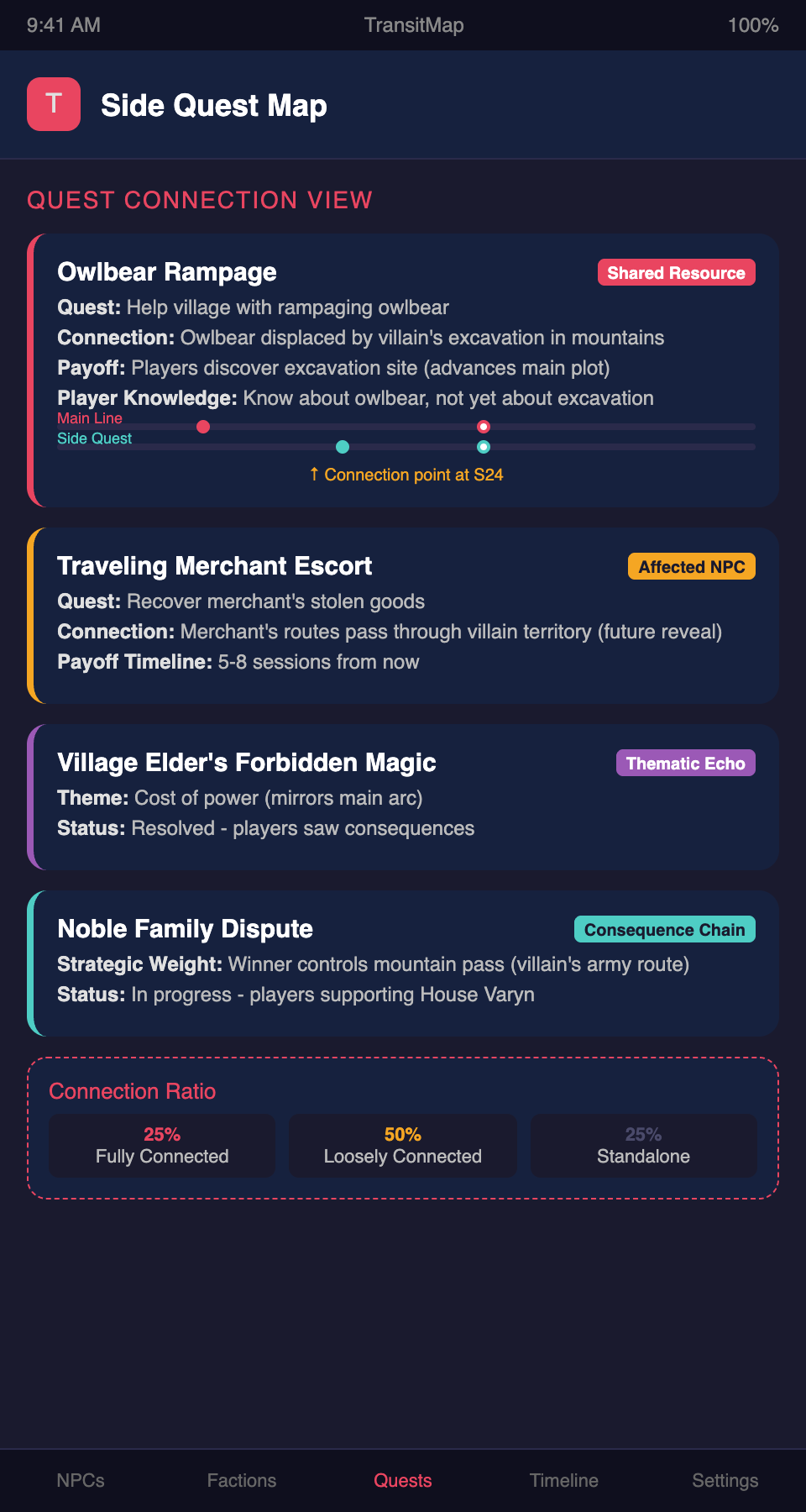
Example: The players take a side quest to help a village deal with a rampaging owlbear. During the quest, they discover the owlbear was driven from its territory by excavation work in the mountains. The excavation is being conducted by agents of the main villain, digging for an artifact needed for their plan.
The side quest is genuinely about the owlbear. The connection to the main plot is a discovery, not a bait-and-switch. The players feel like they solved a local problem AND advanced their understanding of the main threat.
Technique 2: The Affected NPC
A side quest introduces or involves an NPC who is also connected to the main storyline — they just do not reveal that connection immediately.
Example: The players help a traveling merchant recover stolen goods. The merchant is grateful and becomes a recurring ally. Several sessions later, the players learn the merchant's trade routes pass through the villain's territory, and the merchant has been unknowingly carrying messages for the resistance.
The connection emerges naturally over time, making the world feel interconnected rather than contrived.
Technique 3: The Thematic Echo
The side quest explores the same thematic question as the main storyline, but on a smaller, more personal scale.
Example: If your main storyline is about the cost of power, a side quest might involve a village elder who used forbidden magic to save her people and is now suffering the consequences. The side quest does not advance the plot, but it deepens the theme. When the players later face a similar choice at the campaign level, this side quest gives them a reference point.
Thematic connections are the most subtle and the most satisfying. Players may not consciously recognize the parallel, but it enriches their experience of the campaign's central question.
Technique 4: The Consequence Chain
The outcome of the side quest creates conditions that affect the main storyline.
Example: A side quest to resolve a territorial dispute between two noble families seems purely political. But the resolution determines which family controls the mountain pass — and the main villain needs that pass for their army's march route. Whichever family the players support will determine whether the villain's advance is slowed or accelerated.
This technique is powerful because it gives side quests strategic weight. The players are not just doing a favor — they are shaping the battlefield for the main conflict.
Technique 5: The Foreshadowing Seed
The side quest contains an element that foreshadows a future development in the main storyline.
Example: A side quest to clear a haunted crypt reveals that the crypt's original occupant was killed by the same type of magic the villain is now wielding. The inscription on the tomb describes the magic's weakness. This information will not be relevant for another ten sessions, but when it becomes relevant, the players will have an "aha!" moment of connection.
Foreshadowing seeds require planning. You need to know what is coming in your main storyline and plant the relevant information early. But the payoff — the moment when players realize that a "random" side quest gave them the key to the main conflict — is one of the most satisfying experiences in tabletop gaming.
How to Retrofit Connections
Sometimes you run a genuinely disconnected side quest and only later realize you could connect it. Retrofitting is perfectly valid, as long as you follow two rules:
-
The connection must be plausible. If the side quest involved goblins in a swamp and your main villain is a sky pirate, do not force a connection. Let disconnected quests remain disconnected rather than creating implausible links.
-
The connection should add depth, not contradiction. The retrofit should make the side quest feel richer in retrospect, not rewrite what happened. "The merchant you helped turns out to have connections to the resistance" adds depth. "The merchant was actually a spy and everything she told you was a lie" contradicts the players' experience.
Tracking Side Quest Connections
The practical challenge is remembering which side quests connect to which storylines, and ensuring those connections actually pay off. A side quest with a foreshadowing seed is useless if you forget about the seed.
For each side quest, record:
- The quest itself — What happened, who was involved, how it resolved
- Connections established — Which NPCs, locations, or information connect to other storylines
- Payoff timeline — When should each connection become relevant to the main plot
- Player knowledge — What do the players know from this quest that could be relevant later
When you can see all your side quests laid out alongside your main storyline, patterns emerge. You can see which areas of the campaign have rich connection networks and which are narrative islands. You can plan future side quests to fill connection gaps. And you can time your payoffs so that connections emerge at dramatically appropriate moments.
The Ideal Side Quest to Main Plot Ratio
There is no universal ratio, but a practical guideline is:
- Fully connected side quests (directly advance the main plot): 20-30% of your side quest content
- Loosely connected side quests (thematic echoes, minor NPC connections): 40-50%
- Purely standalone side quests (fun adventures with no connection): 20-30%
Having some purely standalone quests is important. They prevent the world from feeling like everything revolves around the main conflict. Sometimes a goblin raid is just a goblin raid, and that normalcy makes the connected quests feel more significant by contrast.
Want to see exactly how every side quest connects to your main campaign arc? Join the TransitMap waitlist — map side quests as branch lines feeding into your main storyline route, with connection points clearly marked.