Handling Player-Driven Plot Tangents Without Derailing Your Campaign
Why Players Go Off Script
You prepared an urgent quest. The kingdom is in danger. The NPC delivered a passionate plea. And your players decided to investigate the suspicious cheese merchant instead.
This is not your players being difficult. This is your players telling you what interests them. Player-driven tangents are the purest form of engagement — the players are so invested in your world that they are finding their own stories within it. The challenge for you as GM is not to prevent tangents but to handle them without losing your campaign's narrative momentum.
The Two Types of Tangents
Not all tangents are created equal. Understanding the type helps you respond appropriately:
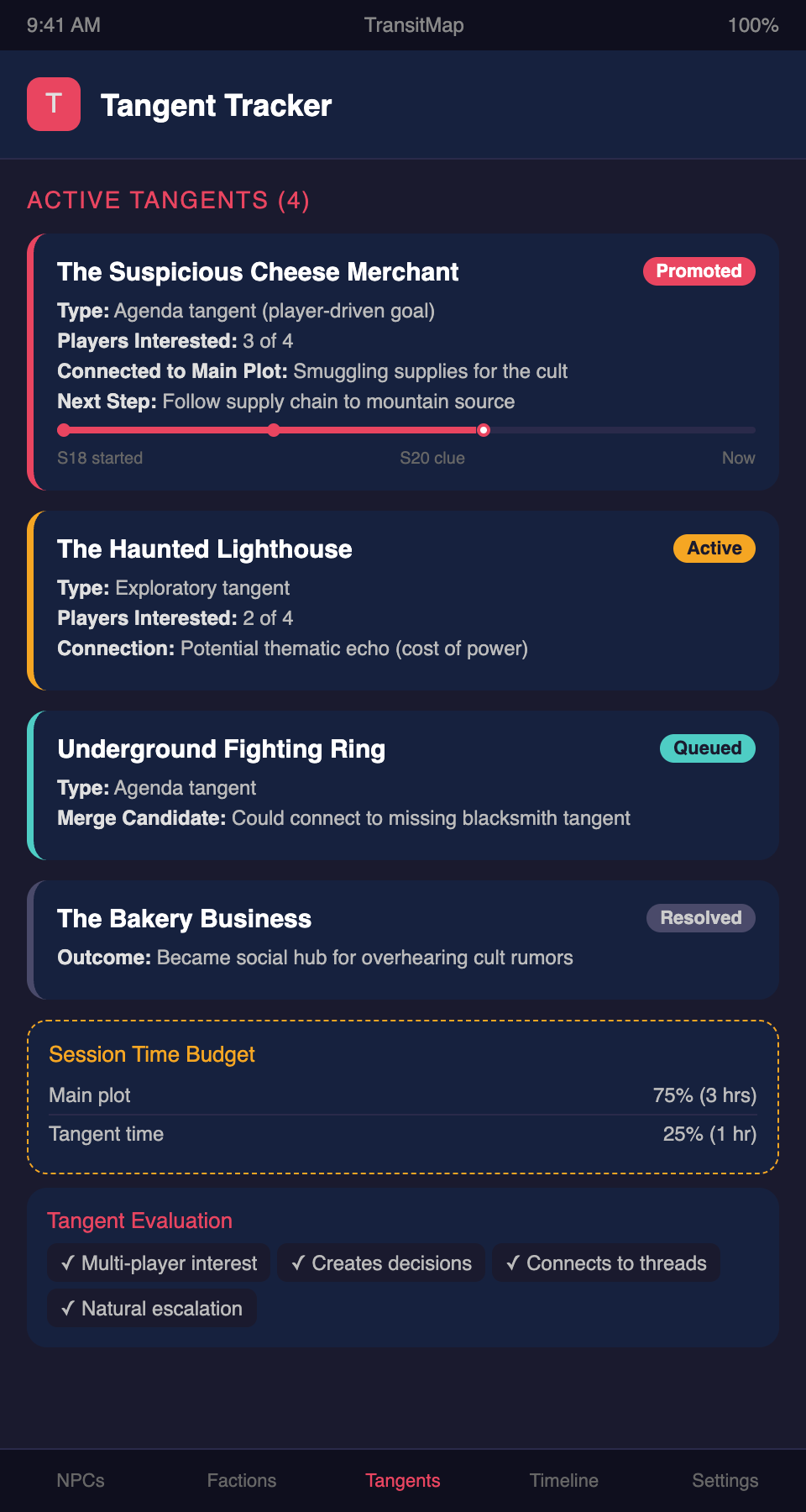
Exploratory tangents happen when players investigate something you mentioned in passing. You described a market, and now they want to spend an hour shopping. You mentioned a weird statue, and now they want its full history. These tangents are driven by curiosity about your world.
Agenda tangents happen when players pursue a goal that is not part of your planned storyline. They want to buy property. They want to start a business. They want to recruit an army. They want to track down an NPC you considered minor. These tangents are driven by player goals that emerged organically from play.
Agenda tangents are more significant and need more careful handling because they represent what the players actually want to do versus what you planned for them to do.
The Golden Rule: Connect, Don't Correct
When players go on a tangent, your first instinct might be to steer them back to the "real" plot. Resist this. Instead, ask yourself: how can I connect this tangent to the main storyline?
The cheese merchant the players are investigating? He is smuggling supplies for the cult that is threatening the kingdom. The bakery they want to open? It becomes the social hub where they overhear rumors about the villain's next move. The property they want to buy? The land deed reveals historical information about the dungeon underneath it.
These connections do not need to be planned in advance. You can create them in the moment by asking one simple question: "What would make this tangent also advance the main plot?"
Not every tangent needs to connect to the main plot. Some tangents are just fun character moments. But when a tangent threatens to consume multiple sessions, finding a connection prevents the campaign from stalling.
Setting Tangent Boundaries Without Saying No
Sometimes a tangent is genuinely impractical. The players want to sail across the ocean, but your campaign is set in a landlocked kingdom and you have no ocean content prepared. Or the tangent would take weeks of game time while a crisis demands immediate attention.
In these cases, you can set boundaries without shutting players down:
- Time pressure — "You could investigate the cheese merchant, but the messenger said the border fort will fall within three days. What's your priority?"
- Partial resolution — "You spend the afternoon at the cheese shop. You learn he gets his supply from the mountains, and something about the route seems off. You can follow up later, but the council meeting is tonight."
- Delegation — "Your character could hire someone to look into the cheese merchant while the party deals with the border situation. What instructions do you give your agent?"
Each of these acknowledges the player's interest without letting the tangent consume the session.
Turning Tangents Into Campaign Gold
Some of the best campaign arcs started as tangents. A player's random interest became a beloved storyline because the GM recognized its potential and cultivated it.
Here is a process for evaluating whether a tangent deserves to become a storyline:
- Is more than one player interested? If the whole table is engaged with the tangent, it has group energy and deserves attention.
- Does it create interesting decisions? A tangent that leads to meaningful choices is narrative gold. A tangent that leads to a dead end is a time sink.
- Can it connect to existing threads? A tangent that intersects with active storylines enriches the campaign. A tangent that exists in isolation dilutes it.
- Does it have natural escalation? A tangent that can grow in stakes over time has arc potential. A tangent that resolves immediately is a scene, not a storyline.
If a tangent passes two or more of these tests, consider promoting it from a tangent to an active storyline in your tracking system.
Managing Multiple Active Tangents
In a long campaign, tangents accumulate. The party is simultaneously interested in the cheese merchant, the haunted lighthouse, the missing blacksmith, and the underground fighting ring — none of which are your main plot.
This is actually a sign of a healthy campaign. It means your world feels rich enough to explore. The challenge is pacing — giving each tangent enough attention to satisfy without losing the main arc.
A practical approach:
- Maintain a tangent queue. List every active tangent the players have expressed interest in. Rank them by player enthusiasm and narrative potential.
- Allocate tangent time per session. In a four-hour session, plan to spend roughly 25% on tangent content and 75% on main plot content. This ratio shifts during transitional sessions between major plot beats.
- Resolve or advance one tangent per session. Either wrap up a tangent completely or advance it one meaningful step. Do not let tangents sit untouched for more than three sessions — the players will forget about them, and dormant tangents become clutter.
- Merge tangents when possible. The cheese merchant and the missing blacksmith might be connected. Merging tangents reduces your tracking load and creates satisfying narrative connections for the players.
When Tangents Signal a Problem
Occasionally, persistent tangent behavior signals that the players are not engaged with your main storyline. If the players consistently avoid the main plot in favor of side activities, consider:
- Is the main plot clear? Players might not understand what they are supposed to be doing or why it matters.
- Are the stakes personal? A threat to a kingdom the players do not care about is not compelling. Connect the threat to something they care about — their NPC friends, their property, their backstories.
- Is the main plot fun? Sometimes GMs design plots that are narratively interesting but not fun to play. If the main plot involves a lot of information gathering and negotiation but your players want combat and exploration, the tangents are telling you what kind of game they prefer.
- Have you given them agency in the main plot? If the main plot only advances when specific things happen in a specific order, players feel railroaded and seek freedom through tangents.
Listening to what tangents tell you about player preferences is one of the most valuable GM skills you can develop.
Recording and Tracking Tangent Threads
The practical disaster scenario is this: a tangent emerges in session 8, the players are excited about it, you promise to follow up, and by session 14 you have completely forgotten about it. The players bring it up and you have no notes.
Every tangent that lasts more than one scene needs to be captured in your tracking system. At minimum, record:
- What the tangent is about
- Which players are most interested
- What the players learned or decided
- What the natural next step would be
- Whether and how it connects to other storylines
When you can see your tangents alongside your main plot threads on a single visual timeline, you can make smart decisions about when to advance them, when to merge them, and when to bring them to a satisfying close.
Want to turn player tangents into your campaign's best storylines? Join the TransitMap waitlist — track every tangent as a visual branch line and see how it connects to your main narrative route.