Long-Running Campaign Continuity: Keeping It Together After 50+ Sessions
The Scale Problem
A campaign that runs for 50 or more sessions generates an extraordinary volume of content. Conservatively, that is 200 hours of play, dozens of NPCs, hundreds of established facts, multiple resolved and active storylines, and a world history that has been improvised and refined session by session.
No human memory can hold all of this reliably. The GMs who run multi-year campaigns successfully are not the ones with superhuman recall. They are the ones who recognized early that continuity at scale is an engineering problem, not a memory problem, and built systems accordingly.
The Three Types of Continuity Failure
At the 50+ session mark, continuity failures fall into distinct categories, each requiring different prevention strategies:
Factual drift — Established facts change subtly over time. The population of the capital was "about ten thousand" in session 5 and "around fifty thousand" in session 38. The wizard's mentor was named Aldric, then Aldren, then somehow Aldric again. These errors seem minor individually but accumulate into a world that feels unreliable.
Character amnesia — NPCs lose their established personalities, motivations, or knowledge. The gruff blacksmith is suddenly jovial. The cautious spymaster takes reckless risks. The NPC who should be furious with the players is inexplicably friendly. Character amnesia breaks the most immersive element of your world — the people.
Narrative orphans — Storylines that were established and then abandoned. The mysterious letter found in session 12 is never explained. The faction that was rising in power simply stops being mentioned. The player's backstory villain never appears. Narrative orphans tell your players that threads they invested in do not matter.
Building Long-Term Continuity Infrastructure
The Canonical Record
Create and maintain a document that serves as the single source of truth for your campaign world. This is not your session log — it is a curated reference that contains only confirmed, canonical facts.
Organize it by category:
- World facts — Geography, history, calendar, magical rules, political structure
- Character facts — NPC descriptions, personalities, relationships, current states
- Story facts — What has happened in the campaign, what the players know, what is still secret
- Player character facts — Backstory elements, abilities, commitments, relationships
The discipline required: every time you establish a new fact during play, add it to the canonical record within 24 hours. Every time a fact changes, update the record. Every time you need to reference a fact during prep, check the record rather than relying on memory.
The Storyline Registry
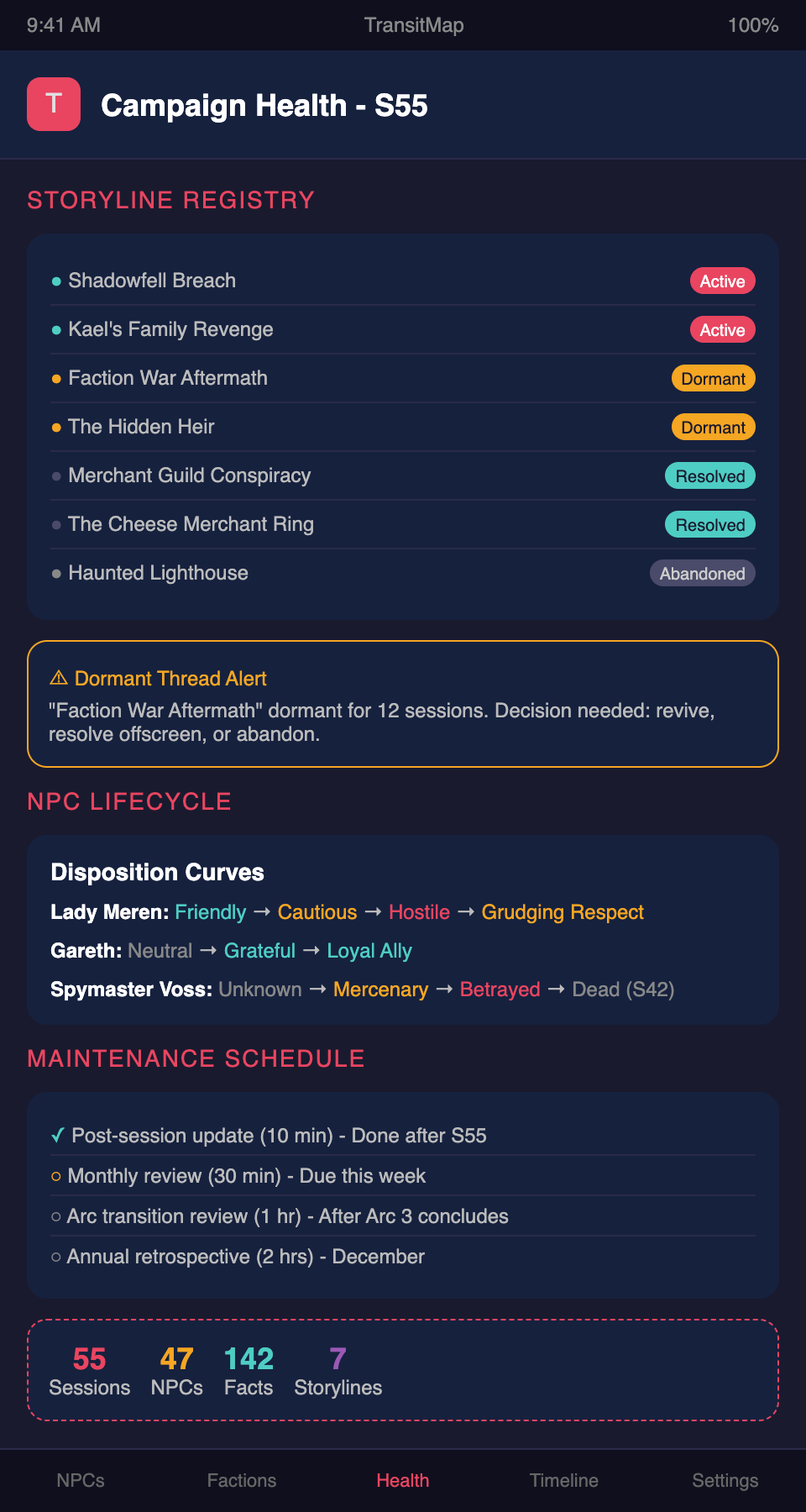
Maintain a list of every storyline that has been introduced in the campaign, with its current status:
- Active — Currently being advanced by the players or by world events
- Dormant — Introduced but not currently in focus. Still exists in the world.
- Resolved — Completed. Archived for reference.
- Abandoned — Introduced but the GM decided not to pursue it. Note why.
Review this registry monthly. Any storyline marked "dormant" for more than ten sessions needs a decision: revive it, resolve it offscreen, or consciously abandon it with a brief narrative justification.
The registry prevents narrative orphans by making every unresolved thread visible and accountable.
The NPC Lifecycle Tracker
For a campaign with 40+ NPCs, tracking each one individually every session is impractical. Instead, use a lifecycle approach:
- Introduction — When and how was this NPC introduced? What was the players' first impression?
- Key interactions — A brief log of every significant interaction with the players (date and one sentence)
- Current state — Updated after every appearance or offscreen development
- Relationships — Who is this NPC connected to? How have those connections changed?
- Disposition curve — A simple tracker of how this NPC's attitude toward the players has changed over time (hostile → cautious → friendly, or friendly → betrayed → hostile)
The disposition curve is especially valuable for long campaigns. It prevents character amnesia by making emotional trajectories visible.
Continuity Maintenance Rituals
Long-running campaigns benefit from regular maintenance rituals:
Post-session update (10 minutes) — Update session log, canonical record, storyline registry, and relevant NPC entries while your memory is fresh.
Monthly review (30 minutes) — Review the storyline registry for dormant threads. Scan the NPC tracker for characters who have not appeared recently. Check the canonical record for any entries that need updating based on recent events.
Arc transition review (1 hour) — When a major arc concludes, do a thorough review. Archive resolved storylines. Promote dormant storylines that are ready to activate. Retire NPCs whose roles are complete. Set up the tracking infrastructure for the next arc.
Annual retrospective (2 hours) — For campaigns that run more than a year, an annual review is invaluable. Read through your session logs to reconnect with early campaign events. Identify threads you have forgotten. Celebrate how far the campaign has come.
Involving Players in Long-Term Continuity
At 50+ sessions, your players are stakeholders in continuity. Involve them:
Session recaps by players. Start each session by having a player recap the previous session. This surfaces what they remember and what they consider important — which may differ from what you consider important.
A shared campaign wiki. Let players contribute to the campaign's reference documents. Players who write about NPCs they care about reinforce continuity for the whole table.
"Previously on..." moments. When revisiting a thread from many sessions ago, provide a brief "previously on..." summary that orients everyone. Do not assume players remember details from session 12 when you are in session 55.
Player-submitted questions. Between sessions, invite players to ask questions about the world or the story. Their questions reveal what they are thinking about and what they might have forgotten or misunderstood.
When Continuity Errors Are Discovered Late
In a 50+ session campaign, you will eventually discover a continuity error that has been in place for twenty sessions. The NPC's backstory contradicts something established in session 8. The timeline does not add up across a six-month stretch. A piece of world lore contradicts itself.
At this scale, aggressive retconning is dangerous — too many downstream facts depend on the error. Instead:
- If the error is minor and unnoticed by players, quietly correct your records and move on
- If the error is significant and noticed by players, acknowledge it transparently and propose a narrative explanation if one is plausible
- If the error is load-bearing (other facts depend on it), accept the "wrong" version as canon and adjust the contradicting element instead
The goal is not a perfect record. The goal is a consistent-enough record that players trust the world.
Running a campaign that has grown beyond what you can hold in your head? Join the TransitMap waitlist — visualize your entire campaign's storyline history, active threads, and NPC network on a single navigable map designed for the long haul.