Mid-Campaign Course Correction: How to Fix a Campaign That's Going Off Track
Recognizing That Something Is Wrong
Campaign problems rarely announce themselves. They accumulate slowly — a slightly less engaged table here, a session that feels like it is dragging there. By the time you consciously realize something is wrong, the problem has usually been building for several sessions.
Warning signs to watch for:
- Phone checking — Players who used to be fully present are increasingly distracted
- Passive play — Players wait for you to tell them what to do instead of driving the action
- Declining attendance — Scheduling conflicts that did not exist before start appearing
- Short sessions — Sessions that used to run four hours are ending at three
- Rules lawyering spike — When players are not engaged with the story, they engage with the mechanics instead
- Side conversations — In-session conversations that have nothing to do with the game
- "So what are we doing?" — Repeated confusion about the current objective
These symptoms have different causes. Diagnosing the right one is essential for effective correction.
Diagnosing the Problem
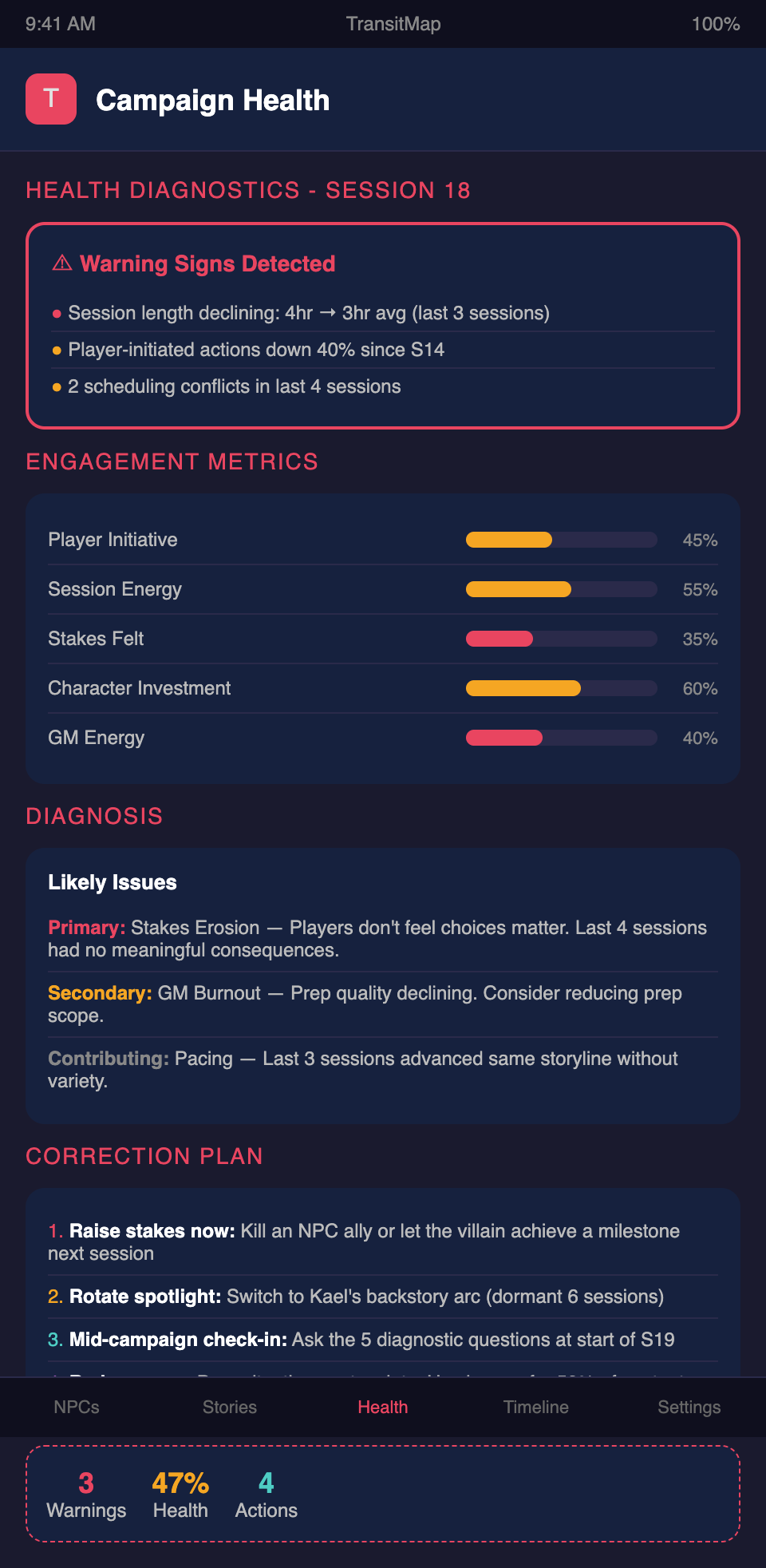
Common mid-campaign problems fall into five categories:
Pacing failure — The campaign is moving too slowly or too quickly. Sessions feel like filler, or important moments fly by without impact.
Engagement mismatch — The type of content you are running does not match what the players enjoy. Too much combat for a narrative group. Too much politics for an action group. Too much dungeon crawling for players who want social interaction.
Stakes erosion — The players no longer feel that their choices matter. Maybe the threat feels abstract. Maybe failures have no consequences. Maybe success does not feel rewarding.
Character disconnect — The players do not feel connected to their characters anymore. The character concept that was exciting at Level 1 has become stale at Level 8. Backstory elements have been ignored. The character does not feel like they belong in the current storyline.
GM burnout — You are tired. Prep feels like a chore. Sessions feel like an obligation. Your creative energy is depleted. This is not a campaign problem — it is a sustainability problem — but it manifests as declining campaign quality.
The Mid-Campaign Conversation
The most powerful course correction tool is a direct conversation with your players. This is not a session zero redo — it is a focused check-in that takes fifteen to twenty minutes at the start of a session or as a between-sessions discussion.
Ask these questions:
- "What are you enjoying most about the campaign right now?" — This tells you what to keep.
- "What is not working for you?" — This surfaces specific complaints.
- "What do you want more of?" — This guides your adjustments.
- "What do you want less of?" — This identifies what to cut.
- "Are you still excited about your character?" — This reveals character disconnect.
Listen without defending. Your players are not attacking your campaign — they are offering information that will make it better. Take notes. Thank them. Then act on what you learn.
Course Correction Techniques
For Pacing Problems
If too slow: Skip to the next interesting thing. Cut travel montages, shopping sessions, and scenes that do not advance story or character. Introduce a deadline that forces action. Let three in-game days pass in one sentence.
If too fast: Insert a downtime session. Give the players a moment to breathe, explore, and interact with each other and the world. Slow down your reveals — let moments breathe before moving to the next one.
For Engagement Mismatches
Shift the content mix. If players want more combat, add combat encounters that advance the plot. If they want more roleplay, create social scenarios with meaningful stakes. You do not have to abandon your campaign's core — just adjust the ratio.
Add variety. Sometimes the issue is not the type of content but the monotony. Five political intrigue sessions in a row is exhausting even for players who love political intrigue. Alternate between content types.
For Stakes Erosion
Make consequences visible. Show the players what happens when they fail — or what would happen if they stopped fighting. Have the villain achieve a milestone. Let an NPC they care about suffer.
Raise personal stakes. Connect the current conflict to something a player character cares about. Threaten their ally. Challenge their values. Target their home.
Let the players lose something. A significant loss — an NPC death, a destroyed safe haven, a failed quest — reminds players that the campaign is not a guaranteed victory march.
For Character Disconnect
Reactivate backstories. If a player's backstory has been dormant, activate it now. Bring a backstory NPC into the current storyline. Create a scene that forces the character to confront their past.
Allow character evolution. A player whose character concept is stale may need to evolve. A class change, a new motivation, a dramatic personal event — give the character a reason to grow.
Rebuild the spotlight rotation. Make sure every player character has had a meaningful moment in the last five sessions. If someone has been in the background, bring them to the foreground.
For GM Burnout
Reduce your prep. Use improv-heavy techniques. Prep situations, not scripts. Let the players drive more of the content.
Run a palate cleanser. Take a break from the campaign for one to two sessions and run a one-shot. The change of pace refreshes everyone.
Share the load. Ask a player to GM for a session. Have players write session recaps instead of doing it yourself. Delegate worldbuilding tasks to engaged players.
Take a break. If you need to skip a week, skip a week. A rested GM runs a better game than a burned-out one.
Structural Course Corrections
Sometimes the problem requires structural changes to the campaign, not just adjustments:
The arc reset — Conclude the current arc quickly (even if it feels rushed) and start a new arc that addresses the identified problems. The new arc can continue the same campaign with a fresh direction.
The time skip — Jump forward in time. Characters have grown, the world has changed, and the campaign starts fresh from a new baseline. This can resolve stale character dynamics and reset stakes.
The scope shift — Change the campaign's scope. A national-scale political campaign can shift to a personal-scale survival adventure. A dungeon-crawling campaign can open into a sandbox. Match the scope to what the players actually enjoy.
The character refresh — Allow players to change characters if they want to. Some players would rather start fresh than try to salvage a character concept that is not working. Make the transition feel narratively justified rather than arbitrary.
When to End the Campaign
Sometimes course correction is not enough. The campaign has run its course — the energy is gone, the group dynamic has shifted, or the story has nowhere satisfying to go. Ending a campaign deliberately is better than letting it die slowly from declining attendance.
If you decide to end, give it a conclusion — even a rushed one. Resolve the main storyline in a condensed final session. Give the players closure. Celebrate what the campaign achieved. Then start something new.
Need to see your campaign's big picture so you can identify what needs fixing? Join the TransitMap waitlist — view your storylines, pacing, and player engagement visually, and spot problems before they become crises.