Building a Clue Tracking System for Mystery Campaigns
Why Mystery Campaigns Fail
The most common way a mystery campaign fails is not through poor storytelling. It is through information management failure. The GM knows the solution. The GM designed clues that point to the solution. But the players either never find the clues, misinterpret the clues, or find the clues in an order that makes the solution incomprehensible.
This failure mode is so common that many GMs avoid mysteries entirely. But mysteries are uniquely powerful in tabletop RPGs — the combination of player deduction, character investigation, and GM improvisation creates experiences that no other medium can match.
The solution is not to avoid mysteries. It is to build a clue management system that ensures the mystery is always solvable, always fair, and always within the GM's ability to track.
The Three-Clue Rule
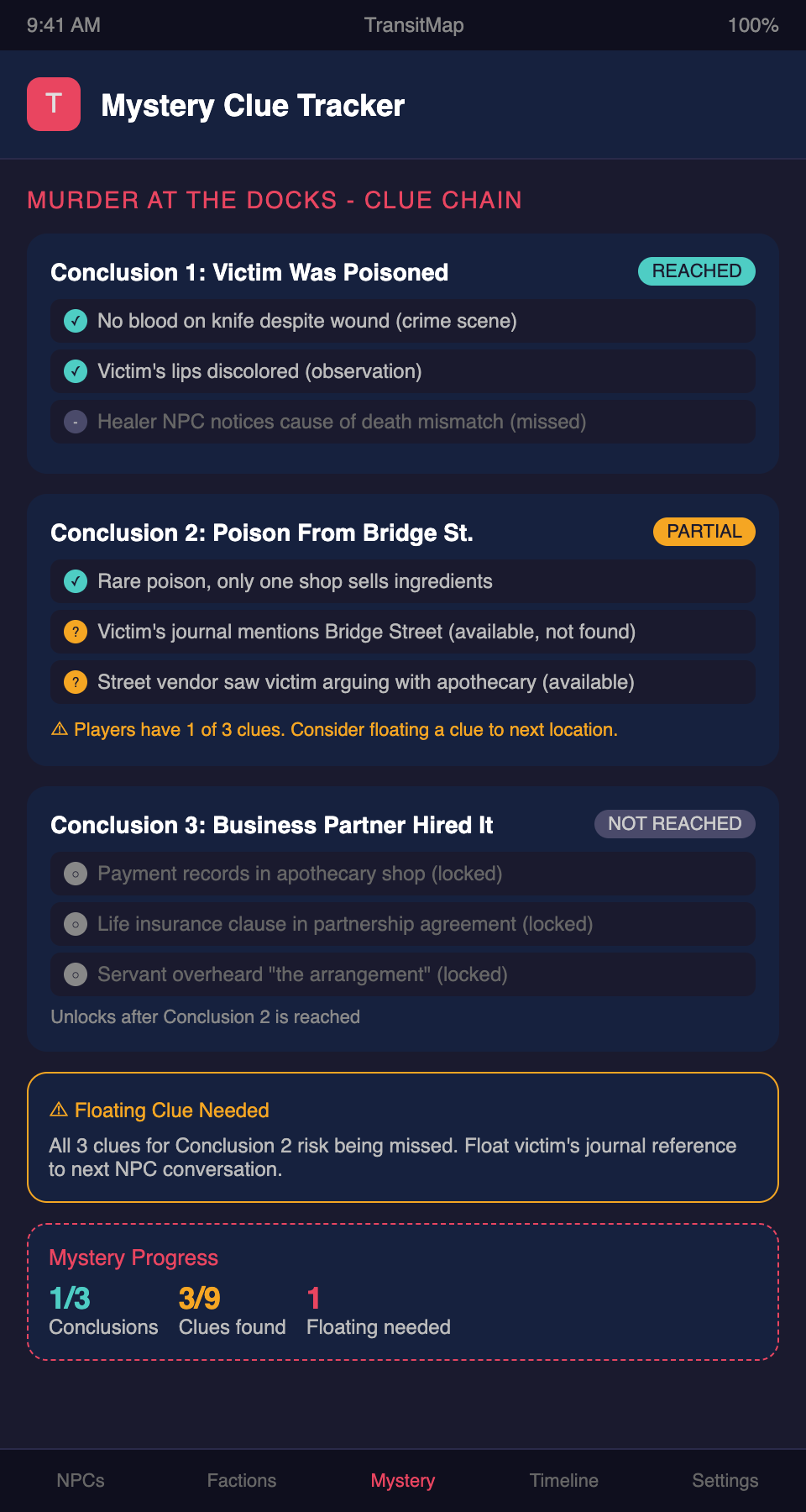
The foundational principle of mystery design in RPGs is the three-clue rule, credited to game designer Justin Alexander: for every conclusion you want the players to reach, design at least three clues that point to that conclusion.
Why three?
- Players will miss at least one clue. It will be in a room they did not search, from an NPC they did not talk to, or in a document they skimmed over.
- Players will misinterpret at least one clue. They will read it as pointing to a different conclusion than you intended.
- With three clues, even if one is missed and one is misinterpreted, the third can still lead them to the right answer.
This means your clue budget for a mystery is three times the number of conclusions. If solving the mystery requires reaching five conclusions, you need at least fifteen clues distributed throughout the investigation.
Designing Clue Chains
A mystery is not a single deduction. It is a chain of deductions, where each conclusion leads to the next phase of investigation.
Example mystery chain:
-
Conclusion 1: The victim was poisoned, not stabbed (the stabbing was staged)
- Clue A: No blood on the knife despite the wound
- Clue B: The victim's lips are discolored
- Clue C: A healer NPC notices the cause of death does not match the wound
-
Conclusion 2: The poison came from the apothecary on Bridge Street
- Clue D: The specific poison is rare and only one shop sells the ingredients
- Clue E: The victim's journal mentions visiting Bridge Street the day before
- Clue F: A street vendor remembers the victim arguing with the apothecary
-
Conclusion 3: The apothecary was hired by the victim's business partner
- Clue G: Payment records in the apothecary's shop
- Clue H: The business partner had a life insurance clause in the partnership agreement
- Clue I: A servant overheard the business partner discussing "the arrangement"
Each conclusion has three clues. The players need to reach each conclusion to progress to the next link in the chain.
Building Your Clue Tracker
For each mystery in your campaign, maintain a tracker with these fields:
For each conclusion:
- The conclusion itself (what the players need to figure out)
- Three or more clues that point to this conclusion
- Where each clue is located (NPC, location, document, observation)
- Whether each clue has been found, available but not found, or not yet available
- Whether the conclusion has been reached, partially reached, or not reached
This tracker is your GM dashboard during mystery sessions. At a glance, you can see:
- Which conclusions the players have reached
- Which clues they have found
- Which clues are still available for discovery
- Whether any conclusion has all its clues missed (requiring intervention)
The Floating Clue Technique
When all three clues for a conclusion have been missed, you have a problem. The mystery is stuck. The floating clue technique solves this: you take a clue that was originally placed in a missed location and move it to wherever the players go next.
The players skipped the apothecary's shop and missed all three clues pointing to the poison source? The next NPC they talk to mentions hearing about a strange purchase at an apothecary. The next location they visit has a receipt from Bridge Street in an unrelated drawer.
Floating clues are not cheating. They are adaptive game design. You are not changing the mystery — you are changing the delivery method for the same information. The players still have to make the deduction; they are just encountering the clue in a different wrapper.
Track floating clues in your system so you know which clues have been relocated and where.
Managing Information Flow
The biggest tracking challenge in mystery campaigns is information flow — ensuring that the players have access to the right information at the right time, and that the information they have is internally consistent.
Information rules:
-
Clues should be discoverable through player action. Passive perception catches subtle clues. Active investigation reveals hidden ones. Social interaction extracts information from NPCs. Do not require a specific action to find a specific clue — allow multiple approaches.
-
Clues should be interpretable. A clue the players cannot understand is not a clue. If a clue requires specialized knowledge, provide the expertise through an NPC, a book, or a character's background feature.
-
Red herrings should be clearly distinguishable. A red herring that is indistinguishable from a real clue creates frustration, not challenge. Red herrings should be debunkable with moderate effort. If the players spend significant resources investigating a red herring, they should be able to rule it out and move on.
-
Information should never contradict. Real clues should all point consistently toward the truth. If two real clues seem to contradict each other, there should be a logical explanation that the players can discover.
Running Mystery Sessions
Before the session: Review your clue tracker. Know which conclusions are outstanding, which clues are available, and where the players are likely to go.
During the session: When players investigate a location or talk to an NPC, check your tracker. Are there clues here? If yes, deliver them naturally through description, dialogue, or discovery. If the players are in a location with no clues and seem stuck, consider floating a clue to their current location.
After the session: Update your tracker. Mark clues as found or missed. Note any conclusions the players reached. Note any new theories the players have — some of these might be better than your planned solution, and you can adapt accordingly.
Between sessions: If the players are stuck, design the next session to put them in contact with unfound clues. If the players are racing ahead, ensure the next conclusion in the chain has its clues in place.
Common Mystery Campaign Mistakes
- The single-clue bottleneck — Only one clue points to a critical conclusion. If the players miss it, the mystery stops.
- The genius GM trap — Designing a mystery so clever that the GM is the only person who could solve it. Mysteries should be solvable by normal people paying attention.
- The investigation railroad — Only one correct order of investigation. Players should be able to pursue leads in any order.
- Static mysteries — The culprit does nothing while the players investigate. Culprits should be covering their tracks, planting false evidence, or committing additional crimes — creating new clues and new urgency.
- No partial success — Players who solve part of the mystery should get partial results. Do not make it all-or-nothing.
Building a mystery campaign and need to track every clue, conclusion, and information chain? Join the TransitMap waitlist — map your mystery as a transit network where clue lines converge at conclusion stations, and never lose track of what your players know.