NPC Relationship Mapping: Visualizing Your Campaign's Social Web
Why Relationships Matter More Than Characters
A well-designed NPC is good. A well-designed relationship between NPCs is better. Individual NPCs provide encounters. Relationships between NPCs provide storylines.
Consider: a blacksmith is a character. A blacksmith who is married to the mayor's sister, owes money to the thieves' guild, and secretly supplies weapons to the resistance — that is a nexus of storylines. Every relationship is a potential plot thread. Every connection is a lever the players can pull.
Most GMs design NPCs as individuals and discover relationships later, if at all. Designing relationships deliberately — and mapping them visually — transforms your campaign's social landscape from a collection of characters into a living network that generates story.
Building a Relationship Map
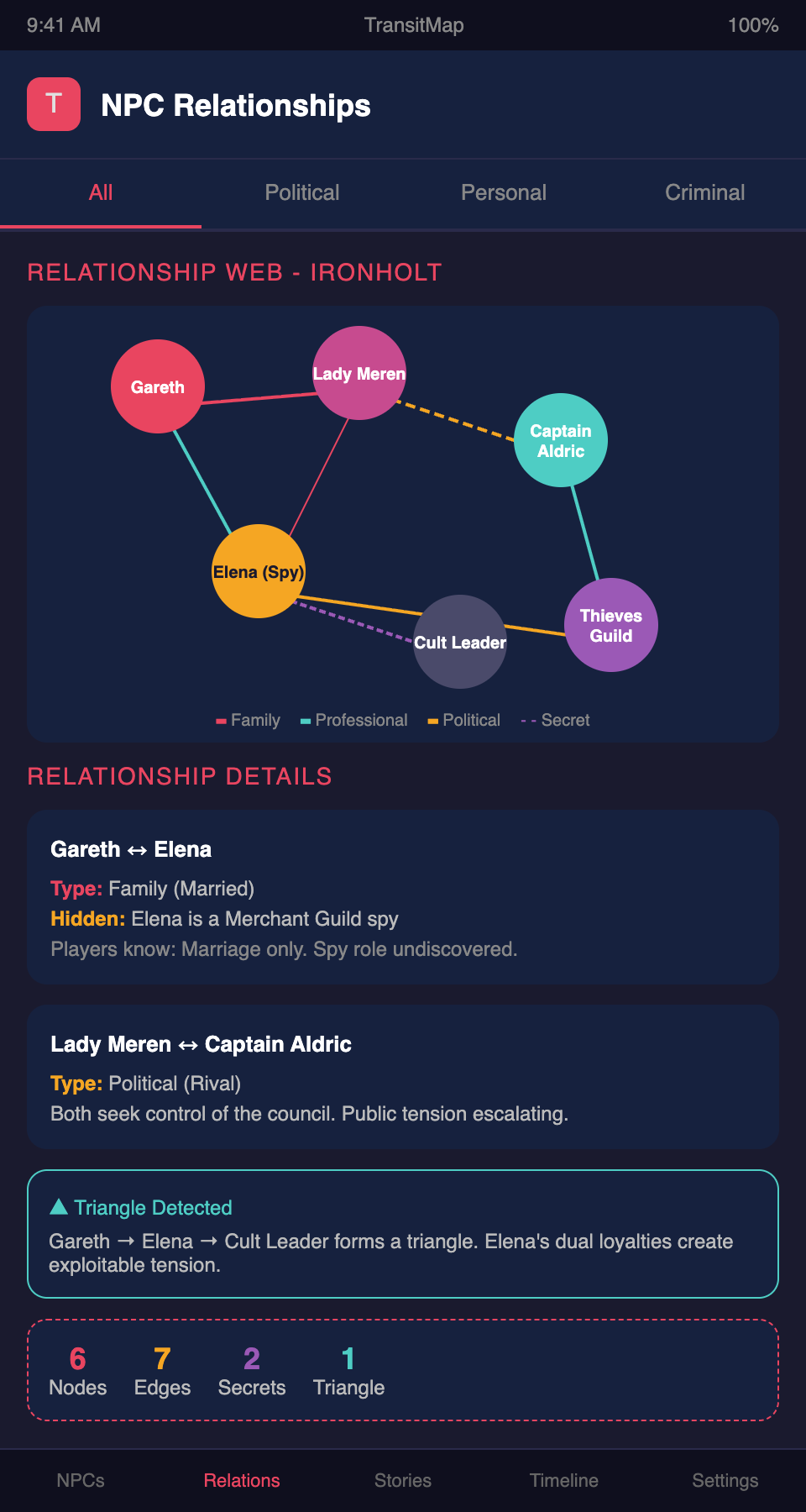
A relationship map is a visual diagram with NPCs as nodes and labeled connections between them. Start with your most important NPCs and work outward.
Step 1: Place your principals. Put your five to eight most important NPCs on the map. These are the characters who drive your main storylines.
Step 2: Draw known relationships. Connect NPCs who have established relationships. Label each connection with the relationship type:
- Family — Spouse, parent, child, sibling
- Professional — Employer/employee, business partner, guild member
- Political — Ally, rival, patron/client, co-conspirator
- Personal — Friend, lover, mentor/student, enemy
- Secret — Any relationship that is not publicly known
Step 3: Identify missing connections. Look at your map for NPCs who are isolated — not connected to any other NPC. These characters are narrative islands. Either connect them to the network or consider whether they are needed.
Step 4: Add the players. Place the player characters on the map and draw their relationships to NPCs. This shows how the players are connected to the social web and where they have leverage or vulnerability.
Reading the Map for Story Opportunities
Once your relationship map exists, it becomes a story generation tool. Look for these patterns:
Triangles — Three NPCs who are all connected to each other create natural conflict. If A is allied with both B and C, but B and C are enemies, A is in an impossible position. The players can exploit or resolve this tension.
Bridges — An NPC who connects two otherwise separate groups is a bridge character. If they are removed, the groups lose their connection. Bridge characters are natural targets for assassination, corruption, or recruitment.
Clusters — Groups of tightly interconnected NPCs form clusters. These clusters often correspond to factions. If a cluster has only one connection to the rest of the map, that connection is a vulnerability.
Isolated nodes — NPCs with no connections are either unnecessary or represent untapped potential. Could they be connected to an existing cluster? Could their isolation be a plot point?
Asymmetric relationships — A loves B, but B barely notices A. C trusts D, but D is betraying C. Asymmetric relationships create dramatic irony and are fuel for player-driven revelations.
Maintaining the Map Over Time
A relationship map is not a one-time creation. It needs to evolve with your campaign:
Add new connections when they form. When the players introduce two NPCs who did not previously know each other, draw that connection. When a political alliance is brokered, update the map.
Remove connections that are severed. When a friendship ends, when a business partnership dissolves, when someone betrays their ally — remove or relabel the connection.
Change connection labels when relationships evolve. An NPC who was an enemy becomes a grudging ally. An NPC who was a friend becomes a rival. The map should reflect current reality, not historical state.
Promote and add NPCs. When a new NPC becomes significant, add them to the map. When a minor NPC becomes important, connect them more deeply.
Archive departed NPCs. When an NPC dies, leaves the story, or becomes irrelevant, remove them from the active map and archive their entry.
Using the Map at the Table
During play, your relationship map serves as a quick-reference for social interactions:
"Who would know about this?" Scan the map for NPCs connected to the relevant topic. The spymaster is connected to the thieves' guild, which is connected to the smuggler who operates at the docks. That is the information chain.
"How does this NPC react to this news?" Check who the NPC is connected to. If the players just arrested the NPC's brother, the NPC reacts strongly. If the players saved the NPC's patron, the NPC is grateful.
"Who else is affected?" When something significant happens to an NPC, trace their connections. Everyone connected to them should react in some way — even if it is just hearing the news and forming an opinion.
Advanced Techniques
Layered maps. Create multiple relationship maps for different aspects of your world:
- Political map — Power relationships, alliances, rivalries
- Personal map — Friendships, romances, family ties
- Criminal map — Underworld connections, blackmail, smuggling networks
- Information map — Who talks to whom, who spies on whom
Layering reveals interesting discrepancies. Two NPCs might be political rivals but personal friends. An NPC might be a respected leader on the political map and a blackmail victim on the criminal map.
Historical maps. Create snapshots of your relationship map at key campaign moments. Comparing the map from session 1 to the map at session 30 shows how dramatically the social landscape has changed — and gives you a powerful visual to share with players at milestone moments.
Player-facing maps. Create a version of the relationship map that shows only what the players know. Share it with them as a reference tool. When they discover a new connection, add it to their map. This gives players agency in navigating the social landscape and makes them feel the satisfaction of uncovering hidden relationships.
Ready to map your campaign's social web and discover storylines hiding in the connections? Join the TransitMap waitlist — visualize NPC relationships as an interconnected transit network where every node is a character and every line is a relationship that drives your story.