Managing Parallel Storylines in Your Tabletop RPG Without Losing Threads
The Parallel Storyline Juggle
Complex campaigns naturally generate parallel storylines. The main quest is happening, but so are the faction conflicts, the player backstory arcs, the mystery subplot, and the emerging rivalry with a secondary antagonist. Each storyline has its own momentum, its own characters, and its own demands on session time.
Running parallel storylines well is what separates a campaign that feels like a living world from one that feels like a series of disconnected episodes. But it requires deliberate management — without it, some storylines dominate while others wither from neglect.
How Many Parallel Storylines Can You Actually Run?
Be honest about your capacity. The answer depends on several factors:
- Session length — A three-hour session can meaningfully advance two to three storylines. A five-hour session can handle three to four.
- Player count — More players means more personal storylines competing for time.
- Storyline complexity — A simple "find the artifact" storyline demands less attention than a political intrigue web.
- Your prep time — Each active storyline requires prep. If you have two hours of prep per week, three to four active storylines is manageable.
A practical maximum: Most GMs should run three to five active storylines simultaneously, with additional storylines held in reserve as dormant threads.
The Storyline Status System
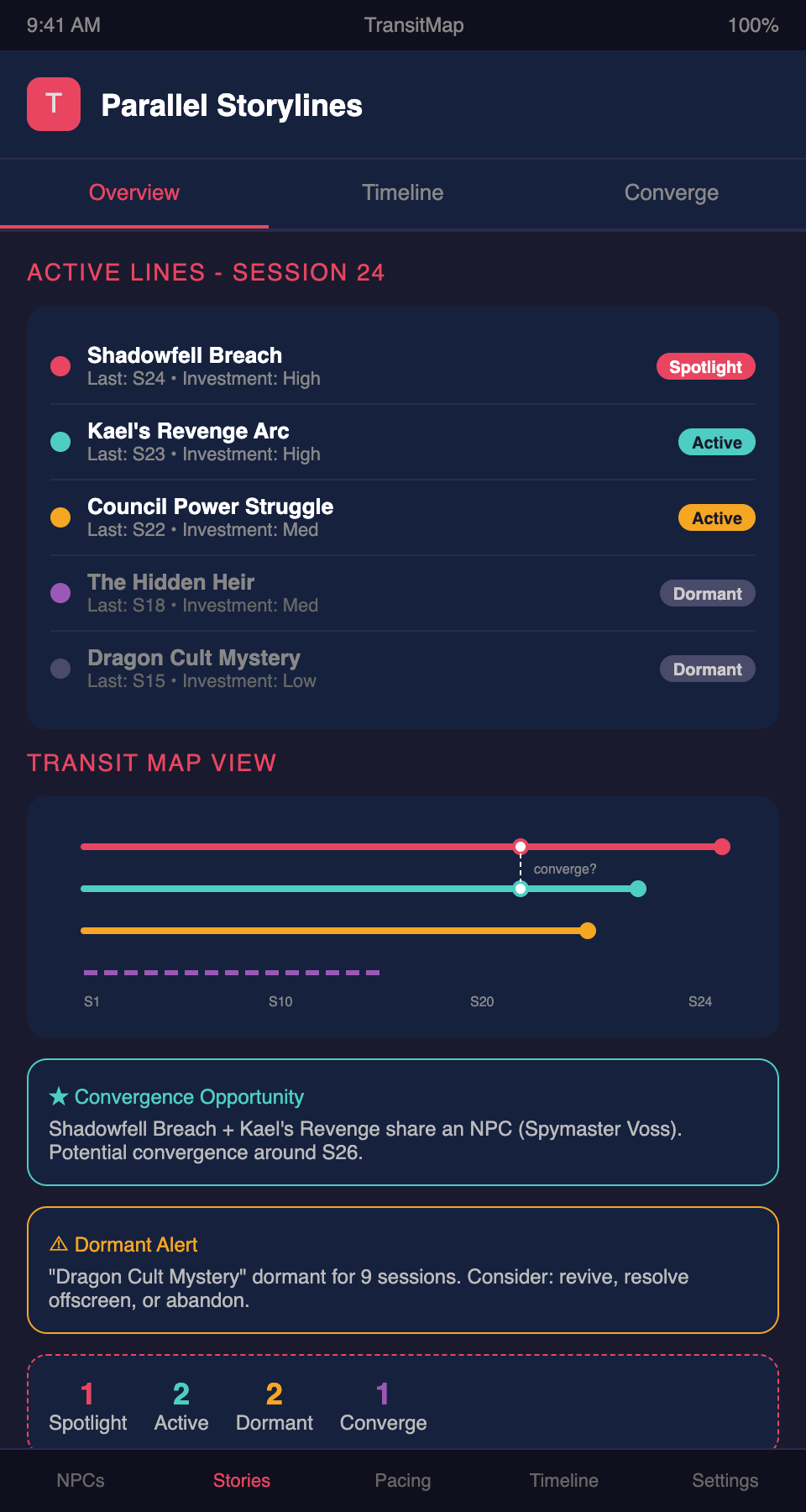
Categorize every storyline in your campaign:
Spotlight — The storyline that is receiving primary focus right now. Usually the main quest or the most urgent thread. Gets 40-60% of session time.
Active — Storylines that are in motion and receive regular attention. Advance at least once every two to three sessions. Get 20-40% of session time, split among them.
Dormant — Storylines that exist in the world but are not currently being advanced. They should simmer in the background — occasional mentions, subtle developments — but they do not demand session time.
Queued — Storylines you have planned but not yet introduced. They are waiting for the right moment to enter play.
The key discipline: only one storyline should be in the spotlight at a time, and no more than three should be active simultaneously. Everything else is dormant or queued.
Rotating the Spotlight
The spotlight should rotate through your storylines based on narrative momentum and player interest:
Rotate when a storyline reaches a pause point. Every storyline has natural breaks — a clue is found but needs research, an ally is recruited but needs time to prepare, a decision has been made but consequences have not yet arrived. Use these pauses to shift the spotlight to another storyline.
Rotate when players signal interest. If players are asking questions about a dormant storyline, they are telling you they want it activated. Respond to these signals within a session or two.
Rotate on a rough schedule. If no natural rotation presents itself, aim to shift the spotlight every three to five sessions. This prevents any single storyline from monopolizing the campaign.
Rotate with purpose. When you shift the spotlight, create a transition that connects the storylines. The players finish a dungeon (main quest) and return to town to find a political situation has escalated (faction storyline). The transition is seamless because the world kept moving while they were underground.
Keeping Dormant Storylines Alive
Dormant storylines should never be truly silent. Use these techniques to maintain their presence without demanding session time:
Background mentions. An NPC mentions a rumor related to the dormant storyline. A newspaper headline references an event connected to it. A player's contact sends a brief message about developments.
Environmental evidence. The players travel through an area affected by a dormant storyline. They see the consequences of a dormant faction's activities. They notice a change in the landscape that relates to a dormant threat.
Brief interjections. A thirty-second scene at the end of a session: "Meanwhile, in the northern fortress, the cult leader receives the final component for the ritual." These flash-forward moments keep the dormant storyline in players' awareness.
Player backstory connections. A dormant storyline can stay relevant through its connection to a player character. Even when the storyline is not in the spotlight, the player feels its presence through their character's history.
Weaving Storylines Together
The most satisfying moments in a multi-storyline campaign are convergence points — moments when separate storylines intersect and influence each other.
Types of convergence:
- Shared NPCs — An NPC who appears in two storylines creates a natural connection. The merchant the players know from the trade storyline turns out to be connected to the mystery storyline.
- Shared locations — The dungeon that is relevant to the main quest is located in territory controlled by the faction the players are negotiating with.
- Shared consequences — An action taken in one storyline has consequences that affect another. Defeating the bandit leader (adventure storyline) destabilizes the region and creates a power vacuum the factions (political storyline) rush to fill.
- Shared themes — Two storylines that explore the same thematic question from different angles. The main quest is about the cost of power; the backstory arc is about personal ambition. They echo each other.
Plan two to three convergence points per campaign arc. These do not need to be forced — look for natural intersections between your storylines and lean into them.
The Parallel Storyline Tracker
Your tracking system should give you an at-a-glance view of all storylines and their status:
For each storyline, track:
- Status — Spotlight, Active, Dormant, or Queued
- Last advanced — Which session last touched this storyline
- Current state — One sentence summary of where things stand
- Next beat — What should happen next when this storyline gets attention
- Connections — Which other storylines intersect with this one
- Key NPCs — Which characters are involved
- Player investment level — How interested are the players (high/medium/low)
Review this tracker during every prep session. It takes thirty seconds to scan and immediately shows you which storylines need attention, which are overdue for advancement, and where convergence opportunities exist.
When to Kill a Storyline
Not every storyline needs to reach a conclusion. Sometimes a storyline is not working — the players are not engaged, the premise did not hold up, or it has been eclipsed by better content. When this happens:
- Resolve it quickly offscreen. "You hear that the trade dispute was settled by the merchant guild. The tariffs are back to normal." Done.
- Merge it into another storyline. The failing storyline's most interesting elements get absorbed by a healthier storyline.
- Let it fade naturally. Stop mentioning it. If the players do not ask about it, it was not important to them.
Killing a weak storyline frees up space for stronger ones. Do not let sentimentality keep a dead thread on life support.
Want to see all your parallel storylines laid out like a transit map — with clear status, connections, and pacing? Join the TransitMap waitlist and track every narrative thread as a visual line running alongside your campaign's main route.